Page 22 - CEAST 9340 - Instructions for Use and Maintenance 7510.000MN1r ed. 1 rev. 1
Transportation may be done with the instrument “visible” or enclosed in special packag-
ing (e.g.: wooden crates).
Transportation is normally performed by TRANSPORTERS, who are the CUSTOMER’S
responsibility.
The instrument is normally transported in a crate and packed in horizontal position.
During transport the crate, containing the instrument, must be firmly held down with
cables or straps in order to impede movement.
The means of transport and lifting must always be done according to the given indications
by trained personnel (e.g.: warehouse personnel, forklift workers, or crane workers).
4. TRANSPORT AND MOVEMENT
4.1 LIFTING AND HANDLING
4.1.2 MOVEMENT OF THE INSTRUMENT
X
The instrument is equipped with six eyebolts (four on the upper part of the turret and two
on the lower right side of the test chamber) that are used to lift it by ropes and a forklifts.
Leaves the pallet on the floor of the laboratory. Move and place the instrument in verti-
cal position following the procedure described in chapter 6.2.3 Installation Procedure.
When the instrument is in vertical position, use always the four eyebolts (on the upper
part of the turret) to lift and move it in the laboratory.
During movement of the instrument, proceed slowly
4.1.1 MOVEMENT IN PACKAGING
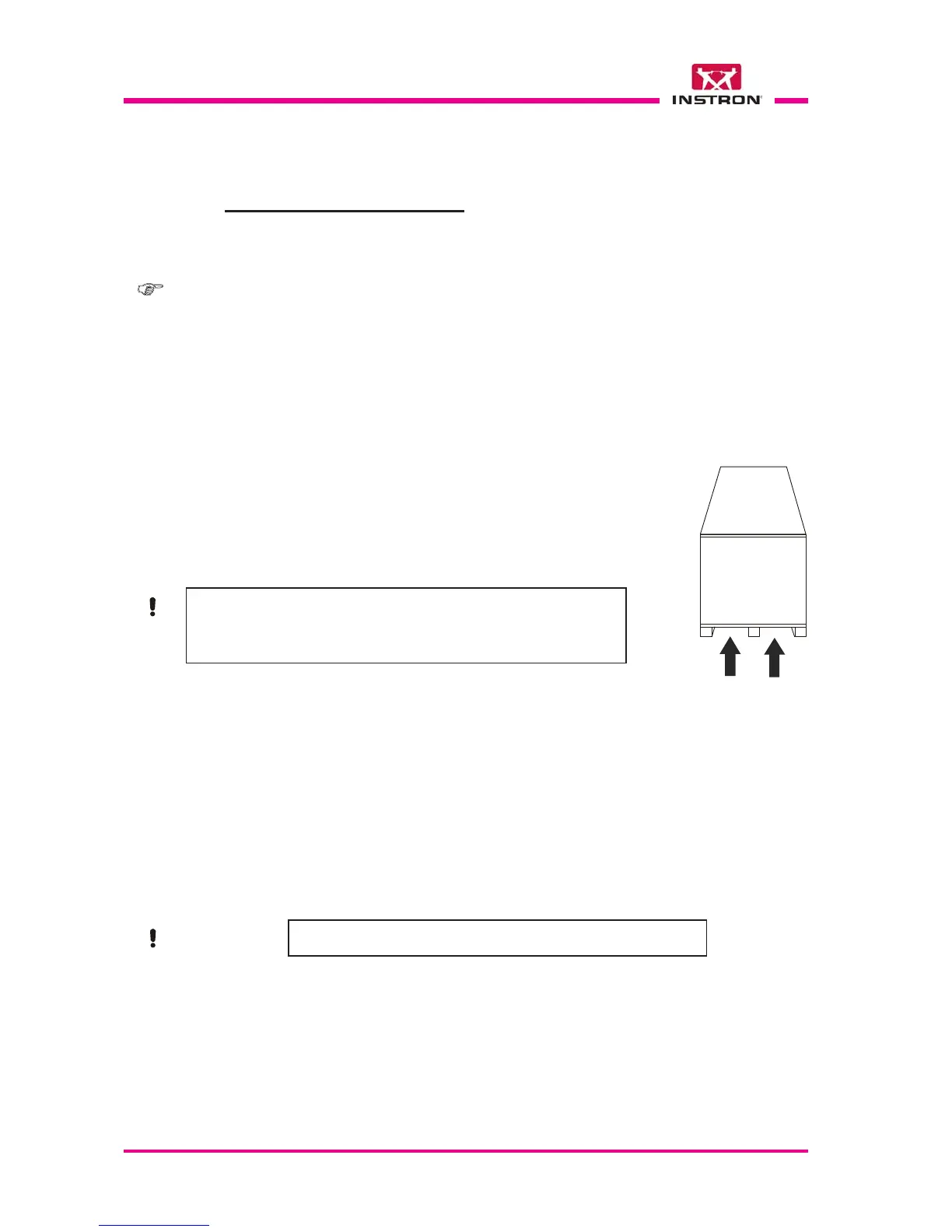
When the instrument is moved in crates, it
is necessary to use a forklift or pallet-mover.
The lifting points for the forks of the forklift
are indicated in the figure to the right.
The weight of the crate containing the instrument is ap-
proximately 550 kg. Lifting machinery must therefore be
able to lift these loads.
X


 To Next Page