MENU
Insert effects
Chains
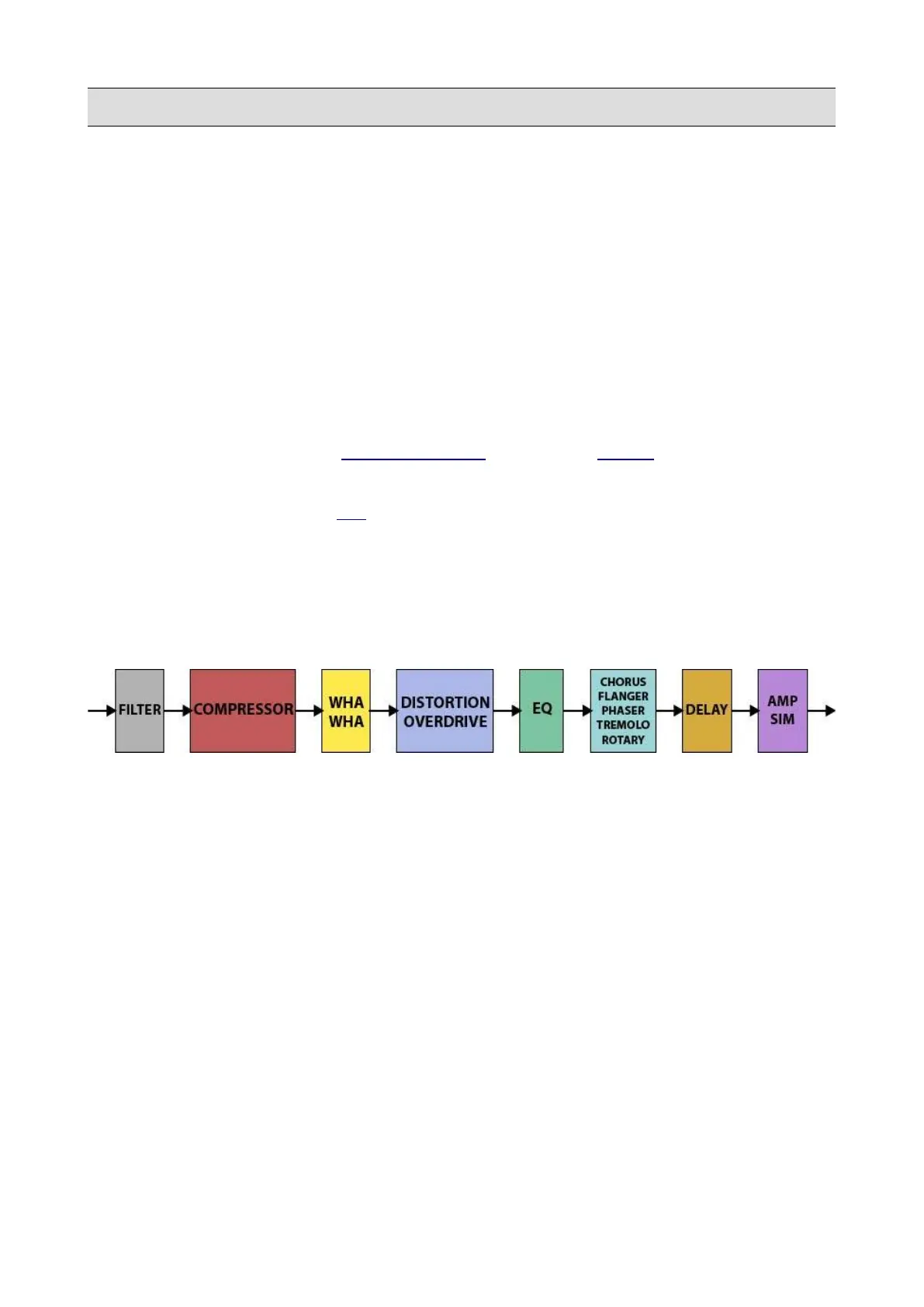
An INSERT EFFECT is composed by multiple stages, each one of them alters the sound in a
different way. All the stages are connected together in series and the audio signal goes through all
the stages from the first to the last before reaching the main outputs.
The series of all the stages is called a “chain”. Typical examples of effect chains are the guitar
pedalboards, in which a variable number of effect pedals are arranged in a predefined order to
achieve a specific sound.
The two available INSERT EFFECTS (EFX1 and EFX2) have a slightly different signal path:
• INS EFX1: processes the MIC RO 2/ GUITAR input and the VOICE sound engine output. It
is equipped with a high definition distortion module.
• INS EFX2: processes the GM sound module output. Same of EFX1 but it does not have the
high definition distortion module.
A chain is built as follows: the audio signal first goes through the dynamic effects (filter
compression and distortion), then is fed to the equalizer and at last is processed by the modulation
effects (chorus and delay). At the very end of the chain, there is an amp simulator that can be used
to imitate the sound of a guitar cabinet. Each stage of the chain works independently from the others
A brief description of all the available effects in the chain is given below:
• FILTER: filters out the high frequency components of the signal. Can be used to remove
unwanted noises or to darken the sound.
• COMPRESSOR: reduces the dynamic range. In other words, amplifies the volume of soft
sounds, without affecting the loud sounds (or reduces the loud sounds without affecting the
soft sounds).
• WHA WHA: typical guitar effect, alters the resonance and central frequency of a band pass
filter to shape the sound, imitating a human voice saying the syllable “wah”.
• OVERDRIVE: imitates the sound of a tube amplifier pushed into saturation, creating what is
known as soft clipping. It introduces a little distortion, without drastically changing the
sound.
• DISTORTION: amplifies the signal, producing a constant and consistent clipping of the
peaks of the waveform, creating what is known as hard clipping. This generally results in a
much more square-wave, saturated and distorted sound.
122 - KETRON - LOUNGE


 To Next Page