– Programming Manual 13. Programming 83
13.3.2.
Programming a limit on acceleration value
Acceleration is a signal directly coming from the vibration sensor (accelerometer) and
allows improving the system reaction in case of alarm conditions (excessive
vibration).
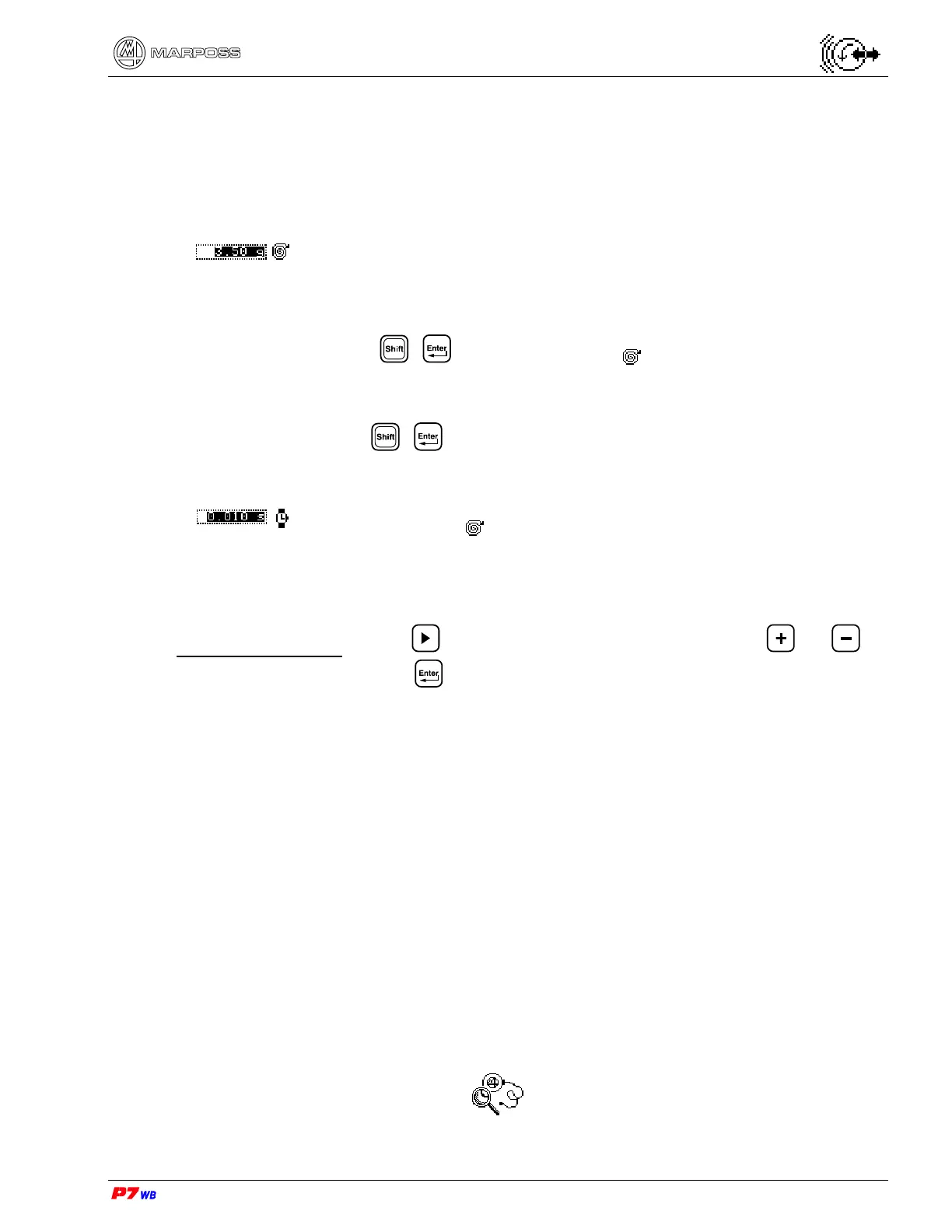
Acceleration limit: acceleration value beyond which the Vibration
Alarm signal is activated.
This datum can be programmed with values within 0.01g and 3.50g,
and 0.01g resolution.
Press + to disable (No ) the intervention of the
acceleration limit; the Vibration Alarm signal is activated based on
the vibration value (limit L3 exceeded).
Press + to restore the intervention of the acceleration limit
with the last programmed value.
Time upon which the acceleration value must be higher than the
acceleration limit to activate the output of the Vibration Alarm
signal.
This datum can be programmed with values within 0 and 9.999 s,
and 0.001 s resolution.
Value programming: press to highlight the involved field, press or to
view the desired value, then to confirm.
13.3.3.
Type of balancing algorithm
The following types of balancing algorithm are available, corresponding to parameters
pre-defined based on the type of grinder.
Normal
Normal balancing: suggested for “normal” grinders (default condition)
Slow
Slow balancing: suggested for “elastic” grinders
Fast
Fast (aggressive) balancing: suggested for “rigid” grinders
Moreover there are other five types of balancing algorithm (1^free - 5^free) whose
parameters were defined by Technical Personnel upon the system configuration.
The parameters relevant to each type of balancing algorithm are displayed by
selecting the "Balancing heads Info " folder, section 18 page 3.



 To Next Page