
 Need help?
Do you have a question about the Planet GS-4210-16T2S and is the answer not in the manual?
Details on items included in the switch package and how to check for missing or damaged components.
Overview of the GS-4210 series features, including cost-optimization, green technology, and performance.
Guidance on the manual's structure, explaining each section's content for effective navigation.
Detailed list of physical, switching, PoE, and Layer 2 features supported by the managed switch.
Technical specifications including hardware, port details, power requirements, dimensions, and Layer 2 functions.
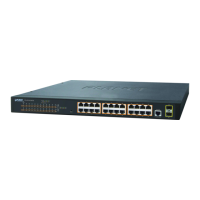
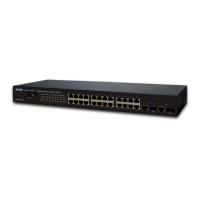
Description of the switch's front panel, including port layout and LED indicators for status monitoring.
Step-by-step instructions for installing the switch on a desktop, shelf, or in a 19-inch rack.
Lists the necessary hardware and software prerequisites for managing the switch.
Comparison of Console, Web Browser, and SNMP Agent methods for accessing and managing the switch.
Instructions for connecting to the switch via the console port using terminal emulation software.
Guide to accessing and managing the switch through its web-based interface using a standard browser.
Information on using external SNMP applications for configuring and managing the switch.
Description of the main web page, panel display, and main menu functions for switch management.
Details on configuring system information, IP, IPv6, user, time, logs, and SNMP settings.
Guide to configuring the switch's IP address, subnet mask, and gateway settings.
Comprehensive guide to VLAN configuration, including overview, IEEE 802.1Q, GVRP, and examples.
Explanation of STP theory, parameters, and configuration for network loop prevention.
Configuration options for QoS, including basic and advanced modes, class mapping, and rate limiting.
Overview of security settings like Storm Control, 802.1X, DHCP Snooping, DAI, IP Source Guard, and DoS.
Configuration of DHCP snooping for security, including global settings, VLAN settings, and port configuration.
Configuration for Dynamic ARP Inspection to prevent ARP poisoning attacks, including global, VLAN, and port settings.
Feature to restrict IP traffic on untrusted ports by filtering based on DHCP Snooping or static bindings.
Setup for Port Security Limit Control to manage the number of users per port based on MAC address and VLAN ID.
Configuration options for protecting the server from DoS attacks through protocol checks.
Framework for configuring access control using RADIUS or TACACS+ servers for authentication, authorization, accounting.
Parameters for configuring TACACS+ server connection sessions and server settings.
Parameters for configuring RADIUS server connection sessions, including retries and timeouts.
Configuration for accessing the switch via Console, Telnet, HTTP, and HTTPS.
Configuration for MAC-based, IPv4-based, and IPv6-based ACLs and ACEs.
Configuration and viewing of static and dynamic MAC addresses, including MAC filtering.
Configuration and status of LLDP, including global, port, and MED settings for network discovery.
Tools for system troubleshooting, including cable diagnostics, ping tests, and trace router.
Configuration for PoE features, including global settings, port settings, and delay settings.
Configuration for RMON statistics, events, alarms, and history for network monitoring.
Procedures for switch maintenance including factory default, reboot, backup, upgrade, and configuration management.
Steps to log on to the switch's console port using terminal emulation software.
Instructions for logging into the switch remotely using the Telnet service.
Basic commands available in User Mode for performing essential tasks and viewing system information.
Commands available in Privileged Mode for advanced system management and configuration.
Commands for entering Global Configuration Mode and managing various system settings.
Explanation of how the switch builds and uses the address table for frame forwarding.
Description of the Store-and-Forward technique for efficient and stable packet handling.
Explanation of PoE technology, standards (802.3af/at), and system architecture (PSE/PD).
Pin assignments for RJ45 connectors supporting 1000Mbps and 1000BASE-T interfaces.
Pin assignments for RJ45 connectors supporting 10/100Mbps and 10/100BASE-TX interfaces.
 General
| Switch type | Managed |
|---|---|
| Switch layer | L2/L4 |
| Quality of Service (QoS) support | Yes |
| Console port | RJ-45 |
| SFP module slots quantity | 2 |
| Installed SFP modules quantity | 0 |
| Basic switching RJ-45 Ethernet ports type | Gigabit Ethernet (10/100/1000) |
| Basic switching RJ-45 Ethernet ports quantity | 16 |
| 10G support | No |
| Number of VLANs | 4094 |
| Networking standards | IEEE 802.1D, IEEE 802.1Q, IEEE 802.1ab, IEEE 802.1p, IEEE 802.1s, IEEE 802.1w, IEEE 802.1x, IEEE 802.3, IEEE 802.3ab, IEEE 802.3ad, IEEE 802.3u, IEEE 802.3x, IEEE 802.3z |
| Virtual LAN features | Stacked VLAN, Private VLAN, Tagged VLAN, Protocol-based VLAN |
| Copper ethernet cabling technology | 10BASE-T, 100BASE-TX, 1000BASE-T |
| Authentication | Port-based authentication |
| Security algorithms | 802.1x RADIUS, HTTPS, SSH, SSL/TLS |
| Stackable | - |
| Form factor | 1U |
| Certification | FCC, CE |
| Product color | Blue |
| Housing material | Metal |
| Throughput | 26.7 Mpps |
| Jumbo frames | 9216 |
| MAC address table | 8000 entries |
| Supported network protocols | IPv4 / IPv6 |
| Input current | 0.8 A |
| AC input voltage | 100 - 240 V |
| AC input frequency | 50 - 60 Hz |
| Power consumption (max) | 10.4 W |
| Heat dissipation | 35 BTU/h |
| Storage temperature (T-T) | -10 - 70 °C |
| Operating temperature (T-T) | 0 - 50 °C |
| Operating relative humidity (H-H) | 5 - 95 % |
| Fiber ethernet cabling technology | 1000BASE-X |
| Harmonized System (HS) code | 85176990 |
 Weight and Dimensions
| Depth | 207 mm |
|---|---|
| Width | 445 mm |
| Height | 45 mm |
| Weight | 2000 g |


 To Next Page