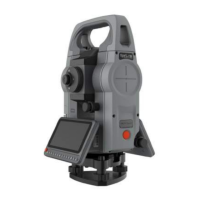
Total Station Manual
Pay attention to the following safety matters when you use the laser ranging
free of prism.
Warning:
Total station fit out laser level 3R/Ⅲa which is recognized by the loge, which is
above:
the vertical locking screw saying: “3A laser product ”.This product belongs to Class
3R level laser .According to the following standards IEC 60825-1: 2001Class 3R/Ⅲa
laser product can reach five times of emission limits of the Class 2/ Ⅱ in the
wavelength between 400nm-700nm.
Warning :
Continuous stare into the laser beam is harmful.
Prevention:
Do not stare at laser beam or point to others. The reflected beams is the
effective signal of the instrument. It’s safety to observe by eyepiece.
Warning:
When the laser beam is irradiated reflected by prisms, plane mirrors, surface of
metal and windows, it’s dangerous to look straight into the reflected beams.
Prevention :
Don’t stare at the reflected beams. When the laser is switched on (distance
mode), do not obstruct optical path or stand near the prism. Target at a prism with
total station telescope only.
Warning :
It’s dangerous to use the Class 3R laser device improperly.
Prevention:
To avoid injury, each user must carry safety prevention measures and operate
the instrument within the safety scope according to standard IEC60825-1: 2001).
The following is the explanation of the main part of the standard:
Class 3R level laser products are used outdoors and in construction (surveying with
No-Prism).
A: Only trained and certified persons are allowed to install, adjust and operate the
laser equipment.
B: Set up appropriate laser warning sign within the operating field
C: To prevent anyone from looking into the laser beam use an optical instrument to
observe.
D: In order to prevent laser damage to persons, the laser beams should be blocked at
the end of the working route, and also should be cut off when people work in the
restricted area (harmful distance)where laser beams crossing are harmful.
E: The route of the laser beam must set to be higher or lower than the human eye.


 To Next Page