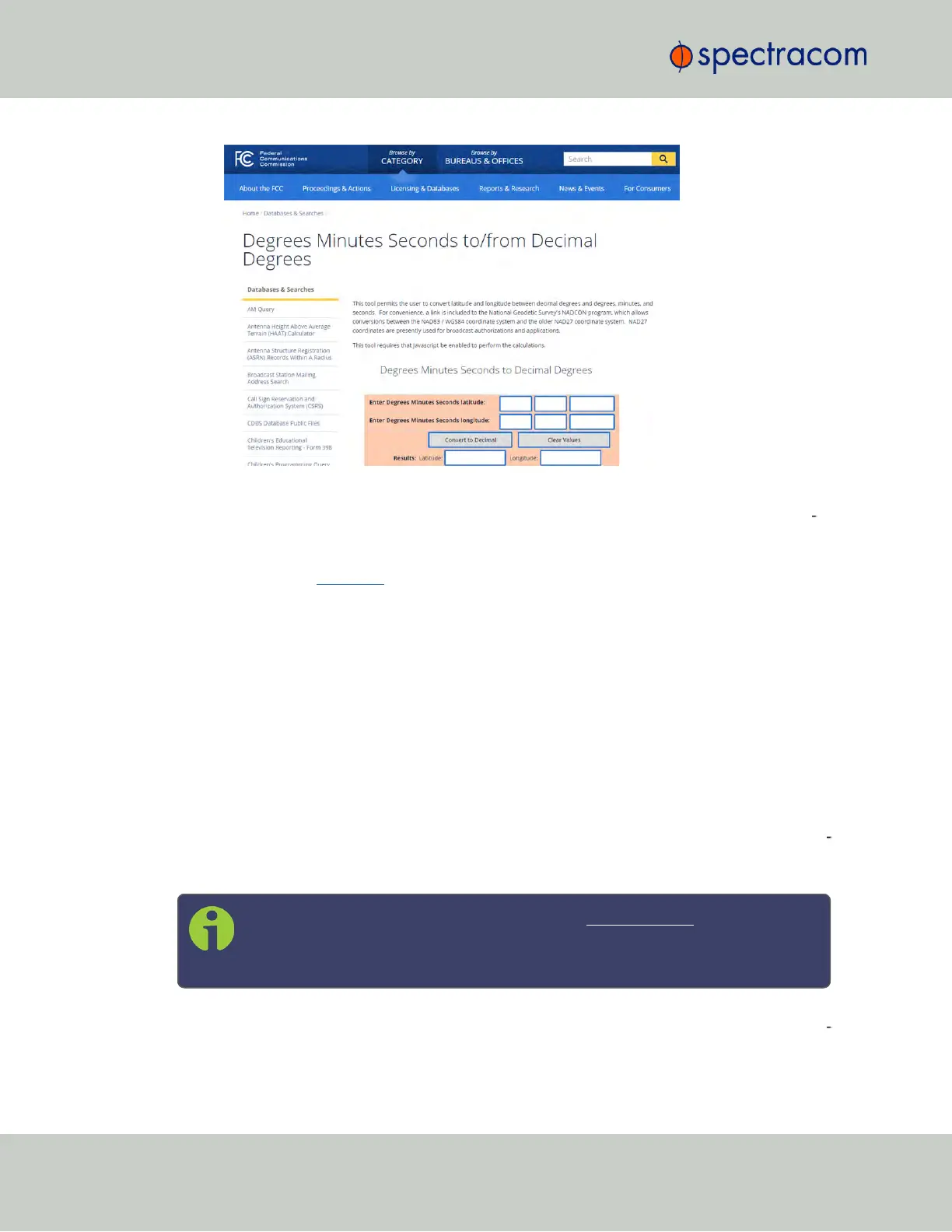
4.
Determine your altitude: Finding the altitude of your SecureSync's antenna position is
not as crucial as finding the latitude and longitude. Looking up the altitude for the gen
eral area may suffice for many applications.
If a more exact altitude is desired, the use of a topographical map is recommended.
Applying the WGS 84 standard will likely yield the most accurate elevation.
5.
Click Submit to apply any changes you may have made.
3.3.2.10 GNSS Constellations
SecureSync allows you to select which GNSS constellations shall be tracked, i.e. you can
determine if you want e.g., GLONASS satellites to be tracked (besides GPS).
The options offered depend on the type of GNSS receiver installed in your SecureSync unit,
and if a Multi-GNSS license file is installed.
Selecting GNSS Constellations
If your SecureSync is equipped with a GNSS receiver, it is capable of tracking GNSS con
stellations other than GPS. Which ones depends on the receiver model; for more information,
see "Determining Your GNSS Receiver Model" on page170.
Note: In order to track several constellations simultaneously, the Multi GNSS
Option is required. For more information, see "Determining if the Multi-GNSS
Option Is Installed" on page188.
With a u-blox M8T receiver and a Multi-GNSS license file installed, the following GNSS con
stellations are supported:
184
CHAPTER 3 • SecureSync User Reference Guide Rev. 23
3.3 Managing References


 To Next Page