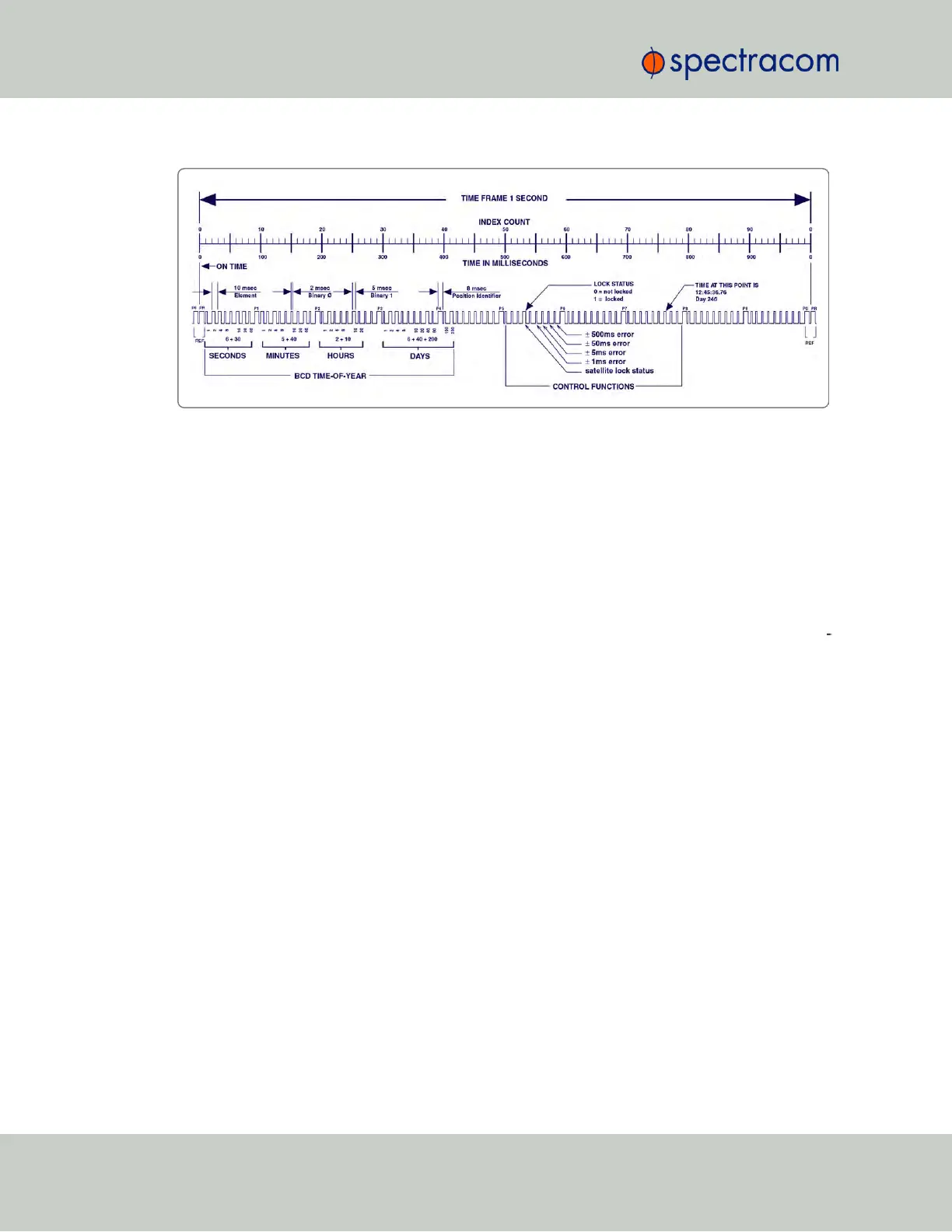
Figure 5-63: FAA modified IRIG B
Notes
The beginning of each 1.0 second time frame is identified by two consecutive 8.0ms elements
(P
0
and P
8
). The leading edge of the second 8.0ms element (P
R
) is the "on time" reference
point for the succeeding time code. 10pps position identifiers P
0
, P
1
, ..... P
8
(8.0 ms duration)
occur 10ms before 10pps "on time" and refer to the leading edge of the succeeding element.
The time code word and the control functions presented during the time frame are pulse-width
coded. The binary "zero" and index markers have a duration of 2.0ms, and the binary "one"
has a duration of 5.0 ms. The leading edge is the 100pps "on time" reference point for all ele
ments.
The binary coded decimal (BCD) time-of-year code word consists of 30 digits beginning at
index count 1. The binary coded subword elements occur between position identifiers P
0
and
P
5
(7 for seconds; 7 for minutes; 6 for hours; 10 for days) until the code word is complete. An
index marker occurs between the decimal digits in each subword to provide separation for
visual resolution. The least significant digit occurs first. The BCD code recycles yearly.
Twenty-seven control functions occur between position identifiers P
5
and P
8
. FAA uses this field
to communicate satellite lock status and time error and indicators. The first flag element is at
530ms which indicates satellite lock. The ±1ms error flag occurs at 550ms. The ±5ms error
flag occurs at 560 ms. The ±50ms error flag occurs at 570ms. The ±500ms error flag occurs
at 580ms.
The straight binary (SB) time-of-day code word normally found between position identifiers P
8
and P
0
is eliminated for FAA IRIGB. All elements between position identifiers P
8
and P
0
are set
to Binary0.
534 SecureSync User Reference Guide
APPENDIX


 To Next Page