237
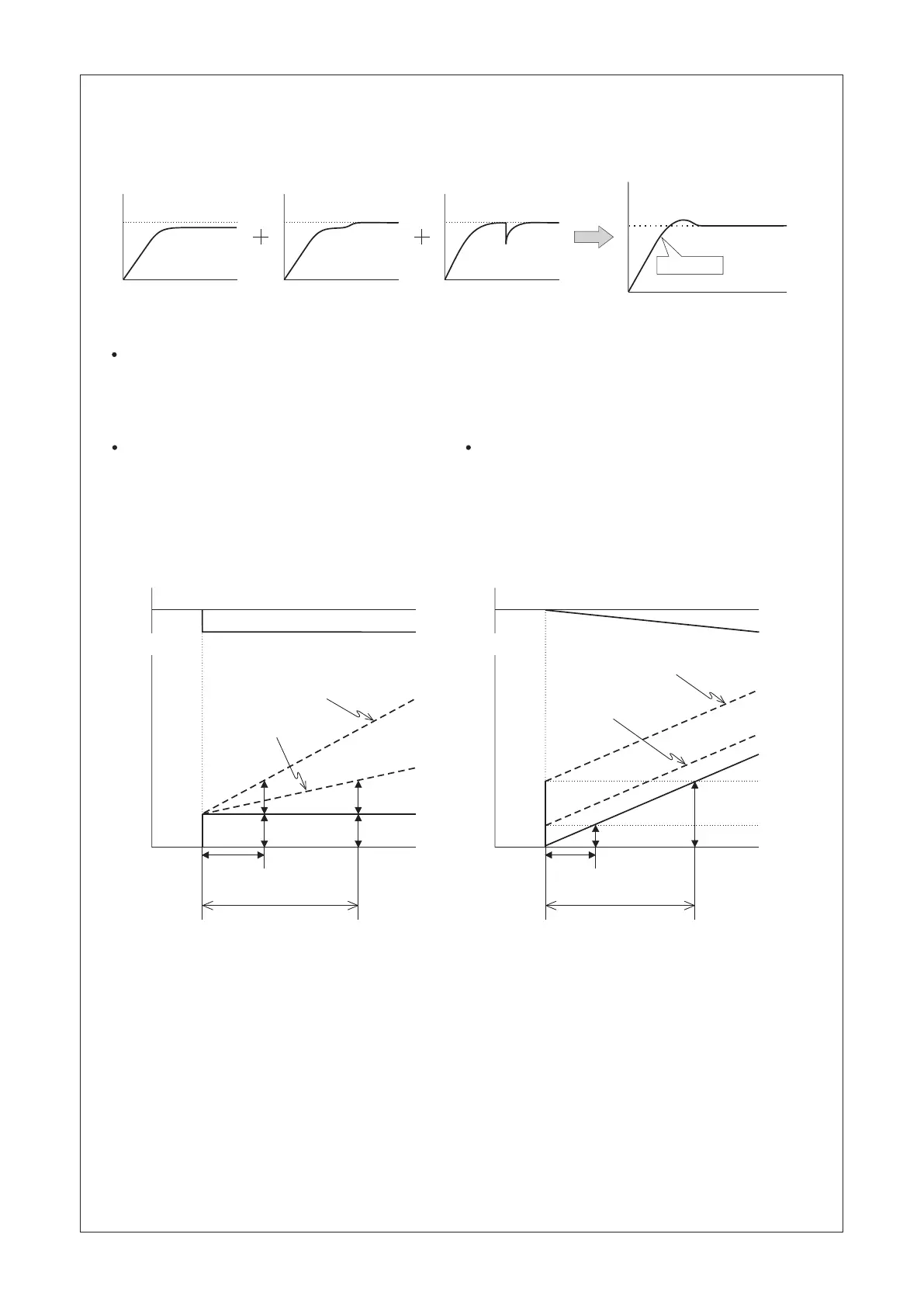
Derivative time is the period required for a ramp-type
deviation in derivative control (e.g., the deviation shown
in the following graph) to coincide with the control output
in proportional control action. The longer the derivative
time will cause the stronger derivative control action.
The Definition of Derivative Time
Integral time is the period required for a step-type
deviation in integral control (e.g., the deviation
shown in the following graph) to coincide with
the control output in proportional control action.
The shorter the integral time will cause the stronger
integral control action. If the integral time is too short,
it will cause a quick and huge correction then may
have the temperature waving.
The Definition of Integral Time
TI1
TI2
0
TD1
TD2
0
PID Control
(4) PID Control
PID control is a combination of P(proportional), I (integral) and D (derivative) control actions, in which the
temperature is controlled smoothly by proportional control action without hunting, automatic offset adjustment
is made by integral control action, and quick response to an external disturbance is made possible by
derivative control action.
(With a short integral time)
(With a long integral time)
:
TI integral time
P action
Control output rate
Deviation
Control Cycle and Time-Proportioning Control Action
When the temperature control is used with a relay or SSR to control the output, it will follow the designated cycle
time to intermittently turn “ON” or “OFF” in a specified period. This preset cycle is called control cycle and this
control method is called time-proportioning control action. A PLC system in the main unit is always using this
method to procure temperature control.
PI action
(With a short integral time)
PI action
(With a long integral time)
(With a shor t derivative time)
(With a long derivative time)
TD : derivative time
D1 action
D2 action
Deviation
Control output rate
PD action
(With a short derivative time)
PD action
(With a long derivative time)
P action


 To Next Page