238
100 %
0%
Narrower
Wider
It is possible to suppress overshooting although a
comparatively long startup time and reaction time
will be required.
Auto-Tuning
Adjust the PID Parameters
All PID process/temperature controllers require the adjustment of the P, I, D and other parameters in order to allow
accurate control of the load. There have been a variety of conventional methods but the Auto-Tuning methods make
it possible to obtain PID constants suitable to a variety of objects automatically.
It is convenient while the PID constants calculated via the Auto-Tuning operation and normally they are more correct
than tuning by manual. Usually, the Auto-Tuning do not cause problems and we will suggest using it to set up the
parameters. Except for some particular applications if the more accurate constants is necessary. In which case,
refer to the following to readjust the PID constants.
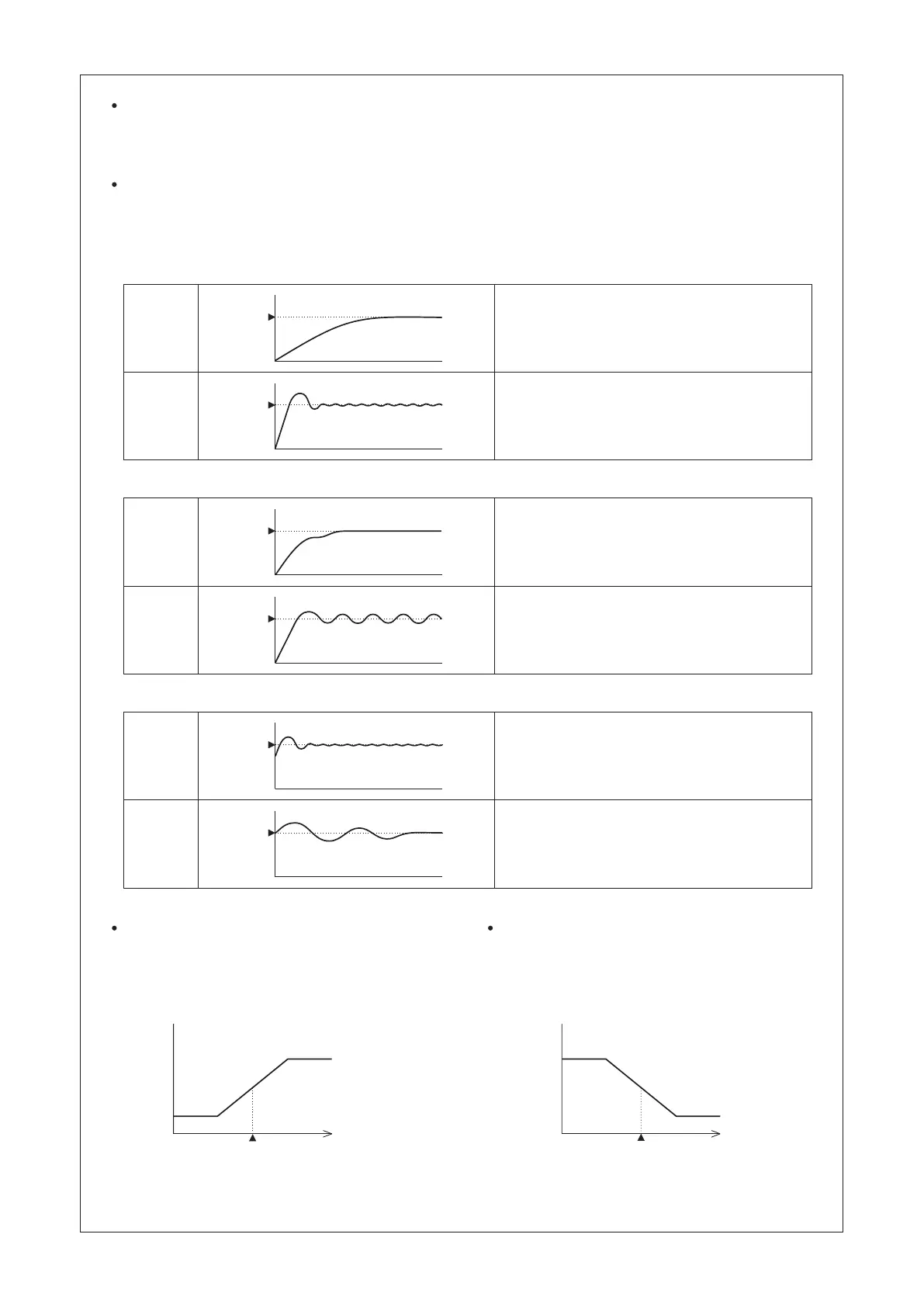
Response to Change in Proportional Gain
Set point
Set point Set point Set point Set point Set point
Wider
Narrower
Wider
Narrower
The process value reaches the set point within a
comparatively short time and keeps the
temperature stable although overshooting and
waving will result until the temperature becomes
stable.
It is possible to reduce waving, overshooting and
undershooting although a comparatively long
startup time and set time will be required.
The process temperature reaches the set point
within a comparatively short time although
overshooting, undershooting and waving will
result.
Response to Change in Integral Time
The process value reaches the set point within a
comparatively short time with comparatively small
amounts of overshooting and undershooting
although fine-cycle waving will result due to the
change in process value.
It will take a comparatively long time for the
process value to reach the set point with heavy
overshooting and undershooting.
Response to Change in Derivative Time
The Definition of the Forward Operation
The Definition of the Reverse operation
To increase the control output rate when the
temperature of the object is higher than the
set point (positive deviation). Usually using
in a cooling control.
To increase the control output rate when the
temperature of the object is lower than the set point
(negative deviation). Usually using in a heating
control.
100 %
0%
Output Rate
Set point
Temperature
Output Rate
Set point
Temperature


 To Next Page