GDP-32
II
INSTRUCTION MANUAL
October 2002 Section 15, Page 4
TX
RX
a a
n
*
a
∞
∞∞
∞ ∞
∞∞
∞
TX
RX
n
*
a
∞
∞∞
∞
TX
RX
a
n
*
a
15.3 A NOTE ON RESISTIVITY CALCULATIONS
Since received voltage magnitudes for RPIP and CR are calculated using Fourier transforms, the
square-wave current that is used to calculate apparent resistivities must be multiplied by 4/π to
get its equivalent Fourier amplitude. Therefore, the values of I (Tx Curr) used in Section 15.4
must be multiplied by 4/π for RPIP and CR to get the correct apparent resistivities.
Resistivity calculations for TDIP use the square-wave value of the received voltage during the
on-time (V
p
), so the square-wave current amplitude can be used directly.
15.4 RESISTIVITY CALCULATIONS
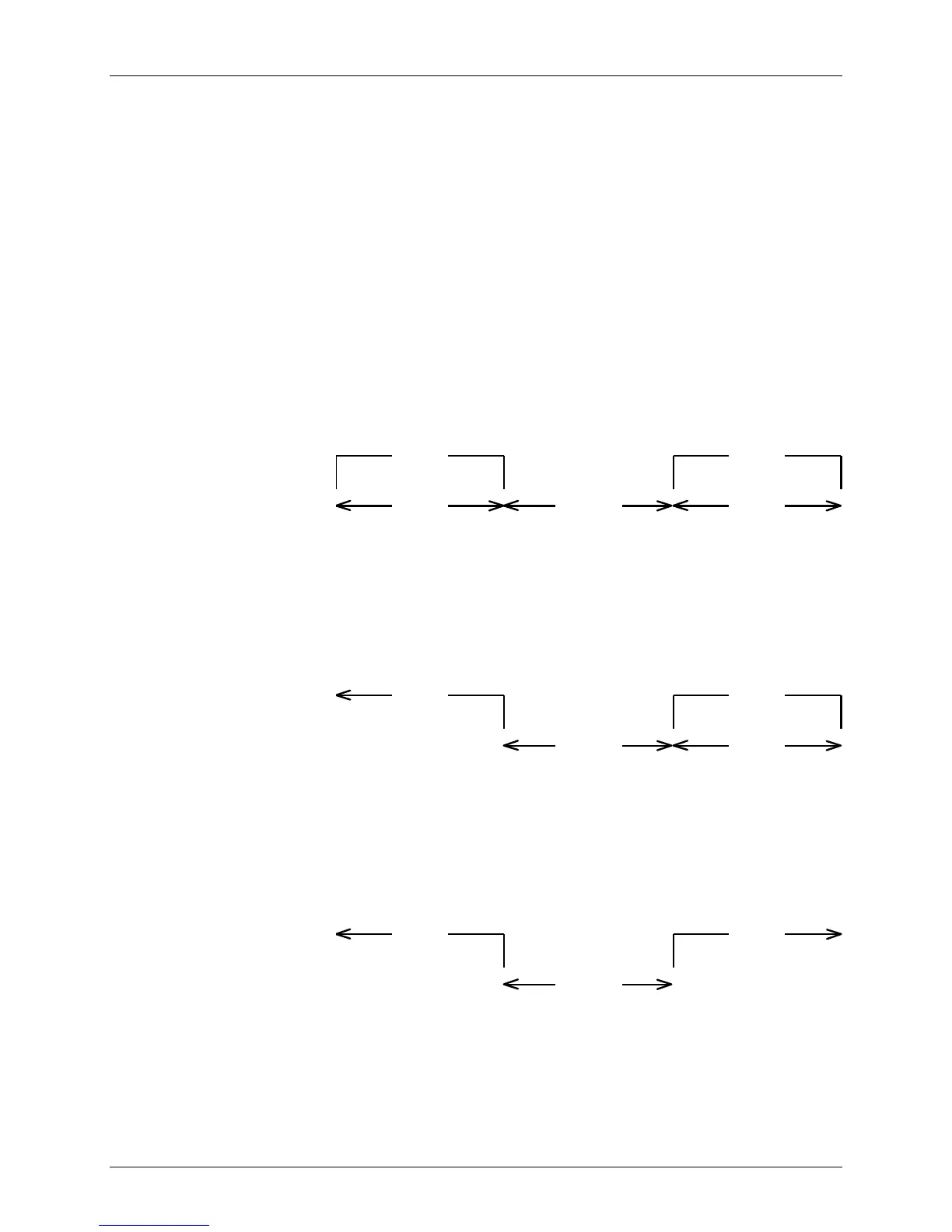
Five types of arrays are defined in the GDP-32
II
programs for which resistivities are to be
calculated. These are Dipole-Dipole, Pole-Dipole, Schlumberger, and Gradient.
The parameters that are manually entered by the operator, and the values that are measured by
the GDP-32
II
are bracketed [] in the description of parameters.
DIPOLE - DIPOLE
RHO = (π
ππ
π * V / I) * (a * n * (n + 1) * (n + 2))
Where: a = [A-SP] = A-spacing in meters
n = [N] = N-spacing
V = Received voltage in volts [Measured]
I = 4/π * [Tx Curr] = Transmitter current in amperes * 4/π
POLE - DIPOLE
RHO = (π
ππ
π * V / I) * (2 * a * n * (n + 1))
Where: a = [A-SP] = A-spacing in meters
n = [N] = N-spacing
V = Received voltage in volts [Measured]
I = 4/π * [Tx Curr] = Transmitter current in amperes * 4/π
POLE - POLE
RHO = (π
ππ
π * V / I) * a * n * 2
Where: a = [A-SP] = A-spacing in meters (basic separation increment)
n = [N] = Number of A-spacings between electrodes
V = Received voltage in volts [Measured]
I = 4/π * [Tx Curr] = Transmitter current in amperes * 4/π



 To Next Page