FAST TRANSIENT ELECTROMAGNETICS PROGRAM
Section 19, Page 21 October 2002
Data Inspection and Downloading
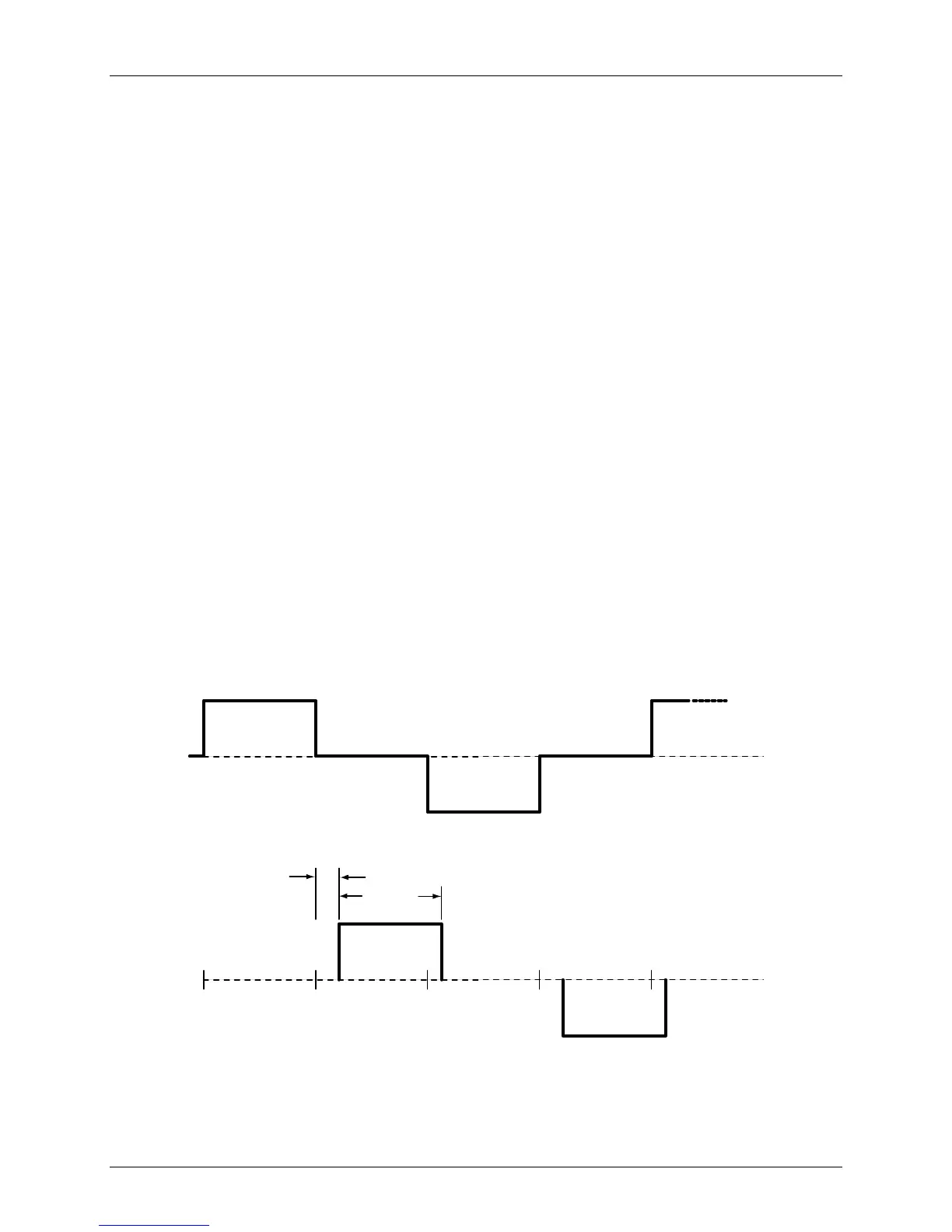
The sampled data falling within the gates as defined above and illustrated in the accompanying
figure are rectified and stacked. These data are stored both in the data cache and as binary files
on the hard disk. Only the first 31 data points are stored in the cache. They may be viewed
and/or dumped from the DATA menu using procedures common to all the programs. The binary
files are stored on the hard disk with the name BLKnnnn.NTE, where nnnn is an integer
corresponding to the block number of the corresponding partially complete data set stored in the
data cache.
The binary data may be downloaded using either the LAN connection or the serial port. The
steps for downloading are listed below:
1. While the GDP-32
II
power is off, connect it to either a LAN or to the serial port of
another computer (a null modem must be used).
2. Turn on the GDP-32
II
and run Windows.
3. If using the LAN, you may have to re-configure the network parameters in the GDP-32
II
to be compatible with your network.
4. If using the serial port, HyperTerminal is the recommended program to use. You will
have to ensure that the two serial ports are configured identically.
5. The data files are stored in d:\data\.
Binary data files with the extension .NTE may be inspected by converting them to ASCII
format. The utility program TEMASCII.EXE converts a binary file to an ASCII text file of the
same name with extension PRN.
The source code for this utility program is included so that users or customers have prototype C
code for reading a binary file containing uniformly sampled transient data.
t = 0 t = T/4
t = T/2 t = 3T/4
t = T
Current Waveform
t
d
= N
d
∆t
T
w
= N
w
*∆t
T
w
= Acquisition window width (T
w
≤ T/4)
t
d
= Time delay to the first transient sample (i.e., the START parameter)
∆t = A/D sample interval
N
d
=
T = Transmitter period
N
w
= Number of samples (i.e., COUNT parameter)
Explanation of the EQUAL INTERVAL mode data acquisition mode in the GDP-32
II
TEM program
Acquisition delay in sample intervals



 To Next Page