ptg
C H A P T E R S I X Complying with PDF and Accessibility Standards
104
Every version of Acrobat introduces more standards, as well as methods
for evaluating a document according to those standards. Acrobat 9 is no
exception, as you can see in the sidebar “Variations on a Theme.”
To test a document for compliance with a prole, follow the steps out-
lined in #39, “Testing and Fixing a Document with Preight.” For the PDF
standards, you’ll usually nd proles that let you convert to the standard,
verify that the le complies with the standard, or remove the standard’s
information (Figure 40a).
Figure 40a Choose a standards-compliant profile from one of the categories, such as the
PDF/E-1 profile used in the example.
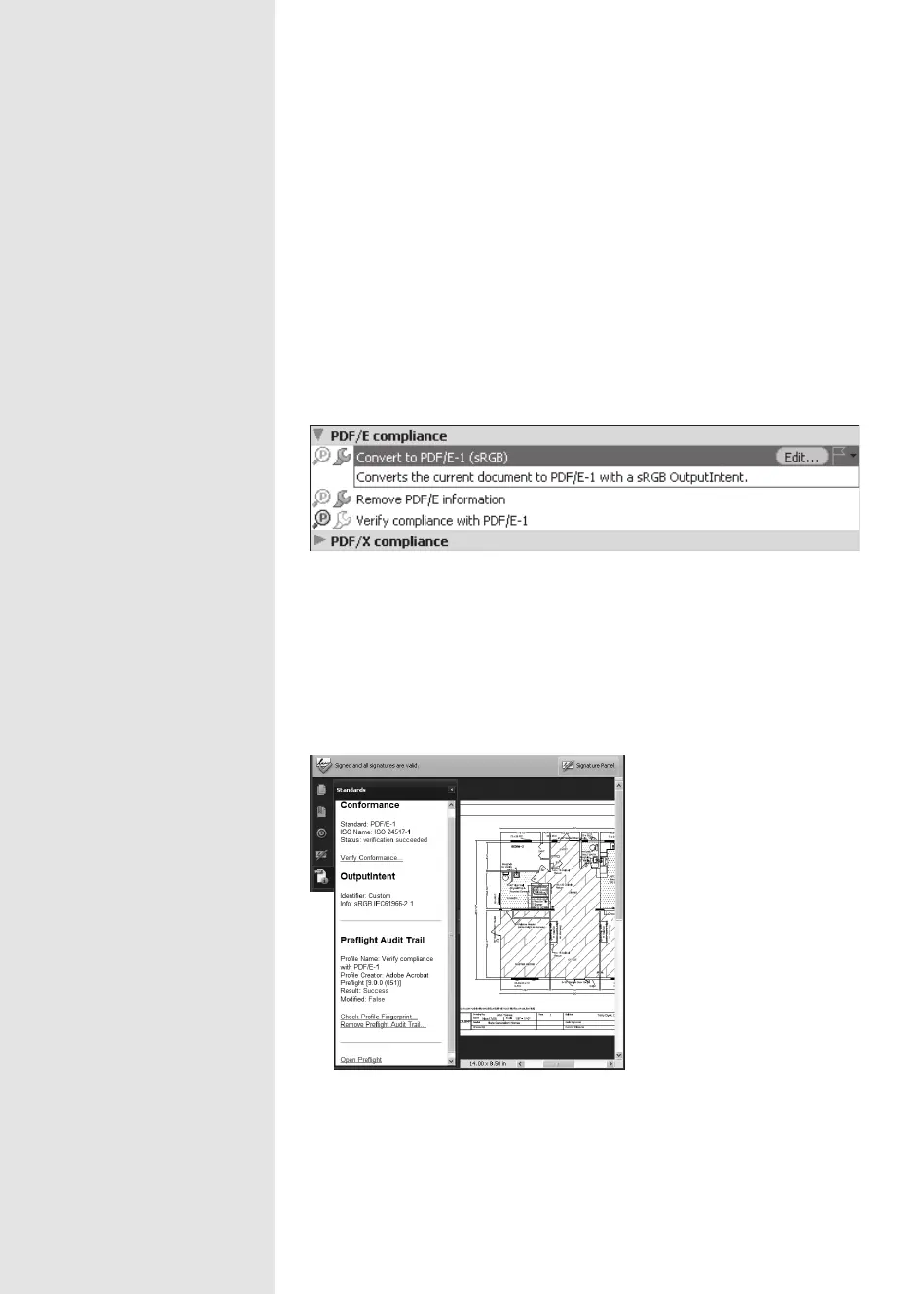
Once the le is saved, your recipient can guarantee its conformance
with the standard by viewing the information in the Standards pane, new
in Acrobat 9. Once you open a PDF le that conforms to a standard, the
Standards pane opens automatically (Figure 40b).
Figure 40b Information about the document and
its applied standard appear in the Standards pane.
Ensuring Standards
Compliance
#
40
Variations on a Theme
You can choose from a number of PDF print standards. The one you select
depends on the final processing of the document:
•
All PDF/X standards are designed for graphics exchange. The files must con-
tain specific page content and resources.
•
All compliance options contain an OutputIntent and a printing profile.
•
A document destined for digital press uses a PDF/X-1a standard; this stand-
ard has versions for 2001 and 2003.
•
Choose PDF/X-3 standards that are 2002- or 2003-compliant; the PDF/X-3
standard includes color usage options—CMYK and spot colors only or cali-
brated color.
•
PDF/X-4 prepress digital data standards based on PDF 1.6 as either com-
plete exchange of printing data (PDF/X-4) or partial exchange with an exter-
nal profile reference (PDF/X-4p).
•
PDF/X-5, also based on PDF 1.6, offers three levels based on graphical con-
tent and ICC profiles.
•
Specific named standards such as Sheetfed Offset (CMYK) are based on best
practice guidelines recommended by industry associations.
Use the PDF/A standard for documents intended for long-term storage in PDF
format. The file can’t include external players, external links, or protection in
order to ensure viewing and printing over the long term. PDF/A standard has
two variations—1a and 1b.
The PDF/E standard is designed for engineering PDF document exchange. PDF/E
files can contain 3D models and annotations. However, the content and resources
must be embedded in the file to guarantee reliable viewing and printing.
From the Library of Daniel Dadian



 To Next Page