DD+DIS150
.06E
Repair and Service
Adjustments and Calibrations
DOCUMENT CONTROL NOTE:
The controlled version of this document resides on MedNet. Any printed copy of this document is uncontrolled.
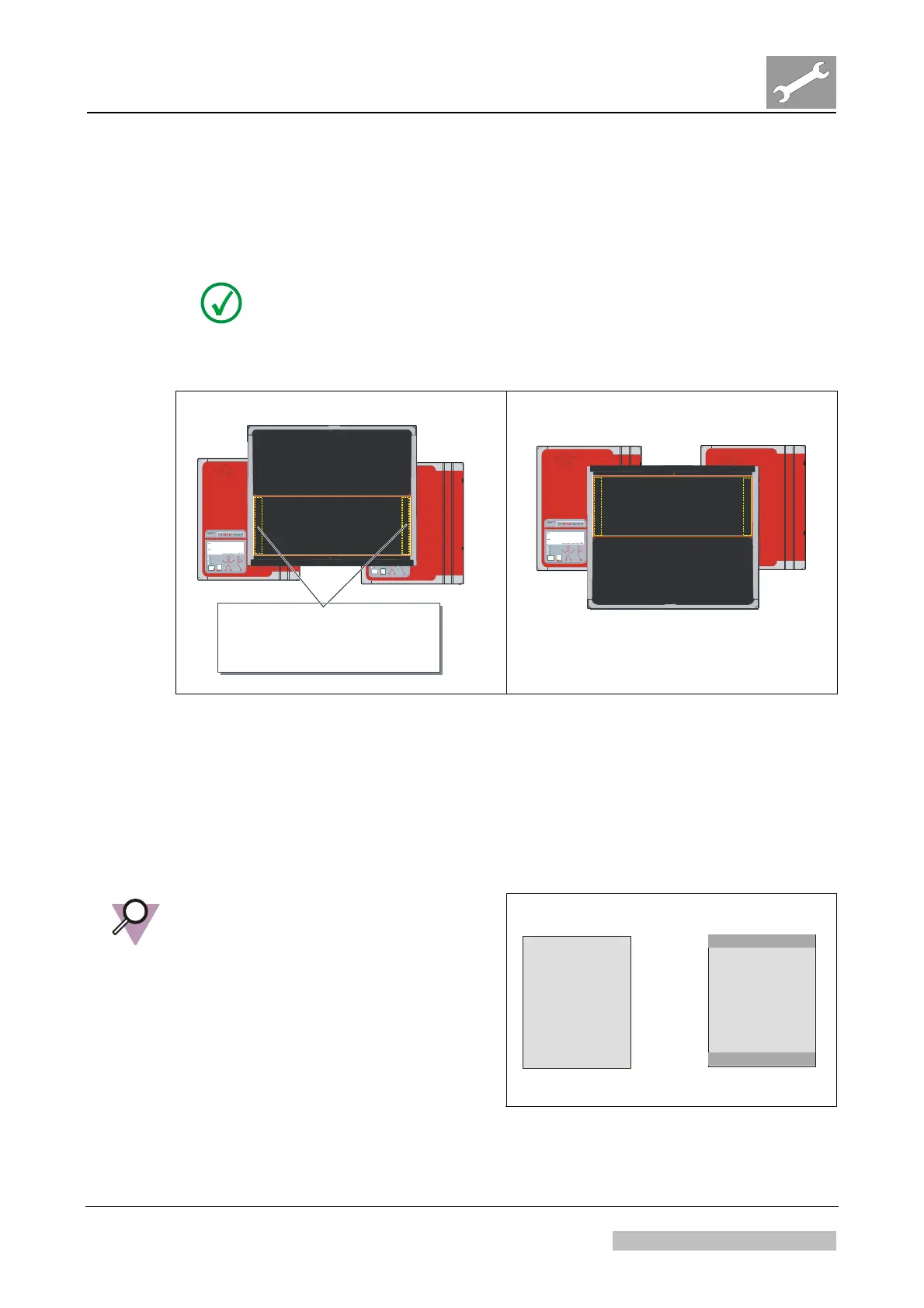
(1) Put 2 cassettes underneath the FLFS cassette when using a FLFS cassette for
shading calibration.
NOTE:
This covers the area where the cassette has no backscatter protection.
Only this area has to be covered, which is used by the digitizer to
determine the shading calibration curves.
Area used by
shading calibration
Put a cassette underneath this area.
This prevents, that the missing
backscatter protection falsifies the
shading calibration result.
FLFS cassette
Area used by
shading calibration
Figure 46: Exposure 1 Figure 47: Exposure 2
(2) Erase the two cassettes which were put underneath the FLFS cassette during
exposure.
(3) Observe IMPORTANT note below when evaluating the flatfield
(Evaluating the flatfield is described in section 3.1.1).
IMPORTANT:
When using a FLFS cassette for flatfield
exposure, the image will be slightly
darker in the upper and lower image
area where the backscatter protection is
removed (approximately 1 cm each).
These darker zones also have to be
used for image quality evaluation in
slow scan and fast scan direction to
verify a successful shading calibration.
Flatfield with
Genrad Cassette
Flatfield with
FLFS Cassette
Effect exaggerated
Figure 48
Edition 1, Revision 3 CR 30-X Chapter 3.6 / 34
10-2009 Type 5175 / 100/110 Agfa Company Confidential



 To Next Page