CHAPTER 2 CONTROLS AND DISPLAY
Page 2-10
091-00019-001 REV B
Page 2-11
091-00019-001 REV BEFD1000 C3 Pro PFD Pilot’s Guide
2.2.2.2. Bearing Pointer Source Select Buttons
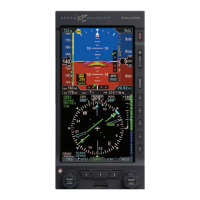
The Lower Left Button and the Lower Right Button are the Bearing Pointer Nav Source
Select Buttons (Figure 2-7). The Lower Left Button controls the Single-Line Bearing
Pointer and the Lower Right Button controls the Double-Line Bearing Pointer. Each
button controls which nav source is connected to the respective Bearing Pointer.
The Bearing Pointers act like a conventional RMI (Radio Magnetic Indicator); the needle
points to the station. Unlike a conventional RMI, the PFD Bearing Pointers can also
point to the active waypoint of a GPS navigator whether that is a VOR, NDB, airport,
intersection, or missed approach point.
Each Bearing Pointer can be connected to any of the available navigation sources; GPS1,
VOR1, GPS2, VOR2, ADF1 or ADF2 (depending on conguration), or to none. Each press
of the Bearing Pointer Nav Source Select Button selects the next available nav source,
cycling through all available nav sources and none, in a round-robin sequence. The
currently connected nav source is displayed directly above its respective button; blank
with only the Bearing Pointer icon indicates that no nav source is selected, and the
Bearing Pointer is removed from the display.
If the selected nav source is a valid choice, but no usable nav data is being received
(e.g., the VOR station is out of range, or the VLOC is tuned to a localizer frequency), the
Bearing Pointer will not be displayed.


 To Next Page