174
Appendix III. Description of System
Alarm Prompt
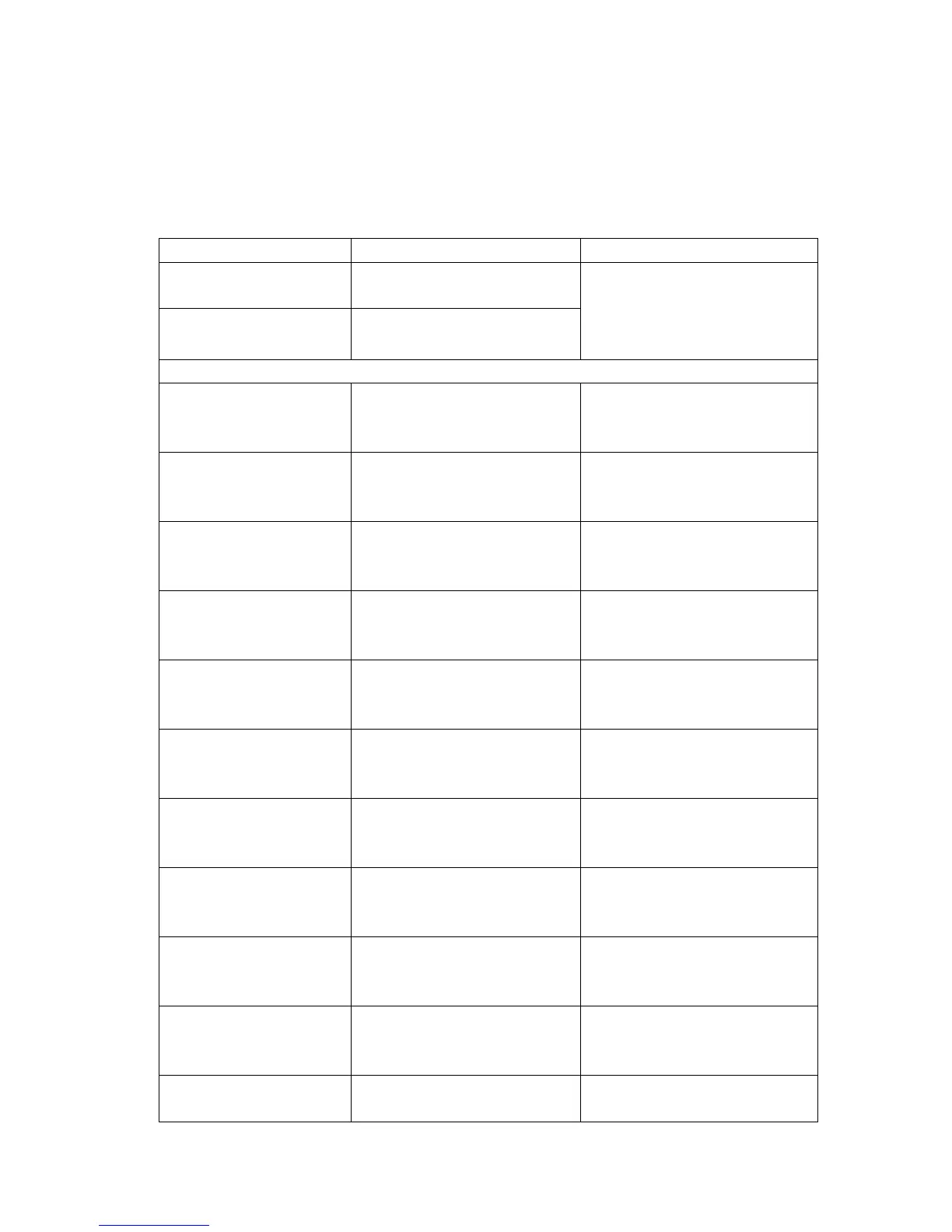
PROMPT MESSAGE CAUSES SOLUTIONS
"XX is too high "
XX is higher than the upper limit value
of alarm limit.
Check whether the alarm limit values are
suitable, and the current status of the
patient.
"XX is too low"
XX is lower than the lower limit value
of alarm limit.
XX means all parameter values in such systems as HR, ST1, ST2, RR, SPO2, IBP and NIBP.
"ECG signal is too weak "
The patient's ECG signal is too small,
so the system can’t do ECG signal
analysis.
Check whether the electrode and lead
cable are connected correctly, and the
current status of the patient.
"Pulse is not found "
The patient's pulse signal is too small,
so the system can’t do pulse signal
analysis.
Check the connection of the sensor, and
the current status of the patient.
"RESP apnea"
The patient's RESP signal is too small,
so the system can’t do RESP signal
analysis.
Check the connection of the lead cable,
and the current status of the patient.
"ASYSTOLE "
The patient suffers from arrhythmia of a
systole.
Check the current status of the patient,
and whether the electrode and lead cable
are connected correctly.
"VFIB/VTAC "
The patient suffers from arrhythmia of
VFIB/VTAC.
Check the current status of the patient,
and whether the electrode and lead cable
are connected correctly.
"COUPLET (two PVS)"
The patient suffers from arrhythmia of
two PVS.
Check the current status of the patient,
and whether the electrode and lead cable
are connected correctly.
"BIGEMINY (PVS bigeminy)"
The patient suffers from arrhythmia of
PVS bigeminy.
Check the current status of the patient,
and whether the electrode and lead cable
are connected correctly.
"TRIGEMINY (PVS trigeminy)"
The patient suffers from arrhythmia of
PVS trigeminy.
Check the current status of the patient,
and whether the electrode and lead cable
are connected correctly.
"R ON T"
The patient suffers from arrhythmia of
R ON T.
Check the current status of the patient,
and whether the electrode and lead cable
are connected correctly.
"PVC (single PVS)"
The patient suffers from arrhythmia of
single PVS bigeminy.
Check the current status of the patient,
and whether the electrode and lead cable
are connected correctly.
"TACHY (tachycardia)" The patient suffers from tachycardia.
Check the current status of the patient,
and whether the electrode and lead cable


 To Next Page