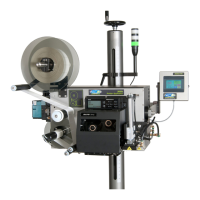
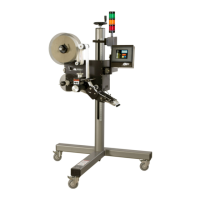
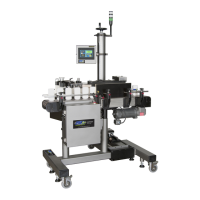
Instruction Manuals: Installation, Operators Maintenance Standard 360a Model Y (360y) Label Applicator
xiv
MACHINE TERMS
Air Assist: Stream of air from the air assist tube.
Air Assist Tube: Small diameter tube with small hole(s) in it mounted under the peel edge that directs a stream of air to help, or
“assist” the label onto the label pad.
Air Blast: Compressed air that moves the label from the label pad or air blow box grid to the product.
Air Blast Jets: Jets with nozzles that press-fit into the inner face of the air blow box grid and can be re-arranged to supply an air
stream pattern that transfers labels of many sizes and shapes to the product.
Air Blow Box: Portion of the Air Blow Nose Assembly; a small, enclosed box that houses the air blast jets, axial fans, and the blow
box grid. The fans generate vacuum inside the box that allows the label, once peeled off the liner, to be transferred and held in place
on the grid until the air blast jets are activated to blast the label onto a product.
Air Blow Box Grid: Grid of holes that air is pushed through via air blast.
Air Filter: Device on the inlet of the air supply that removes debris from the air supply.
Center-line Distance: Distances that can be measured two different ways:
• If labels are of inconsistent sizes or shapes: Distance from the very center of one label to the very center of a second label.
• If labels are consistent sizes or shapes: Distance from the leading edge of the first label to the leading edge of the second
label.
Critical Alarm: Alarm that stops the applicator from applying labels.
Cycle Power: Turning power to the system and/or applicator on and off.
Cycle Time: Amount of time it takes for the applicator to complete the label sequence from when the product detect sensor detects a
product to when the nose assembly goes back to the start position after applying a label to a product.
Dancer Arm: Arm that releases the brake on the unwind shaft, so the roll of labels is free to rotate during label application but
applies the brake to stop the unwind shaft rotation when labeling stops.
Detector Lockout: Function used when more than one product is detected. When this occurs, the applicator ignores product detect
signals until the lockout time or distance is finished.
Drive Roller: Pulls the label liner around the peel edge to dispense a label onto either the product itself, tamp pad, or blow box grid.
It is linked to a stepper motor, and it works in conjunction with the spring-loaded nip roller.
Dual Action Tamp (DAT) Nose: Nose used for applying up to two labels on one product; one label on the product sidewall and one
label on either leading or trailing edge of the product.
• A straight line, air cylinder is used to apply the label for the sidewall label.
• A rotary actuator is used to swing the label 90° into the product path and apply the label for the leading or trailing edge label.
NOTE: Through the HMI the operator can set up one label apply, either sidewall or leading/trailing edge. Labels are applied via
air blasts.
Encoder: Electronic device used to check the speed of a conveyor or wrap station with two possible mounting positions: to the
conveyor motor, or to the conveyor side-frame with a wheel that rides along the conveyor belt surface.
Extended Air Assist: Allows the air assist to stay on longer to aid in putting the label on the pad.
Inverted Tamp Blow (ITB): Tamp slide in the extended position, with label on the pad, waiting for the product detect sensor
to start the labeling sequence.


 To Next Page