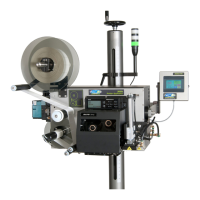
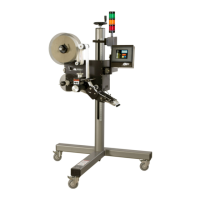
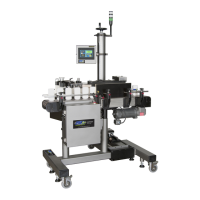
Operator’s Manual: Standard 360a Model Y (360y) Label Applicator
34
3. Adjust the rotary actuator so the label pad is level with the applicator.
NOTE: The rotary actuator’s internal stops control 100% of where the swing arm stops – the shocks act as a “buffer”
only! See the DAT Rotary Actuator Stop Adjustment Guidelines
section for more information.
4. Ensure the label is aligned with the pad so there is no over-hang. To adjust this, move the web liner in or out by adjusting the
guide collars set screws and unwind disks.
5. Loosen the screw right next to the air assist tube to position it with the hole(s) centered on the label and pointing
approximately ¼ in. from the label pad edge.
6. Turn the knob above the Air Assist valve on the valve bank to set the air pressure at 20-30 PSI and press the Jog button to
dispense a label.
a. If the label doesn’t feed out against the label pad or the vacuum doesn’t capture it, increase the air pressure, and
continue until the vacuum captures the label.
b. Air pressure for the HP swing and LP swing should start at 40 PSI and 10 PSI respectively. The air blast pressure
should start around 5 PSI and the vacuum at 20 PSI.
c. It is not uncommon to not use any air blast for a cornerwrap application.
7. Adjust the LP swing pressure setting depending on the weight of the product and amount of friction between the product and
conveyor.
a. Too much pressure and the product cannot push through the swing arm assembly.
b. Too little pressure and the label will not adhere to the surface of the product.
8. Avoid setting the air blast PSI so high that the label is blown off the label pad when the blast valve is activated. The air blast
is used to break the vacuum hold of the label so that the label can be wiped onto the product.
Positioning Corner Wrap Applicator
The product must be presented to the applicator in a consistent manner. Label accuracy cannot be maintained if the surface being
labeled changes speed or distance relative to the label pad.
1. With the air and power turned off to the applicator, rotate the swing arm to the extended position.
2. Push the product down the conveyor within the guides and stop in front of the label pad.
3. Move the applicator in or out and up or down to position the pad where the label should be placed on the front panel of the
product by adjusting the upright stand, outrigger, and/or traverse if using these items.
4. While the swing arm is extended, verify that the label pad is square to the conveyor in both directions so the label will be
applied and wrapped in a straight line around the corner of the product.
Positioning Product Detect and Swing Back Sensors
Before going through this section, make sure the extend and retract times are properly setup. Verify the applicator is in its final
position as well.
NOTE: The setup described assumes no encoder is used. For encoder applications some values may change.
1. Power-up the applicator, turn on the air, and enable the applicator.
2. Position the product detect sensor about 6in. upstream of the extended swing arm.
3. Set the Label Placement value to 0.001 and turn on the conveyor.
4. Place a product on the conveyor and watch/listen for when the LP swing and blow valves activate.
a. If the product hits the label pad before the swing arm was in the low-pressure state, move the product detect sensor
upstream more.
b. If swing arm entered the low-pressure state too soon, move the sensor downstream. Ideally, the swing arm should go
to the low-pressure state as soon as the product touches the label pad.
5. Once the product detect sensor position is set, the swing back sensor position needs set.
6. The swing arm begins to retract once the label is wrapped around the corner and the remaining length of the label is wiped on
the side panel of the product.
a. If the swing arm retracted too late, move the swing back sensor further upstream.
b. If the swing arm retracted too early, move the swing back sensor further downstream.
c. There is no programmed delay between the moment that the swing back sensor is activated to the time that the
swing arm begins to return to the home position.


 To Next Page