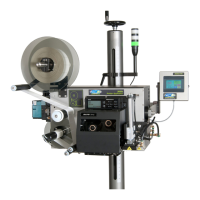
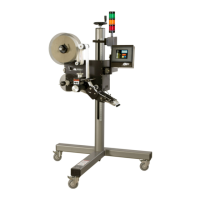
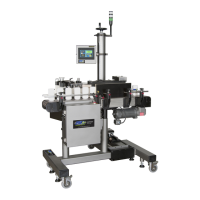
Operator’s Manual: Standard 360a Model Y (360y) Label Applicator
38
DAT Rotary Actuator Stop Adjustment Guidelines
1. Ensure the air pressure reads 40 PSI.
NOTE: Different variables can affect air pressure, such as gravity/weight of the label pad and manifold along with the
applicator’s orientation (Nose Up/Nose Down, Reels Down, Upright and Above, Bottom Up)
2. Adjust airflow needle valves, located on the side of the longest “tube” of the rotary actuator, with a flat blade screwdriver.
a. Turn the screw clockwise (CW) to decrease airflow.
b. Turn the screw counterclockwise (CCW) to increase airflow. Typical flow control setting is ½ turn CCW from
full CW.
NOTE: Proper flow control settings provides a smooth and controlled cycle.
3. Loosen the retract jam nut located on the end of the long rotary actuator tube.
4. Use a
3
/
16
in. Allen wrench and turn the stop set screw CW. This moves the swing tamp arm away from the tamp home shock.
The tamp home shock should protrude from the stop coupling by
1
/
8
in. –
3
/
16
in. Adjust if it does not.
5. Turn the retract setscrew CCW until the swing arm has come to rest against the home stop shock coupling and tighten the jam
nut.
6. Set the extend rotary stop as per above instructions. Note that the extend shock does not have a stop coupling. This shock
should be adjusted to allow for one half of its travel to be compressed when the swing arm is extended.
DAT Shock Absorbers and Flow Controls
Both the linear and rotary actuators have shock absorbers that need adjusted.
1. Adjust the swing home shock stop collar to provide
1
/
8
in. of shock travel.
2. To adjust the shock so the swing arm stops in the right position, press the manual override on the rotary actuator valve and
watch the movement of the swing arm.
3. The arm should hit the shock and stop without bouncing. If it bounces too much, slow the actuator down by adjusting the
flow controls.
The flow controls are integrated into the actuator and are located on each end of the longer cylinders.
1. Turn the screw in with a small screwdriver to slow the arm’s rotational speed and turn it out to speed up the arm’s rotational
speed.
2. The slide shock absorbers are larger and have longer strokes to ensure a smooth stop when moving larger loads.
3. The shocks should be adjusted to ensure that there is at least
1
/
8
in. or more travel available when the slide stop hits the body
of the slide. Do not allow the shocks to bottom-out.
To adjust the shocks,
1. Loosen the clamping screws on the shock mounts and screw the shock in or out.
2. When in position, re-tighten the clamp to ensure the shock stays in place.
3. The flow controls for the slide are mounted on the valve bank. Screwing the knob in slows the speed of the slide’s action
while turning the knob out speeds it up.
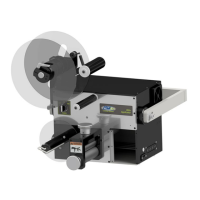
Positioning the DAT Applicator
The product must be presented to the applicator in a consistent manner. Label accuracy cannot be maintained if the surface being
labeled changes speed or distance relative to the label pad.
1. Power-off the applicator and rotate the swing arm to the extended position.
2. Ensure the slide is fully retracted and push the product down the conveyor within the guides and stop the product in front of
the label pad.
3. Move the applicator in or out, or up or down, to position the pad where the label should be placed on the product.
4. Retract the swing arm and move the product in front of the applicator.
5. Extend the slide forward and retract the swing arm. Stop when there is about
1
/
8
in. between the product and the label pad.
You may need to move the slide extend stop by loosening the clamping screw and sliding the stop against the slide body.
6. Once the applicator is properly positioned the product detect sensor can be mounted.


 To Next Page