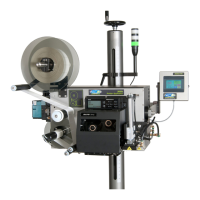
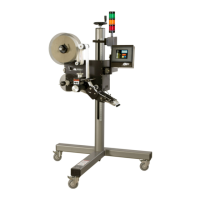
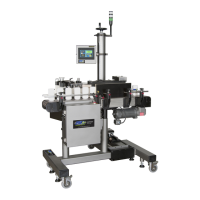
Operator’s Manual: Standard 360a Model Y (360y) Label Applicator
11
Static Test for Corner Wrap Label
1. Configure the applicator for Corner Wrap applications. Start at the Main Menu and tap Setup Menu > Setup Passcode >
Configuration Menu > Top Right-Hand Corner > Special Options Passcode > Apply Mode. Tap the Up or
Down arrows until the Corner Wrap option appears.
2. Enable the applicator and tamp.
3. Increase the air blast pressure to 40 PSI on the Air Blast valve on the valve bank. Turn the knob to adjust.
4. Disable the encoder option by starting at the Main Menu and tapping the Setup Menu > Setup Passcode >
Configuration Menu > Applicator Options > Encoder Option to turn off.
5. Extend the swing arm assembly and the label pad so it is approximately
1
/
8
in. away from the product.
6. Enable the applicator and wave your hand in front of the product detect sensor.
7. Once the swing arm rotates out to the product and the label is blown off the label pad, wave your hand in front of the swing
back sensor. Apply several labels to the same product in this manner.
8. If the label stack is consistent the static test is done. If not, go through the peel edge setup and label stop setup sections of the
corner wrap manual. Once the setup has been verified, reduce the air blast PSI back to its original pressure and, if needed,
enable the encoder option.
Static Test for DAT Label
1. Configure the applicator for tamp only action. Start at the Main Menu and tap Setup Menu > Setup Passcode >
Configuration Menu > Top Right-Hand Corner > Special Options Passcode > Apply Mode. Tap the Up or
Down arrows until DAT option appears.
2. Enable the applicator and tamp.
3. Position the applicator with the tamp assembly extended and the label pad approximately
1
/
8
in. away from the product.
4. Tap the Jog button several times to apply a label stack onto the product. If the stack is consistent, the static test is finished. If
it is inconsistent, follow the remaining steps.
5. Ensure the label pad is made for the label you’re using. Uncovered holes on the pad reduces the available vacuum used to
hold the label in place and results are inconsistent.
6. Check the label stop. One label should be completely dispensed off the liner while the next label should be
1
/
32
in. away from
the peel edge.
a. If this varies more than
1
/
32
in. with each cycle, reset the label sensor.
b. If the reset does not work, see the Troubleshooting Chart
. When corrected, go back, and try the static test again.
c. If there were no label stop issues, go to Step 7.
7. Ensure the label pad surface is clean. If clean, go to Step 8. If not, clean and re-try the static test again.
8. Ensure the vacuum is set correctly.
a. If the label flutters when feeding across the pad the vacuum is too high.
b. If the label falls off or moves after the label has left the liner the vacuum is too low.
c. If the label feed looks smooth go to the Step 9.
9. Work with the air pressure and the position of the air assist tube until the label feeds more consistently onto the pad and re-try
the static test.
a. If the results are still not good enough, go to Step 10, otherwise go to Step 11.
b. If having difficulties correctly positioning the air assist tube, see the Tamp Air Assist Setup
section. If having
difficulties adjusting air pressure, see the Tamp Vacuum Pressure Setup section.
10. Ensure that there are no flaws with the label stock. Try another roll of labels and see if the stack changes.
11. Check the distance from the label pad to the product. If the distance is too large, the labels may float too much. Adjust the
applicator so the label pad just clears the product (within
1
/
8
in.)


 To Next Page