4 - 68
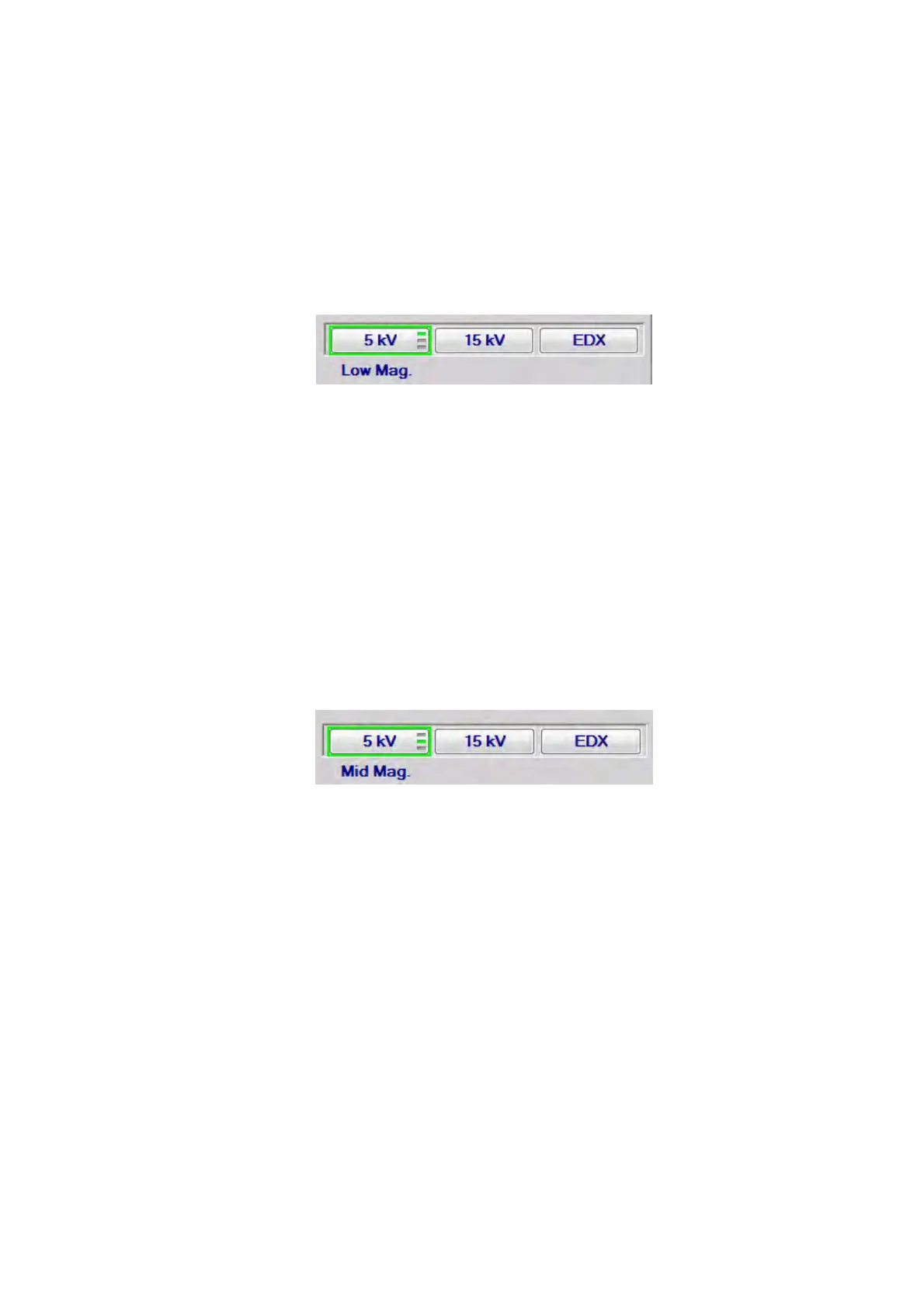
1a. Low mag.
This observation condition tends to produce smooth images with high contrast,
suitable for observation at a magnification of 15x to 2,000x due to low resolution. This
magnification is only reference value. Set the advanced value depending on samples
and purpose.
When [Low mag.] is selected, the [l] mark is displayed in the information area located
in the lower right part of the image observation area. (see 4.3.2)
Figure 4.3.12-2 Observation Condition Settings (5 kV - Low Mag.)
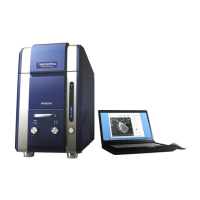
1b. Middle mag.
An electron beam is focused more than [Low mag.], achieving relatively high
resolution. However, in some cases, contrast or image degradation can occur
depending on the observed sample or magnification. This condition is suitable for
observation at a magnification of 2,000x to 6,000x. This magnification is only
reference value. Set the advanced value depending on samples and purpose.
When [Middle mag.] is selected, the [m] mark is displayed in the information area
located in the lower right part of the image observation area. (see 4.3.2)
Figure 4.3.12-3 Observation Condition Settings (5 kV - Middle Mag.)
1c. High mag.
An electron beam is more focused than [Middle mag.], achieving high resolution.
Although charge-up phenomenon and damage to samples can be minimized,
contrast or image degradation can occur depending on the observed sample or
magnification. This condition is suitable for observation at a magnification of 6,000x to
30,000x. This magnification is only reference value. Set the advanced value
depending on samples and purpose.
When [High mag.] is selected, the [h] mark is displayed in the information area
located in the lower right part of the image observation area. (see 4.3.2)


 To Next Page