
 Need help?
Do you have a question about the RKC INSTRUMENT PF900 and is the answer not in the manual?
Outlines the essential steps for operating the instrument before initial use.
Details how to verify the received product against the order and check accessories.
Explains the product's model code structure and suffix code meanings.
Lists and explains the suffix codes for hardware coding and quick start options.
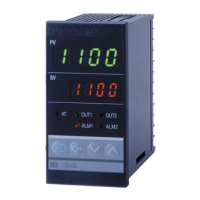
Provides an overview of the instrument's front panel view and components.
Overviews the instrument's input/output capabilities and functional blocks.
Covers quick start codes, digital input, and digital output type code tables.
Details specific displays, lamps, buttons, and indicators on the instrument's front panel.
Explains how to operate the instrument using the front panel keys.
Specifies the required environmental conditions for safe and proper instrument mounting.
Provides essential cautions to consider for noise immunity, safety, and heat dissipation during mounting.
Details the instrument's physical dimensions and the panel cutout specifications.
Describes the step-by-step procedures for mounting and removing the instrument from a panel.
General cautions and recommendations for safe and effective instrument wiring.
Illustrates the terminal configuration and assignments for the instrument.
Detailed wiring instructions for power supply and various input/output terminals.
Introduces the instrument's operation menu and mode switching capabilities.
Explains how to change parameter set values using numeric setting and item selection.
Details the operation of direct keys for mode switching and program control.
Describes the Set data lock function to prevent errors during parameter setting.
Provides descriptions of parameters organized by mode type and lists.
Explains how to set parameters related to PV bias, cycle time, alarms, and communication.
Details the engineering mode for advanced parameter initialization and settings.
Guides the user through initial parameter setup before operating the instrument.
Covers essential precautions for power on, input errors, event hold, and power failures.
Explains the different operation modes and procedures for switching between them.
Details the operation of the program control function, including pattern setup.
Explains the Autotuning function for automatically setting PID values.
Guides on setting parameters using loader communication and the WinUCI-PF900 tool.
Describes the structure and components of a program pattern, including segments and levels.
Explains memory groups for storing PID, Event, Wait, and Time signal settings.
Details the selectable start types for program control operation.
Explains how to use the search function to find intersections in program patterns.
Describes the step function for skipping segments during program control.
Explains how to start, release, and use the hold function during program control.
Details the wait function for pausing program progress based on conditions.
Explains functions for repeating segments or patterns and linking multiple patterns.
Describes the pattern end signal, action, and display.
Explains time and segment signals for external device control based on program progress.
Describes setting output program values for segments and assigning them to outputs.
Covers pattern copy, segment copy, and data clear functions for editing programs.
Explains functions to speed up or back up program progress using key operations.
Shows displays, actions, and solutions for various input error conditions.
Lists self-diagnostic error codes, their descriptions, actions, and solutions.
Details specifications for various measured input types and their characteristics.
Specifies the number, method, and conditions for digital inputs.
Lists specifications for different output types (Relay, Voltage, Current, Triac, Open Collector).
Specifications for communication interfaces (RS-232C, RS-485, RS-422A) and protocols.
Specifications related to program control, including memory and time accuracy.
Covers general specifications like power supply, consumption, ambient conditions, and dimensions.
 General
| Brand | RKC INSTRUMENT |
|---|---|
| Model | PF900 |
| Category | Controller |
| Language | English |




 To Next Page
