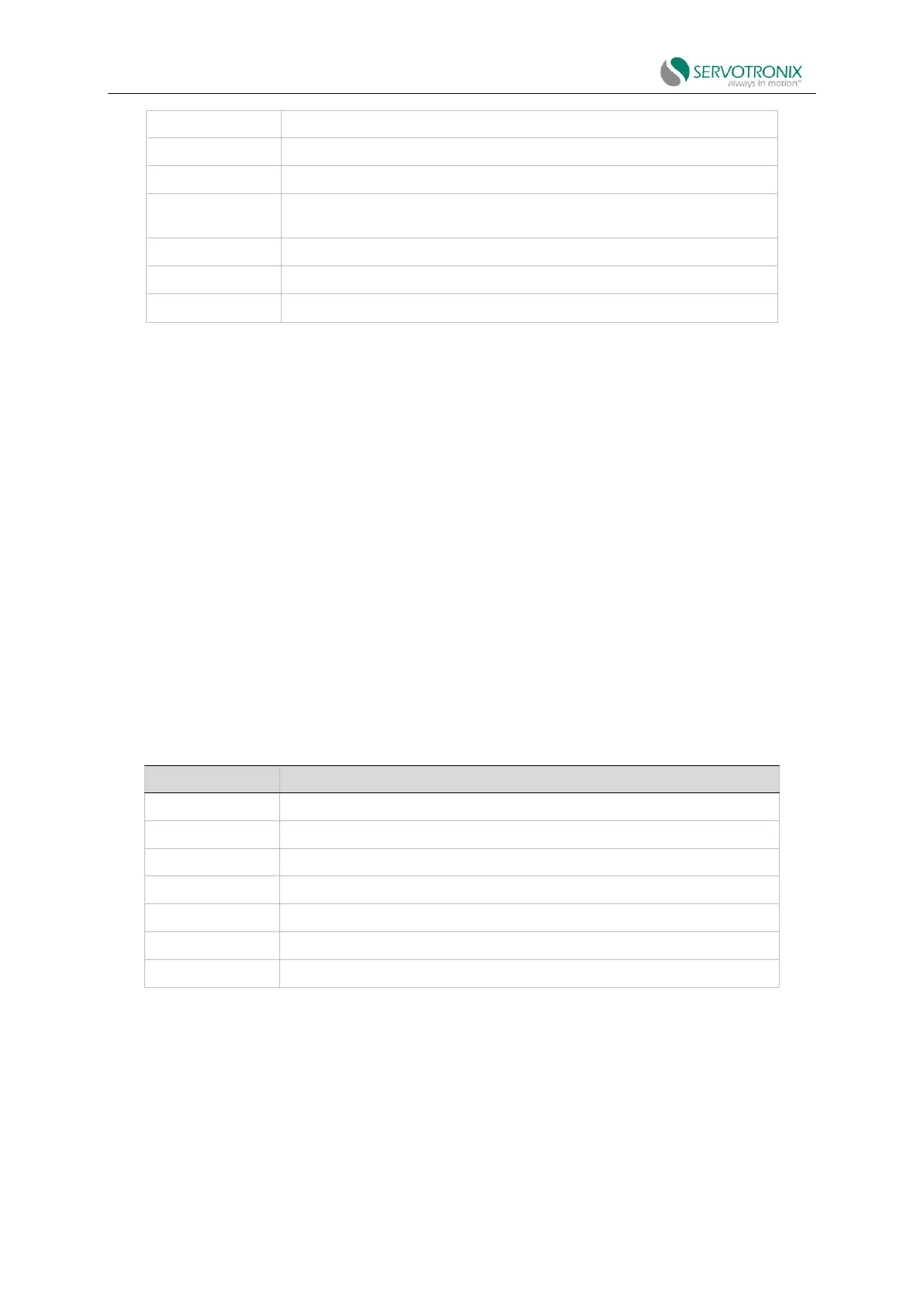
Define analog output function.
Display the analog output value (in volts) set by ANOUTMODE. Read only.
Analog output command (in volt) set by the user in ANOUTMODE0.
Analog output voltage scaling representing motor current (I) or current
command (ICMD).
Analog output command voltage limit for all modes.
Analog output voltage scaling representing velocity (V) or velocity error (VE).
Define the condition that will activate the specified digital output.
6.14 Disabled Mode
The drive may be disabled because the motion controller issues an explicit command or the
drive itself responds to a fault condition. When the drive is disabled, the "disabled mode" function
can be used under special circumstances to make the motor stop running quickly before turning
off the power supply. This can reduce the amount of motor coasting.
Use the ServoStudio2 Emergency Stop screen to select the method and parameters for
stopping the motor when the drive is disabled. The disabled mode consists of two mechanisms:
⚫ Active Disable stops the motor by controlling deceleration to zero velocity and then
disables the drive. Active Disable cannot be implemented when the drive is operating
in current control mode (OPMODE2 or OPMODE3).
⚫ Dynamic braking controls the motor when the drive is disabled by applying the motor
back-EMF to the stop current; therefore, it can also be used in the case of feedback
loss.
Table 6-20
Define how the drive will respond when disabled.
Non-active disable, non-dynamic braking.
Non-active disable, dynamic braking on fault only.
Non-active disable; disable dynamic braking arbitrarily
Active disable on fault*; non-dynamic braking.
Active disable on fault*; dynamic braking on fault only.
Active disable on fault*; disable dynamic braking arbitrarily.
Note: Faults that require immediate disable (to prevent drive damage) and feedback faults that
may cause communication errors (motor runaway conditions) cannot issue an active
disable.
There are three parameters that affect disable and braking.


 To Next Page