LC700 – User’s Guide
3.24
Remote I/O Architecture
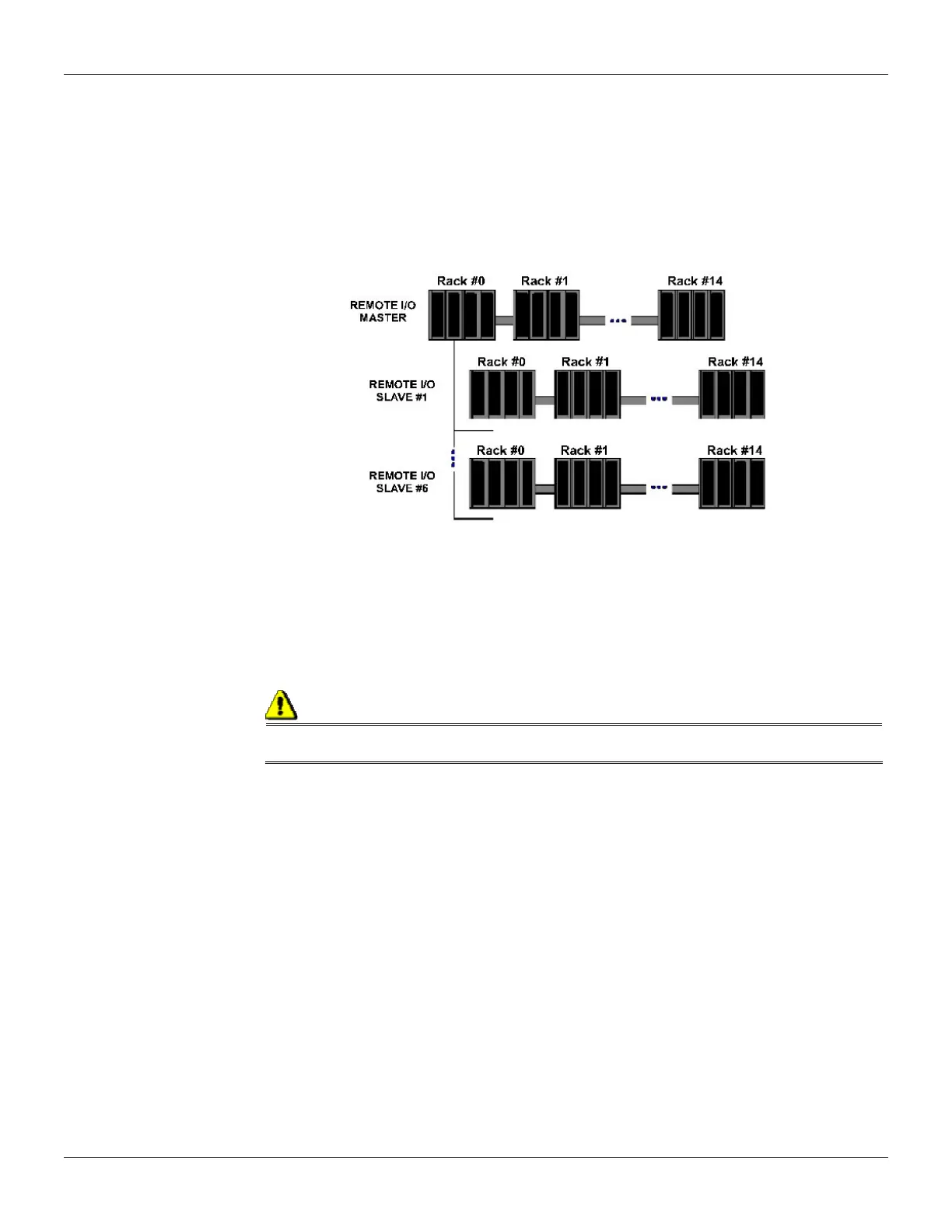
The Remote I/O System is basically composed of a Master Unit and up to 6 Slave Units. Master Unit
and Slave Units are connected through a multi-drop cable that can reach a total length of 4000ft.
The proper cable length and baud rate depend on the level of noise in the application environment.
The available Rack/Slots will limit the total number of modules per System and the maximum
number of Discrete and Analog Points that the LC700 will be able to handle.
Each Remote I/O needs, at least, one power supply. LC700 Remote I/O system structure is shown
as follows:
Figure 3.11- Remote I/O Architecture
Baud Rate and RIO Address Settings
Baud Rate Settings
Each Remote I/O Interface Module (Master or Slave) has a DIP switch to set the baud rate
(communication speed). The DIP switch is located in the frontal panel of the Module and can be
accessed with a small screw driver.
Observation
Make sure to disconnect the Module while setting the switch. Also note that both the Master and
Slave I/O interface must be configured with the same baud rate.
Setting Address of the Remote I/O Interface Module
There is also a dedicated Rotary Switch at the bottom of the Slave Module to set the Slave device
address. Each Remote Unit connected to the Master Unit has to have a unique address. Available
addresses are: 1, 2, 3, 4, 5 and 6.
RIO Limits
To follow has a utilization descriptive of remote and redundant CPU's in LC700. For each master
CPU is possible to have up to 6 RIO’s slave, and to each RIO had:
120 Words (240 bytes) of analog inputs, for example:
• 120 inputs for PT100 (15 X M-402) or;
• 120 inputs 4 to 20 mA (15 X M-401R) or;
• 60 inputs through FB700.
120 Words (240 bytes) of analog outputs, for example:
• 120 outputs 4 to 20 mA (30 X M-501) or;
• 60 outputs through FB700.
The digital inputs and outputs are limited for the total number in the CPU.
For the updating of redundant CPU’s, where it is necessary to use remotes, prevail the same rule.
Whenever the necessity goes bigger than these limits, the user will need to divide in more remotes.


 To Next Page