Troubleshooting the Installation
6-7
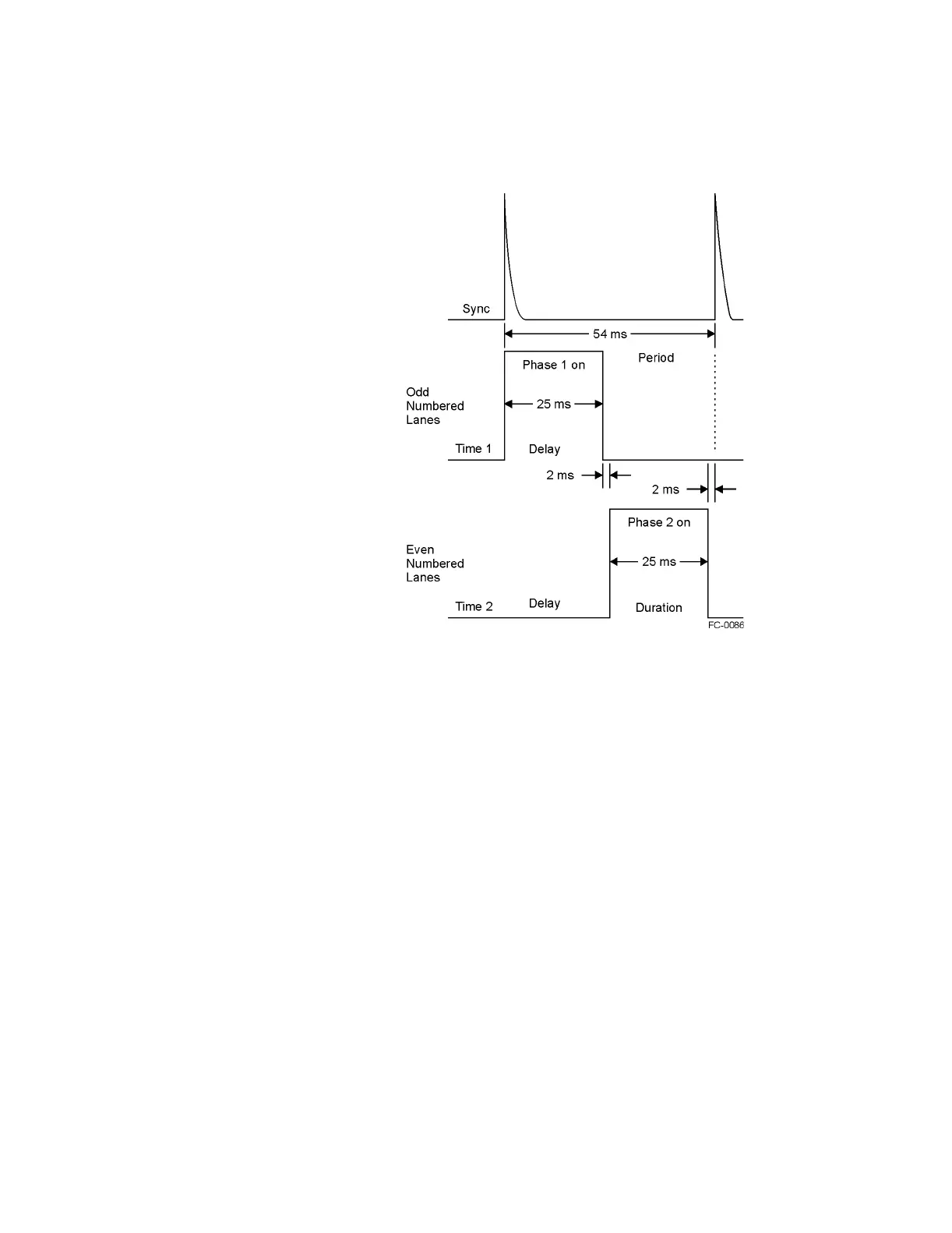
Figure 6-2 TDM Synchronization
Benefits of Using TDM
TDM may remedy the problem of cross-lane interference by removing the possibility
of the RF footprint transmitting into an actively transmitting and receiving adjacent
lane. In this case no physical changes to the plaza or antennas is necessary.
Drawbacks of Using TDM
Based on site criteria, TDM may not be the best solution for correcting cross-lane
interference. By using TDM, you may unintentionally introduce a period of dead time
within the transaction time when a vehicle could pass through the lane unrecorded.
For example, if a toll plaza has five lanes and you choose to use TDM, each lane will
be operating only 20% of the time. If you have window of 80 ms when the lane is
dead, this might be sufficient time for a vehicle to travel through the lane undetected.
The TDM configuration for each lane can be adjusted so that more than one lane is
switched on at the same time. This reduces the amount of time that a lane is off and
reduces the probability of a vehicle passing through undetected. However, by config-
uring the site in this manner, you may reintroduce cross-lane interference across alter-
nating lanes.
Frequency Settings Using TDM
As discussed in “Frequency Separation” on page 6-6, there are two frequencies for
each reader: downlink and uplink. When using TDM to reduce cross-lane interfer-
ence, alternating lanes are switched off for a specified duration. For the IT2200



 To Next Page