IT2200 Reader System with Multimode Capability Installation & Maintenance/Service Guide
2-10
Tag Orientation and Placement
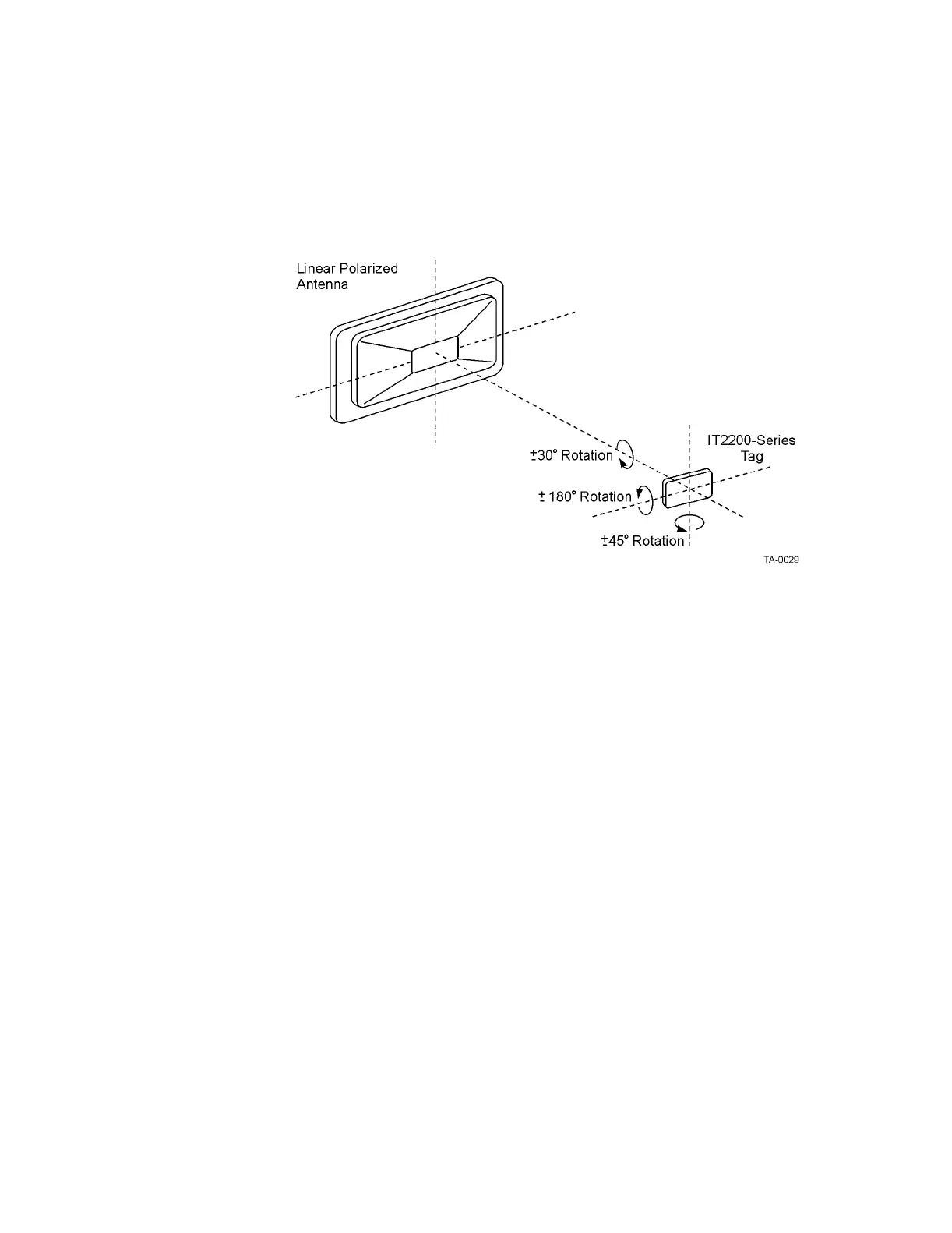
Ideally, in any RFID system, the tag to be read is oriented such that the polarization of
its internal antenna is aligned favorably with the polarization of the system antenna
(Figure 2-4).
Figure 2-4 Tag Orientation with Linear Polarized Antenna
Tags can be mounted on the inside of a vehicle’s windshield or mounted on the license
plate area of the front of the vehicle.
The surface upon which tags are mounted can affect the tag's performance by
directing the reflected signal toward the transmitting/receiving antenna, or in some
cases, by reflecting the signal away from the antenna. Interior tags cannot be mounted
on metallic surfaces because the metal will interfere with the tag’s operation. Exterior
tags can be mounted on metallic or non-metallic surfaces.
Noise and Interference Immunity
Electrical noise and interference, as well as physical obstructions between the tag and
antenna, can degrade communications between a tag and the reader system.
Electrical Noise and Interference
Common sources of noise and interference are other communication devices such as
TVs, cellular phones, two-way radios, radar, and other tags and readers. Other noise
sources include motors, fans, digital equipment, automobile ignition systems,
fluorescent lights, and neon signs.
Physical Obstructions
Some types of obstructions or materials between the tag and antenna can cause little or
moderate to substantial interference with the tag signal. Radio waves penetrate
nonconducting materials (such as snow, ice, dirt, wood, paper, plastic, and cured
concrete) with only moderate attenuation.



 To Next Page