198
T T M R
D
n
FNC
64
1
2
M
3
○○○
n
X Y M S
D.b R.b
KnX KnY
KnM KnS
T C
D,R
V,Z
UnG
K,H
E
" $"
D
TTMR D0 K1
X20
X20
5
10
D
n
n
○
Operand
Devices
Teaching Timer
D occupies 2 components
n = 0~2
D : the ID number of the register which can store the
timed data of “ON” duration ((e.g., From a push
button switch)
n : the setting for multiplier
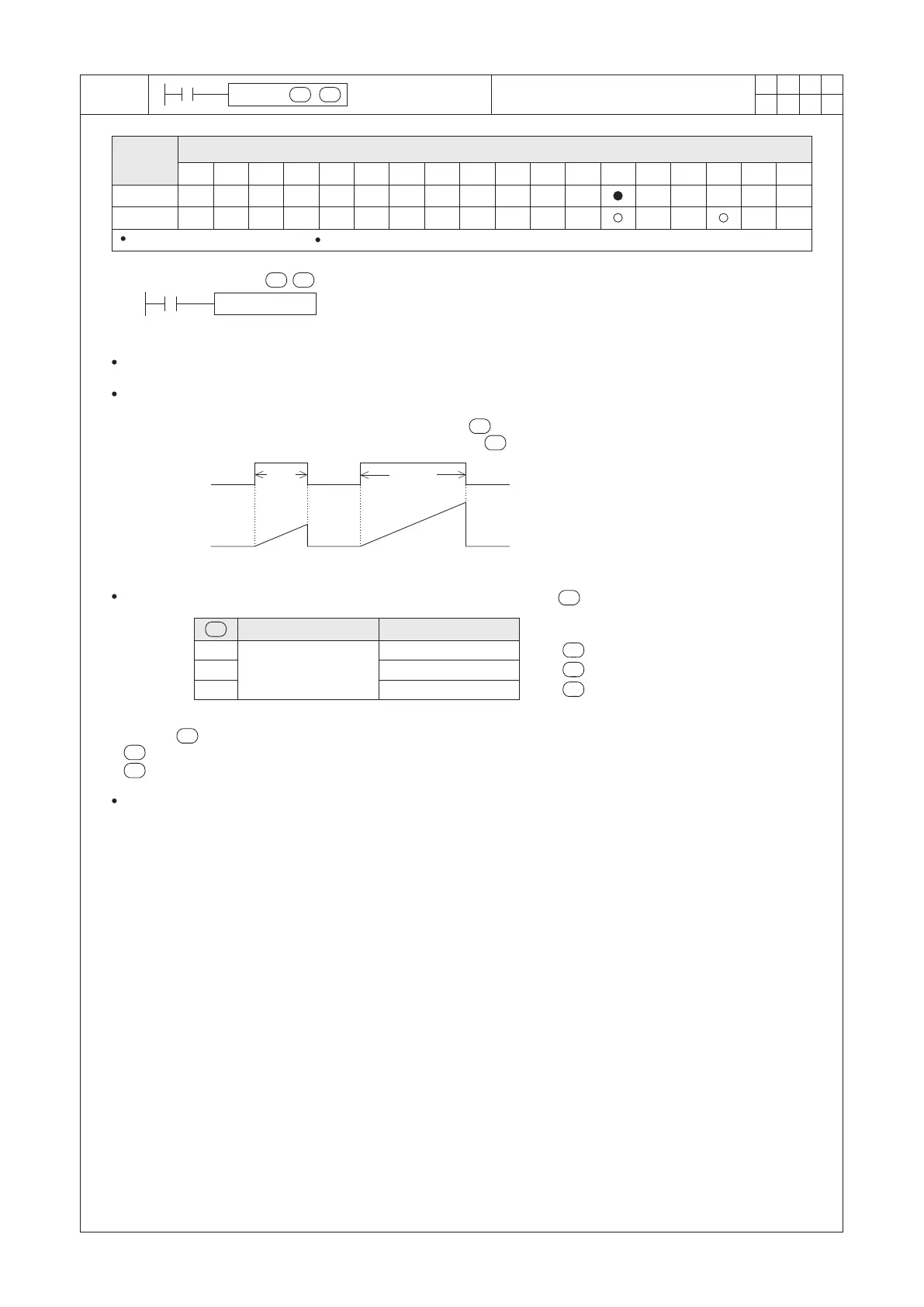
Suppose X20 is the external push button switch.
When X20 = “ON” (it is pressed), the content value of D1 (by the unit of second) will respond to the duration of
X20 = “ON”.
If X20 =“ON” for 5 seconds, then D1=5. Because of the =1, the D0=50.
If X20 =“ON” for 10 seconds, then D1=10. Because of the =1, the D0=100.
5
Sec.
10
Sec.
D1
Content value
The content value of D0 is determined by the content value of D1 and ; their correlation is:
When =0, (D0)=(D1)×1
Content value of D1
10
(Supposed Value)
0
1
2
n
10×1=10
10×10=100
10×100=1000
When =1, (D0)=(D1)×10
When =2, (D0)=(D1)×100
Content value of D0
n
Accordingly, it is easily to use the content value of D0 become the setting value of a Timer T via a proper setting
value of .
=1 can be applied to a 100 ms unit Timer
=2 can be applied to a 10 ms unit Timer
When X20= “ON” → “OFF”, the current value of D1 will be reset to “0” but the content value of D0 will remain as
same as the value before it is disabled.
n
n
n
n
n
n
n


 To Next Page
 Loading...