Need help?
Do you have a question about the Automatic Systems SmartLane and is the answer not in the manual?
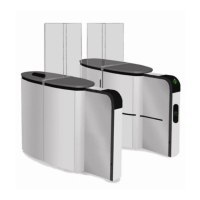
The SmartLane is a security entrance lane designed and manufactured by Automatic Systems, intended to control pedestrian access with or without luggage in both directions, ensuring high levels of security and safety. It is not intended to facilitate general pedestrian traffic or be used as a regular entry/exit gate.
The gate consists of a retractable pane that acts as a barrier to passage. A cabinet houses the obstacle movement mechanism, detectors for security and safety, and the electronic logic controlling the unit. Optional housing extensions can be added to increase the number of detectors for enhanced anti-fraud control and to integrate a ticket reader or other validator. The SmartLane gates are available in two passage widths: 600 mm for standard obstacles (ordinary mobility users) and 900 mm for wide obstacles (reduced mobility users). They can be installed individually or in groups, with left-hand, right-hand, and intermediate units, including hybrid options for linking lanes of different widths.
The system utilizes DIRAS (Infrared Detection Technology developed by Automatic Systems) detection cells. For SmartLane configurations with 1200 mm high mobile obstacles, a classic E/R (transmitter/receiver) cell is used as a safety device in the fixed obstacle. This classic cell type is also used with the 'Early Detection' option. DIRAS cells are arranged in strips of eight (8) transmitter or receiver cells. Transmitter cells are in the left cabinet, and receiver cells are in the right cabinet. Each lane has at least 32 pairs of T/R cells (64 cells), with a physical distance of approximately 45 mm between cells, virtually reduced to 23 mm by cross beams. This high cell density enables a tracking algorithm that predicts user position, detects objects/spaces greater than 23 mm, and manages passages and breaches based on prediction and cell masking sequences. This algorithm allows for effective tailgating detection, differentiation between trolleys and humans, detection of children of all sizes, detection of U-turns, detection of wrong-way movement, detection of crawling users, and a continuously active security zone, reducing false alarms from luggage.
The mechanical transmission of motion involves a geared motor for each mobile obstacle. A connecting rod/crank system links the motor to the mobile obstacle and to the upper and lower shafts via a secondary connecting rod. This system mechanically locks the obstacle in both open and closed positions, preventing manual opening. A baseboard connects the mobile obstacle to the shafts and secures it, featuring a guide tube for the flap's tie rod when the moving obstacle height exceeds 1 meter. The flap slides in a guide, closing the passage area in the upper part of the gate. An analog inductive sensor measures the distance from the crank to the gearmotor, providing the exact obstacle position to the control logic. A preloaded balance spring assists in opening and closing the obstacle. In case of power failure, an intrinsic mechanical device automatically opens the obstacles. An optional electromagnetic locking system can block the crank to lock the obstacle in the open position.
The SmartLane operates in a powered mode. When idle in controlled mode, dynamic status lights are blue, and dynamic orientation lights are green. Upon passage request (e.g., by masking cells, pushbutton, reader), obstacles open if authorization conditions are met. Dynamic status lights turn green, obstacles open, and a time interval for passage is set. If passage isn't started, authorization is cancelled, and the gate returns to idle. If passage is in progress, the system monitors for breaches. Obstacles close after passage, ensuring no one is in front.
Obstacles can be in three idle statuses:
Operating mode can be configured independently for each direction:
Passage authorizations are received via inputs on the AS1605 or AS1603 circuit boards. Timers control the allowed entry and passage time. Successive authorizations are stored.
Evacuation Mode: When activated, obstacles open and remain open for free passage in both directions. This mode has priority over others, except for crawling detection to prevent injury. It can be triggered externally, via a supervision panel, or SmartTouch/Smart & Slim.
Power Failure: Obstacles automatically open via an intrinsic mechanical device. With the locking solenoid option, obstacles can be locked in the open position.
Breaches: Abnormal or unauthorized movements.
All maintenance work must adhere to safety warnings, including disconnecting power and wearing PPE (cut-resistant gloves). Ground wires must interconnect all moving metallic parts.
Recommended Tools: Electrician's toolkit, mallet, drill, ratchet wrench, Cat 6 S/FTP Ethernet cable, PC with mini USB or RJ45 Ethernet cable/supervision panel, circlip pliers, Allen keys, flat spanner set.
Surface Maintenance: Regular cleaning with approved stainless steel product. Avoid hydrochloric acid, hot household bleach, abrasive materials, and pressurized water sprays. Clean obstacles with window cleaner. Vacuum and clean masking strip and lenses of cells with anti-static, non-aggressive cleaning agent.
Troubleshooting: The product has a self-test function, with results visible on the Maintenance Interface's STATUS page.
Dielectric Strength and Leakage Current Test: Inverters have integrated EMC filters, resulting in leakage current to earth. Y-capacitors can be deactivated to limit leakage current if compatibility problems arise, but this affects EMC compliance.
Storage: Store in original packaging in a dry place, protected from dust, heat, and weather. Storage temperature: -30 to +80 °C. Leave powered on to maintain CPU board battery charge. If stored off, allow 30 minutes to 1 hour to warm up before powering on.
Disposal/Destruction: Dispose of components (metal, electronic) according to regulations.
Customization: Optional regulated heating for low temperatures (0 to -20°C), consisting of a heater on a DIN rail and a thermostat on the power board. Optional auto-transformer for 120V mains supply.
 General
| Brand | Automatic Systems |
|---|---|
| Model | SmartLane |
| Category | Turnstiles |
| Language | English |

 To Next Page