Technical / Programming Manual
FT128 Rev 2.2
127
16 Advanced Mode
The latest generation of detectors are the following:
Conventional photoelectric smoke detector 4452
Analogue photoelectric smoke detector 4401
Analogue multi detector 4400
Notes:
The analogue detectors 4401 and 4400 can be set using the address setting tool 4414 in
different modes. In this chapter, only the Advanced mode is described.
The detectors are factory set to the NORMAL mode, see chapters “COM Loop Units”,
page 49 and “Functions / Services / Features, page 100.
The analogue detectors 4401 and 4400 will function in NORMAL mode and replace
analogue detectors 4301 and 4300 in NORMAL mode respectively. (The analogue
detectors 4301 and 4300 cannot use the advanced mode)
The Advanced mode can be set with the address setting tool 4414 only i.e. address
setting tool 3314 cannot be used.
The conventional detector 4452 uses some of the advanced mode functions, see the
function respectively below in this chapter.
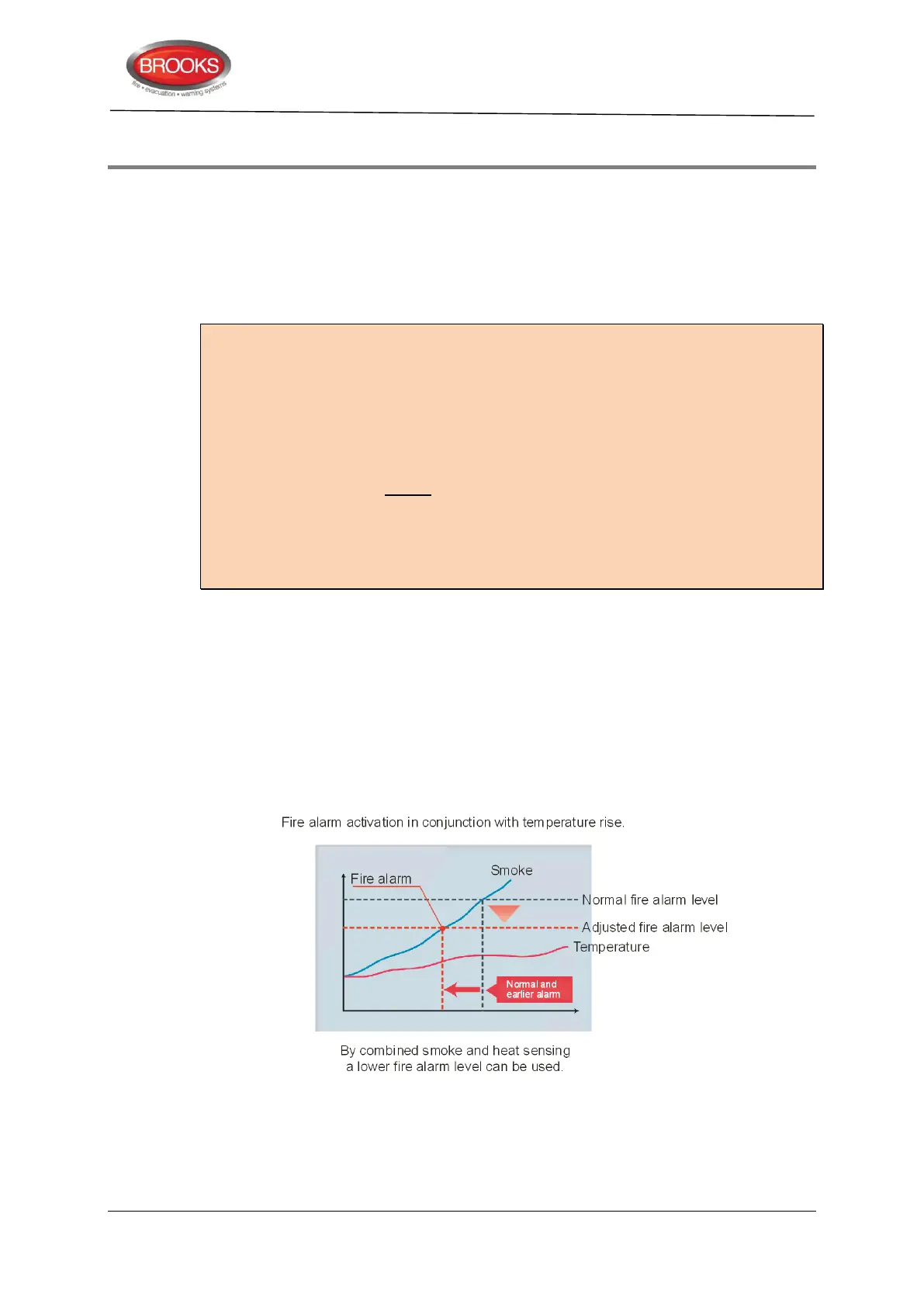
The Artificial Intelligence (AI function) uses combined smoke and heat sensing for the fire
judgement, as well as variable sensitivity and time delay based on the smoke and
temperature changes just before the alarm level is reached. This will secure the real fire
alarms and reduce the nuisance alarms.
The AI function is dependent on if the detector is a photoelectric smoke detector (4452 /
4401) or a multi detector (4400):
Combined heat and smoke sensing will guarantee reliable and accurate fire alarm
detection, e.g. by shortening the delay time and/or adjust the sensitivity (lower alarm
threshold level).
Variable delay time. The delay time is influenced by the temporary temperature and/or
smoke obscuration changes just before and after the alarm threshold level was passed.
The delay time before a fire alarm is activated can be shortened up to 50 % (e.g. from 20
to 10 sec.), or the delay time can be extended in order to reduce nuisance alarms.
A learning function will adapt after a learning period an Alarm algorithm suitable for the
smoke and temperature conditions in the area where the detector is located.



 To Next Page