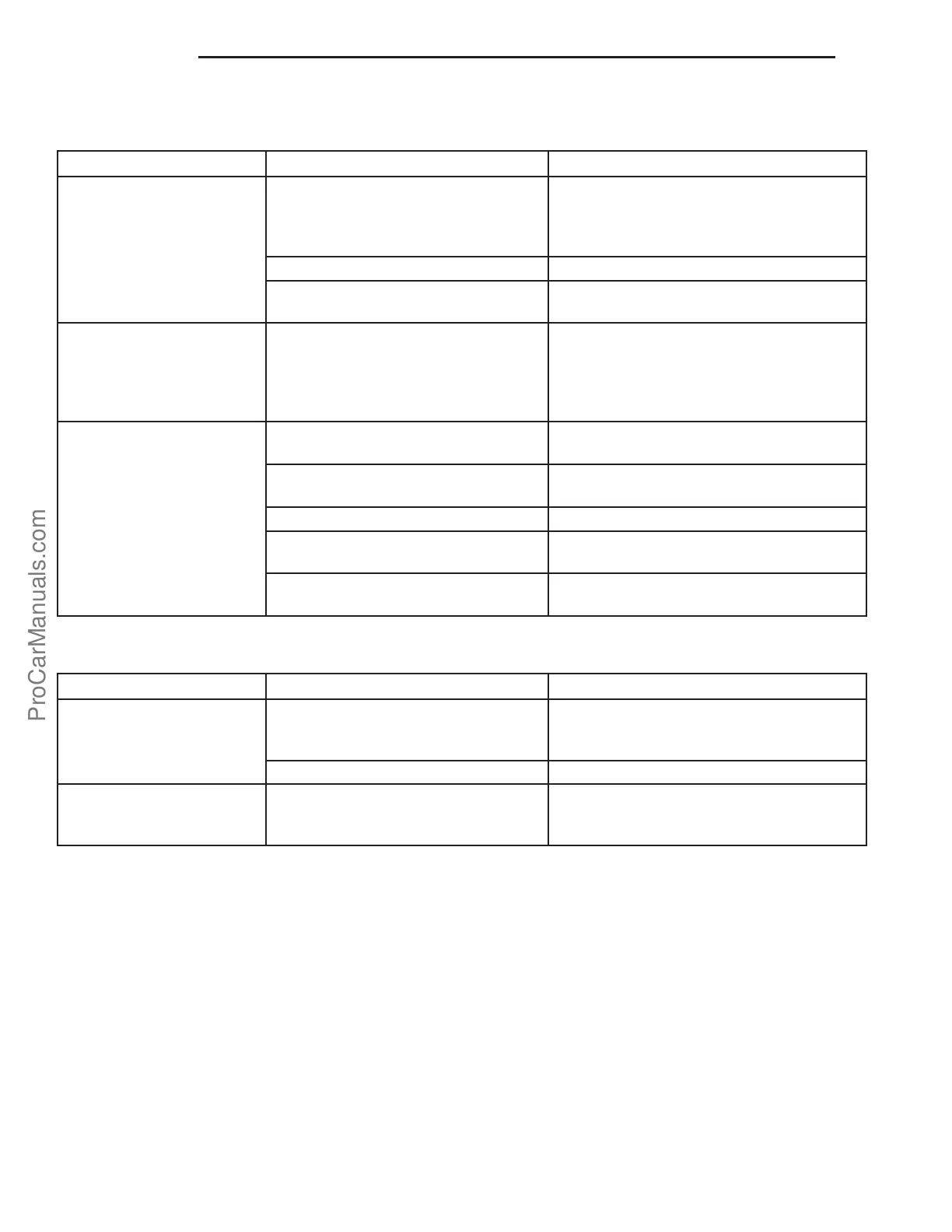
SERVICE DIAGNOSIS - IMPROPER CLUTCH RELEASE
CONDITION POSSIBLE CAUSES CORRECTION
CLUTCH DISC BINDS ON
INPUT SHAFT SPLINES
Clutch disc hub splines damaged
during installation
Clean, smooth, and lubricate disc and shaft
splines. Replace modular clutch assembly,
or clutch disc, and/or input shaft if splines
are severely damaged.
Input shaft splines rough, damaged. Clean input shaft splines. Then lube.
Corrosion or rust formations on
splines of input shaft and disc
Clean input shaft splines and disc splines,
then lube
CLUTCH DISC RUSTED
TO FLYWHEEL AND/OR
PRESSURE PLATE
Occurs in vehicles stored or not
driven for extended period of time.
Also occurs after steam cleaning if
vehicle is not used for extended
period.
Replace modular clutch assembly
CLUTCH WILL NOT
DISENGAGE PROPERLY
Disc bent, distorted during transaxle
installation
Replace modular clutch assembly
Clutch cover diaphragm spring
damaged during transaxle installation
Replace modular clutch assembly
Release fork bent, loose, or damaged Replace fork if worn or damaged
Clutch master cylinder or slave
cylinder leaking
Check and replace master and/or slave
cylinder
Master cylinder adjustable pushrod
loose or damaged
Inspect. Tighten adjustment fastener or
replace master cylinder
SERVICE DIAGNOSIS - CLUTCH PEDAL NOISE
CONDITION POSSIBLE CAUSES CORRECTION
CLUTCH PEDAL
SQUEAKS WHEN
DEPRESSED TO FLOOR
Pedal bushings worn out or
inadequate lubrication
Replace or lubricate bushings
Clutch pedal return spring worn out Lubricate or replace return spring
CLUTCH PEDAL
SQUEAKS DURING
OPERATION
Clutch release lever pivot stud has
inadequate lubrication
Lubricate or replace clutch release lever
DIAGNOSIS AND TESTING - CLASH-INTO-
REVERSE COMPLAINTS
All NV T350 (A-578) manual transaxles are
equipped with a reverse brake. It prevents clash
when shifting into reverse, but only if the vehicle is
not moving.
(1) Depress clutch pedal to floor and hold. After
three seconds, shift to reverse. If clash is present,
clutch has excessive spin time, and the reverse brake
may not be functioning.
(2) Remove transaxle.
(3) Check the input shaft spline, clutch disc
splines, and release bearing for dry rust. If present,
clean rust off and apply a light coat of bearing grease
to the input shaft splines. Apply grease on the input
shaft splines only where the clutch disc slides. Verify
that the clutch disc slides freely along the input shaft
spline.
(4) Check to see if the clutch disc hub splines are
damaged, and replace with new clutch assembly if
required.
(5) Check the input shaft for damaged splines.
Replace as necessary.
(6) Check for broken clutch cover diaphragm
spring fingers.
(7) Install clutch assembly and transaxle.
6s - 4 CLUTCH PL
CLUTCH (Continued)
ProCarManuals.com








 To Next Page