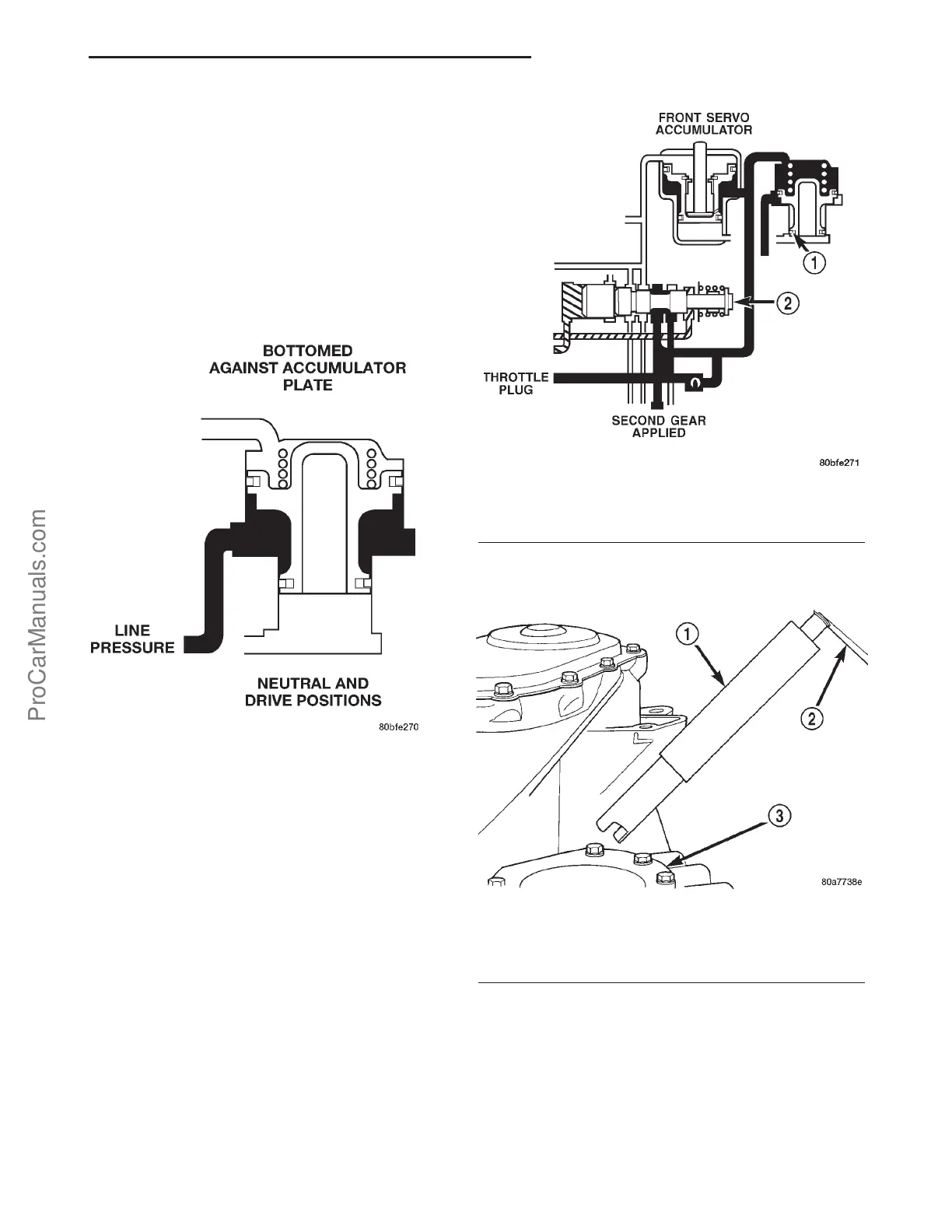
accumulator, the combination of spring pressure and
line pressure forces the piston away from the accu-
mulator plate. This causes a balanced pressure situ-
ation, which results in a cushioned band application.
After the kickdown servo has become immovable, line
pressure will finish pushing the accumulator up into
its bore. When the large end of the accumulator pis-
ton is seated in its bore, the band or clutch is fully
applied.
NOTE: The accumulator is shown in the inverted
position for illustrative purposes.
FINAL DRIVE
ADJUSTMENT - DIFFERENTIAL BEARING
NOTE: Transfer shaft MUST be removed from trans-
axle to obtain an accurate differential turning torque
measurement.
Differential turning torque should be measured
and adjusted during any transaxle or differential
teardown/assembly, or if any of the following parts
are replaced:
• Transaxle case
• Differential carrier
• Differential bearing retainer
• Extension housing
• Differential bearing cups and cones
(1) Position the transaxle assembly vertically on
the support stand, differential bearing retainer side
up.
(2) Install Tool L-4436A into the differential and
onto the pinion mate shaft (Fig. 88).
(3) Rotate the differential at least one full revolu-
tion to ensure the tapered roller bearings are fully
seated.
(4) Using Tool L-4436A and an inch-pound torque
wrench, check the turning torque of the differential
(Fig. 89). Turning torque should be within 5–18
in. lbs.
Fig. 86 Accumulator in Neutral and Drive Positions
Fig. 87 Accumulator in Second Gear Position
1 - BOTTOM IN BORE
2 - SHUTTLE VALVE
Fig. 88 Tool L-4436 and Torque Wrench
1 - SPECIAL TOOL L-4436–A
2 - TORQUE WRENCH
3 - DIFFERENTIAL BEARING RETAINER
PL 31TH AUTOMATIC TRANSAXLE 21s - 61
ACCUMULATOR (Continued)
ProCarManuals.com














 To Next Page