Alarms/Errors
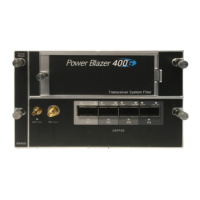
Power Blazer 913
Alarms
AIS (Alarm Indication Signal) for OPU client signal (designated as LO in
the standard), indicates that a PRBS11 pattern is received causing a
failure of the client signal. In TX, generates a PRBS11 pattern.
AIS (Alarm Indication Signal), for OTU serial interfaces, indicates that
polynomial number 11 (PN-11) is over all OTU frame bits including FAS
and MFAS for at least 3 consecutive 8192 bit-interval. In TX, generates
polynomial number 11 (PN-11) over all OTU frame bits including FAS
and MFAS continuously.
AIS-L / MS-AIS (Alarm Indication Signal) for SONET/SDH, indicates that
bits 6, 7 and 8 of the K2 byte contain the “111” pattern in five
consecutive frames. In TX, generates a SONET/SDH signal that contains
a valid Section Overhead (SOH) / Regenerator Section Overthead
(RSOH) and an all-ones pattern on the SPE.
AIS-L (Alarm Indication Signal - Line) for WIS, indicates that bits 6, 7
and 8 of the K2 byte contain the “111" pattern in five consecutive
frames.
AIS-P / AU-AIS (Alarm Indication Signal) for SONET/SDH, indicates that
the H1 and H2 bytes contain an all-ones pattern in three consecutive
frames or more. In TX, generates an all-ones pattern over H1, H2, H3,
and SPE.
AIS-P (Alarm Indication Signal - Path) for WIS, indicates that the H1 and
H2 bytes for a STS path contain an all-ones pattern in three consecutive
frames or more.
AIS-V / TU-AIS (Alarm Indication Signal) for SONET/SDH, indicates that
V1 and V2 bytes for the VT/TU path contain an all-ones pattern in three
(SONET) / five (SDH) consecutive superframes. In TX, generates an
all-ones pattern for the V1 and V2 bytes of the VT/TU path and payload.
BAS Unexp. Period for Path OAM, indicates that the period field value
of the received Basic OAM message is different than the one
configured.





 To Next Page