xiii
Safety Precautions for Using the Equipment
Be careful not to damage the water trap during operation as bacteria and/or mucus may contaminate the MGU-
800/810 series.
The airway adapter, sampling line, flow sensor are disposable products that are intended for single patient use
only. Do not reuse them on other patients as it may cause cross-infection.
To prevent cross-infection, do not allow the sampling gas to return to the breathing system.
When using a sampling line for intubated patients with a closed suction system, do not place the airway adapter
between the suction catheter and endotracheal tube. This is to ensure that the airway adapter does not interfere
with the functioning of the suction catheter.
Do not use the MGU-800/810 series with the flammable anesthetic agents.
To protect the hospital staffs from unnecessary anesthetic agent, it is strongly recommended to connect the
exhaust hole to the gas exhaust system in the hospital.
The sampling line may get clogged by internal condensation.
The contents of the water trap should be handled as a potential infection hazard.
Do not use adult/pediatric type water traps and/or sampling lines with neonates to avoid high sampling flow.
Connect only DRYLINE gas sampling lines to the water trap. Note that there may be other compatible tubing
present, e.g. IV-lines.
Do not use DRYLINE neonatal sampling lines (blue luer lock nuts) with DRYLINE adult water traps as this
could result in incorrect measurement data.
Do not use DRYLINE adult sampling lines (colorless luer lock nuts) with DRYLINE neonatal water traps as
this could result in incorrect measurement data.
Only combine the SPIRIT Flow Sensors and DRYLINE Water Traps as specified. Other combinations might
lead to incorrect measurements.
(
"Connecting to the Respiration Circuit" P7-82)
Use the adult flow sensor for a patient whose tidal volume is above 150 mL.
Use the pediatric flow sensor for a patient whose tidal volume is below 300 mL.
Make sure to use the correct flow sensor depending on the patient conditions, adult or pediatric and the tidal
volume.
Do not confuse the gas sampling line with other compatible tubing, e.g. IV-lines.
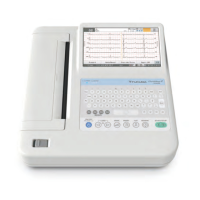
Warnings about the 12-Lead ECG Analysis Function
The 12-Lead ECG analysis function is designed to acquire and interpret ECG data from a resting, supine
patient. If ECG signals from moving or shaking patients are acquired, erroneous 12-lead interpretation result
may occur. Always ensure that the patient is kept motionless during 12-lead ECG signal acquisition and
analysis.
The 12-lead ECG analysis function is intended for use with adult and pediatric patients.
All computerized ECG analysis results should be reviewed by a physician before making decision for the
patient treatment.
Warnings about the BIS Monitoring (HBX-800)
Clinical judgment should always be used when interpreting BIS in conjunction with other available clinical
signs. Reliance on BIS alone for intra-operative anesthetic management is not recommended.
BIS values should also be interpreted cautiously with certain anesthetic combinations, such as those relying
primarily on either ketamine or nitrous oxide/narcotics to produce unconsciousness.
As with any monitored parameter, artifacts and poor signal quality may lead to inappropriate BIS values.
Potential artifacts may be caused by poor skin contact (high impedance), muscle activity or rigidity, head and
body motion, sustained eye movements, improper sensor placement and unusual or excessive electrical
interference.
WARNING
WARNING



 To Next Page