PLDC01938
REVISION 00
01/06/2011
TECHNICAL DEPT.
Stavale
- date 05/09/2011
95/195
1
Before replacing the actuator A, check visually that there are no burnt areas on the motor Z and that the
wires are tightly crimped to the terminals of the connectors B and C and are not damaged. Then check
electrical operation of the actuator manually.
2
Check that the rod A1 emerges easily by unscrewing it by hand.
3
If points 1 and 2 are OK, proceed with the electrical test as described below.
4
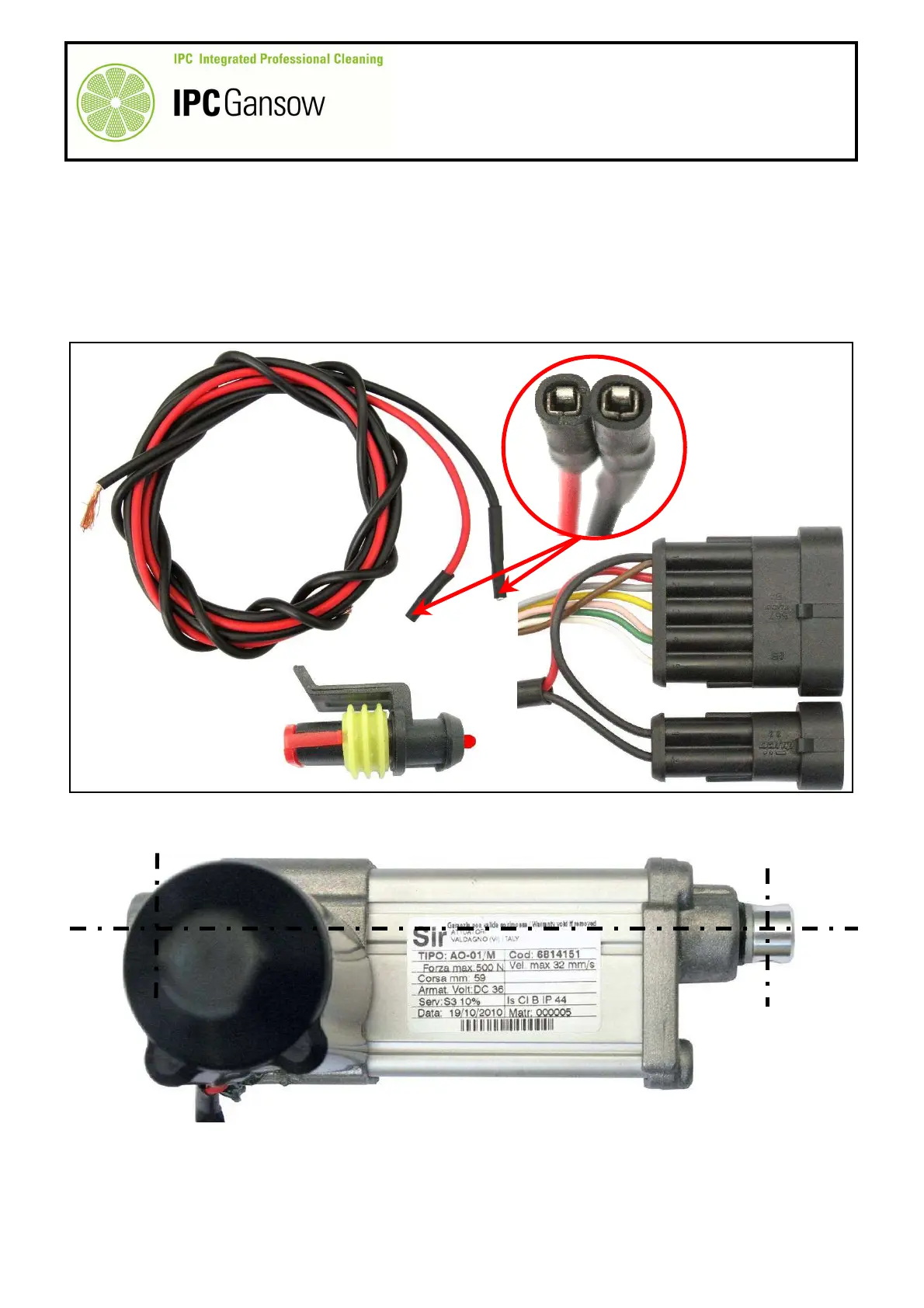
Obtain two wires (D) (D = D1 - D2) with different colours (see photograph below) with plugs compatible with
the terminals of the connector B.
5
Also obtain a bridge E for the fuse connector C. Connect E and C.
6
Place the actuator A with the axis of the hole in the rod A1 on the same plane as the hole in the rigid
support A2.
For testing, the actuators can be powered at a voltage of less than 36 V.
A single 6 V battery is sufficient, providing it has a good amperage (A) as the low voltage (V)
must be compensated for by the amps (A).
D
D2
D1
B
C
PHOTO 201
E
i
A A1
A2
PHOTO 202
Z


 To Next Page