PLDC01938
REVISION 00
01/06/2011
TECHNICAL DEPT.
Stavale
- date 05/09/2011
29/195
9
Test with the brushes mounted.
10
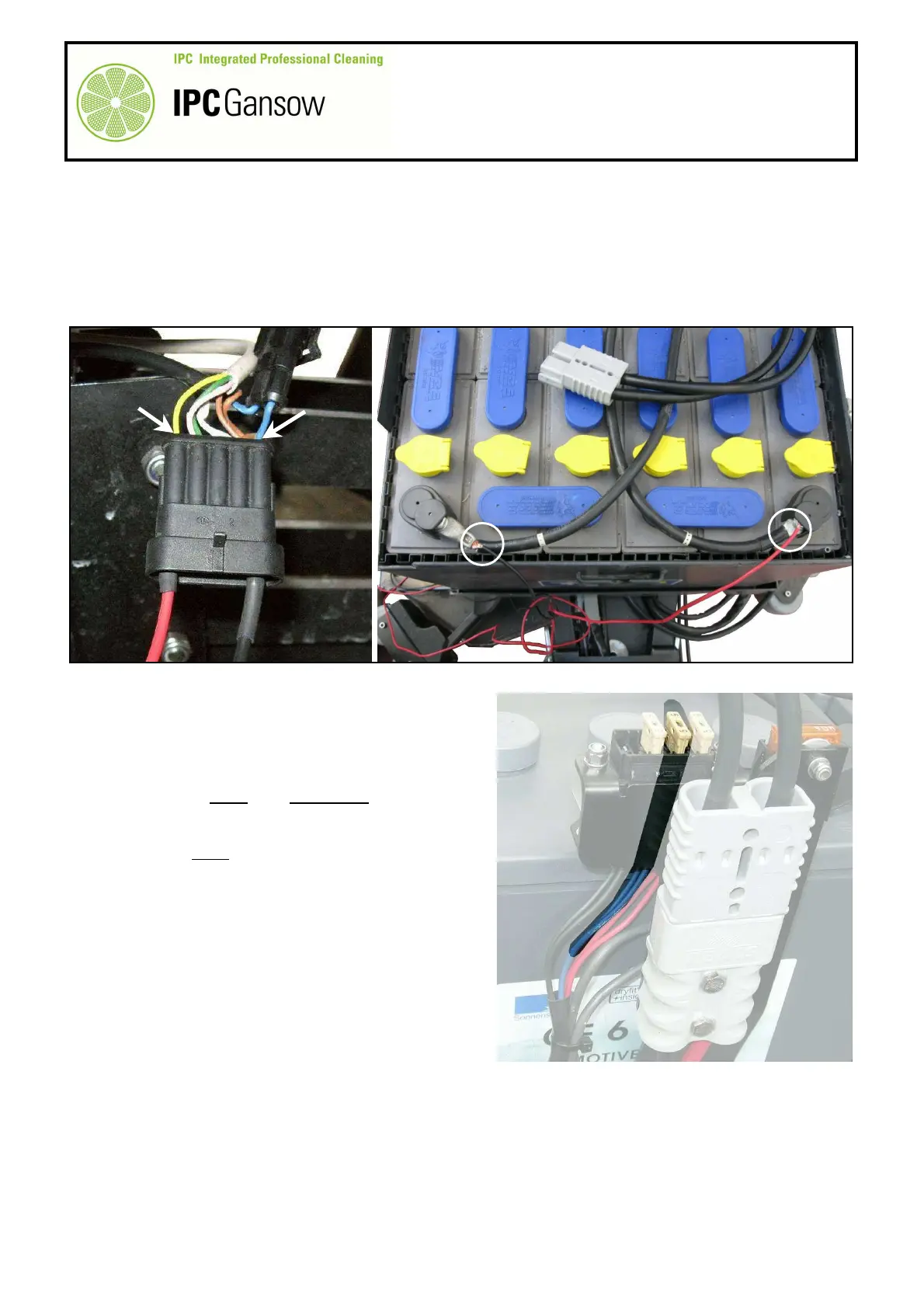
Connect the two wires A1 - A2 to the connector B, connecting the terminal of the red wire A1 to the plug of
the yellow wire B5 in position 5 of the connector B, and the terminal of the black wire A2 to the plug of the
blue wire B1.
11
Connect the other end of the red wire A1 to the positive pole F of the battery and the other end of the black
wire A2 to the negative pole G.
12
If the actuator does not move, check the fuse H.
13
If the fuse H is burnt out, disconnect the actuator from
the batteries, replace the fuse with a new one and
check actuator operation again.
14
If the fuse burns out at the beginning of the test, the
actuator motor might be in short circuit. Disassemble
the actuator as explained in the following paragraph.
15
If the fuse is not blown, but the actuator does not
move, there might be a problem with the micro
switches in the actuator. Disassemble the actuator as
explained in the following paragraph and check the
internal micro switches as explained in paragraph
A2.4.
16
If the actuator requires disassembling (see paragraph
A2.3) for one of the above-mentioned reasons, you are
recommended to test it on the bench (see paragraph
A2.4).
17
On the other hand, if the actuator is working correctly,
the head should move downwards.
18
Keep the actuator connected to the batteries until the
travel is stopped automatically by the internal micro switch.
19
Check actuator operation in the opposite direction (raising).
A1
A2
B
B5
B1
5
A2
F G
A1
PHOTO 63
D
H


 To Next Page