PTS 400.3 PLUS Operation Manual_R02 Page 207/306
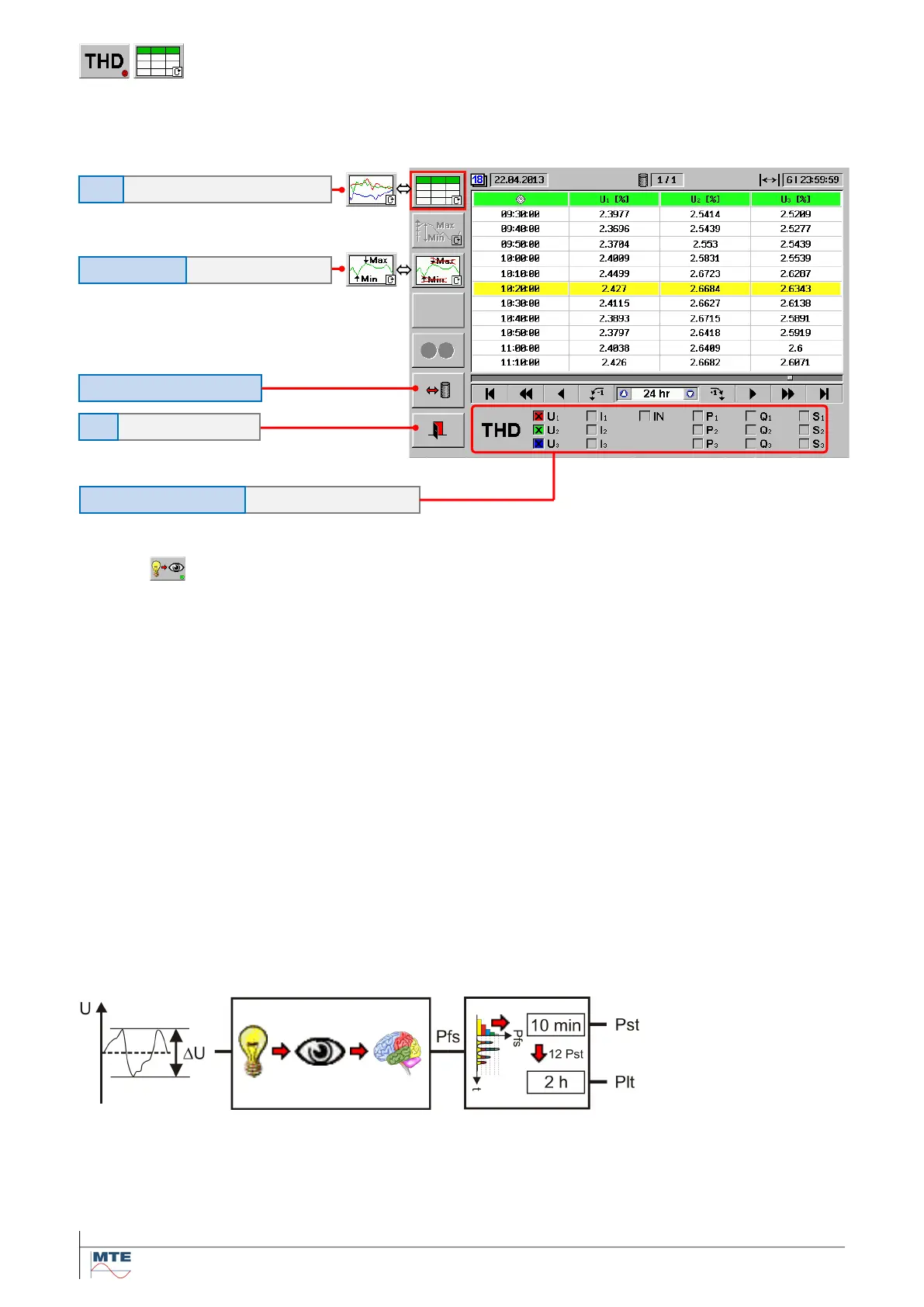
Total Harmonic Distortion table view
Example: Analysis of recorded THD values of voltages U1, U2, U3 over 1 week
12.1.4
Flicker
The luminance variation of a light source, caused by relatively small (U/U: 0.2 … 3.5 %), low fre-
quency (f: 0.01 … 40 Hz) voltage variations is called flicker.
The human perception and reaction to flicker of long duration (several minutes up to hours) is very
subjective and can cause discomfort, headache, up to an epileptic attack.
Flicker is therefore an important power quality problem since the beginning of electricity generation.
It is a very complex task to measure this human perception of flicker correctly.
To get objective, comparable flicker results, based on measurements of the voltage variations, the
measurement and statistical evaluation of the perception of flicker was modeled in the standard
IEC 61000-4-15 based on a 60 W filament light bulb (60W, 230V at 50 Hz or 60W, 120V at 60 Hz).
The flicker measurement is realized regarding the standard IEC 61000-4-15, which is a statistical
evaluation of the human reaction to flicker based on the reaction of a 60W lamp to voltage variations
and the reaction of the human eye and brain to the luminance variation of this lamp. This allows the
objective evaluation of flicker based on measurements of the voltage fluctuations.
IEC 61000-4-15 Flickermeter
The perception limit, where 50% of the people find the light fluctuations disturbing, is defined as per-
ception level P = 1. The flicker perceptibility or flicker severity is indicated in perception units.
A model of the lamp – eye – brain response defines the relation between voltage variations and in-
stantaneous flicker sensation Pfs, followed by a statistically evaluation of the Pfs signal over a 10 min
interval. The main outputs are:



 To Next Page