PTS 400.3 PLUS Operation Manual_R02 Page 147/306
Change of start and end readings
The start and end readings can be changed before, during and after the test.
This can be used to:
Correct wrong entries
Enter an expected end reading
E.g. if the load cannot be controlled, a start reading a little bit higher than the actual
reading of the meter register can be entered, and the register test can be started by
starting the energy measurement, if this reading is reached at the meter under test.
Then an end reading can be entered and the test can be stopped by stopping the en-
ergy measurement, if the end reading is reached at the meter under test. In this way no
load control is necessary. This method could be applied for onsite tests with customer
load, which cannot be influenced.
Test several registers of different meters one by one by entering the corresponding
register readings.
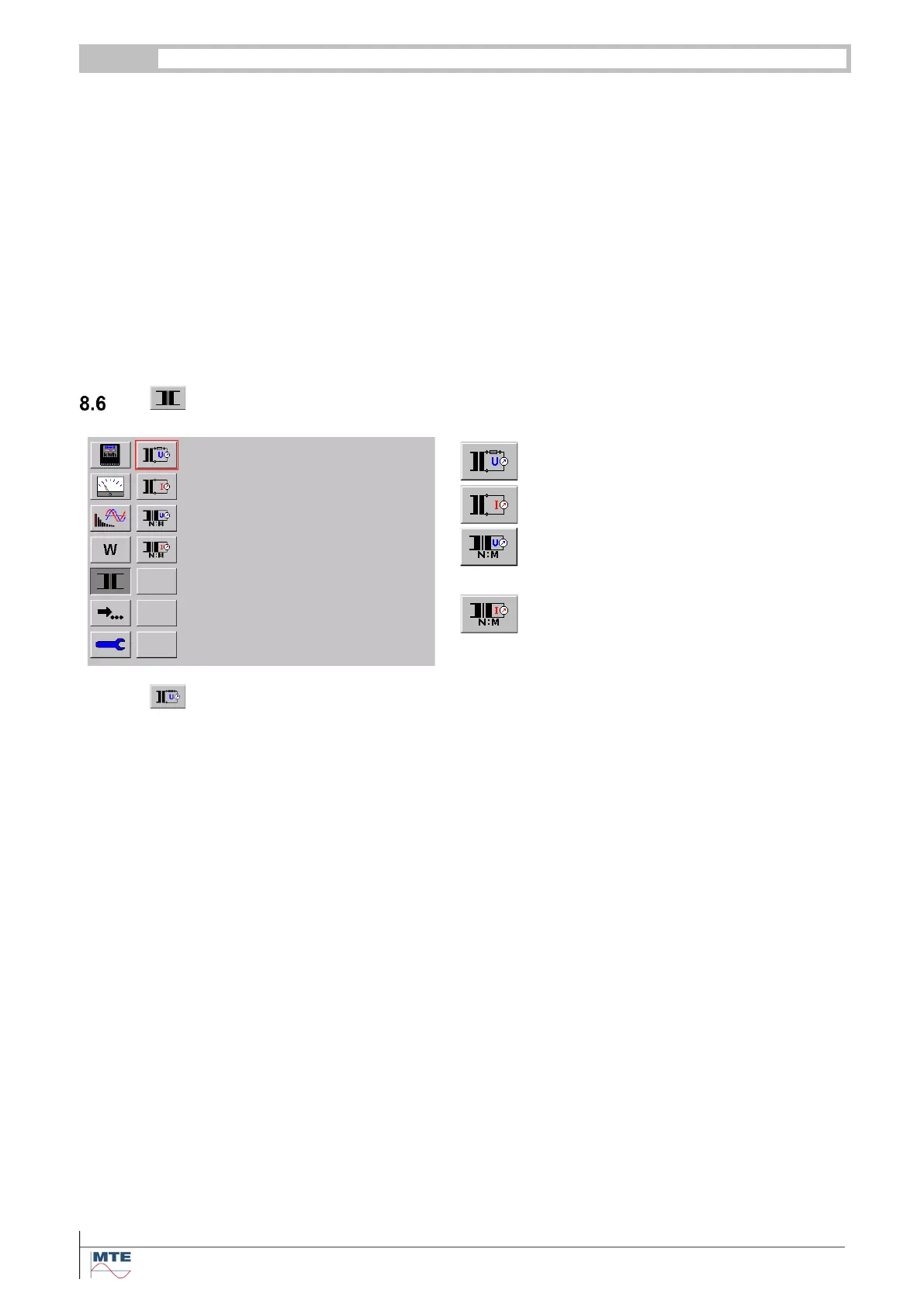
Instrument Transformer Testing
PT ratio measurement (function only
available if VoltLiteWire 40 kV sensor
is detected)
CT ratio measurement (function only
available if at least one clamp-on CT is
detected)
8.6.1
Potential Transformer (PT) burden measurement
The rated secondary voltage (Un) and rated burden (SN) of the potential instrument transformer (PT)
must be entered. These values can normally be found on the nameplate of the transformer.
Optionally the influence of the wires between secondary side of the transformer and the measuring
point can be regarded by entering resistance of fuse and junctions (RF), length (l) and cross section
(A) of the wire.
The instrument measures the burden current (I), the actual secondary voltage (U) and the burden
factor (cos).
As main result the ratio (Sb) of total rated operating burden (Sn) to rated burden (SN) is calculated
and indicated in %.
Regarding the international standard IEC 60044-2 the Sb value should be in the range:
25 % SN Sb 100 % SN
After the exchange of a mechanical meter with an electronic meter in a substation the burden of the
voltage measurement transformer is often too low and measures must be taken to raise the burden
to be in the admissible range again.
For the necessary connections between transformer and instrument see the connection example in
chapter [17.2.10].



 To Next Page