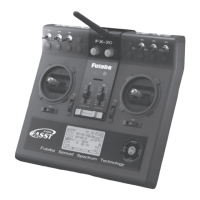
Order No.
35 MHz: F 8042
40 MHz: F 8043
41 MHz: F 8044
FX-30
• The monitor LED on the receiver will now flash once, and a
servo connected to channel 1 moves briefly around the
centre point three times; this indicates that the receiver has
picked up the signal and switched its frequency appropri-
ately.
•
The screen now asks once more whether you want to acti-
vate the radio transmission or not. Confirm your choice,
and the transmitter and receiver work on the newly sele-
cted spot frequency.
Note!
The frequency information is transmitted at very low power,
with an effective range of about one to two metres. For the
system to work, it is absolutely essential to extend the recei-
v
er aerial and fit the transmitter aerial (if you have not already
done so).
The monitor LED on the receiver should flash once the spot
frequency has been transmitted. If it does not, or if the recei-
ver failed to generate the previously described confirmation
signals, then the frequency change has not taken place.
Repeat the procedure, this time placing the transmitter and
receiver closer together.
The spot frequency information is transmitted on channel 80 in
the 35 MHz band, and if this channel should already be in use
by another transmitter, it is possible that the FX-30 will not
transmit with sufficient power to complete the frequency chan-
ge-over. In this case you need to place the two aerials very
close together, or carry out the procedure using the DSC lead.
In the extreme case you may need to place the tip of the trans-
mitter aerial directly on the receiver.
If you are using a R 1410 DPS receiver, you must first install
the appropriate receiver crystal, i.e. the crystal correspon-
ding to the spot frequency you have selected at the trans-
mitter.
19


 To Next Page