Order No.
35 MHz: F 8042
40 MHz: F 8043
41 MHz: F 8044
FX-30
Faults caused by damp or crash-induced shock may not be
obvious to the layman, but after a short period of further use
they may cause catastrophic failure. It is important to use only
the components and accessories which we expressly recom-
mend, and always use genuine robbe-Futaba connectors. It is
not permissible to make modifications of any kind to the sys-
tem components.
ROUTINE PRE-FLIGHT CHECKS
If there are several modellers at your site, ensure that yours is
the only transmitter on “your” frequency before you switch the
transmitter on.
• Always extend the transmitter aerial fully before operating
your model, and check that it is firmly engaged in its
socket.
• Ensure that the throttle stick is at the stop / idle end-point
before you switch the receiver on.
• Always switch the transmitter on first, then the receiver.
• Always switch the receiver off first, then the transmitter.
• Carry out a range check before the flight or run.
• Have you selected the correct model memory?
• Check all the working systems. Ensure that the control sur-
faces respond to the stick commands in the correct
“sense” (right stick = right rudder etc.), and that the travels
are as recommended.
• Are all the mixer functions and switches set correctly?
• Are the batteries sufficiently charged?
• If you are not sure of any point - don’t fly, as this would
endanger yourself and anybody else at the site.
OPERATING THE MODEL
• Never fly above spectators or other pilots.
• Do not fly in any way which could endanger humans or
animals.
• Never fly close to high-tension overhead cables or resi-
dential areas.
• Don’t operate your model in the vicinity of canals, locks or
other public waterways.
• You must not operate your model from public roads,
motorways, paths, squares etc.
Never operate your equipment in stormy weather.
The transmitter aerial must always be extended fully when you
are actually controlling a model. Don’t “point” the transmitter
aerial straight at the aeroplane when flying. The signal genera-
ted by the transmitter is at its weakest in an imaginary line
extending straight from the aerial. It is always best for the pilot
to stand in a position where the long side of the aerial points
towards the model.
If several radio control systems are in use at the same time on
adjacent channels, the operators or pilots should always stand
together in a loose group. Pilots who insist on standing away
from the group endanger their own model as well as those of
other pilots.
INSURANCE
Ground-based models are usually covered by standard perso-
nal third-party insurance policies. To fly powered model air-
craft you will need to extend the cover of your existing policy,
or take out a specific policy. Check your insurance and take
out new cover if necessary.
4
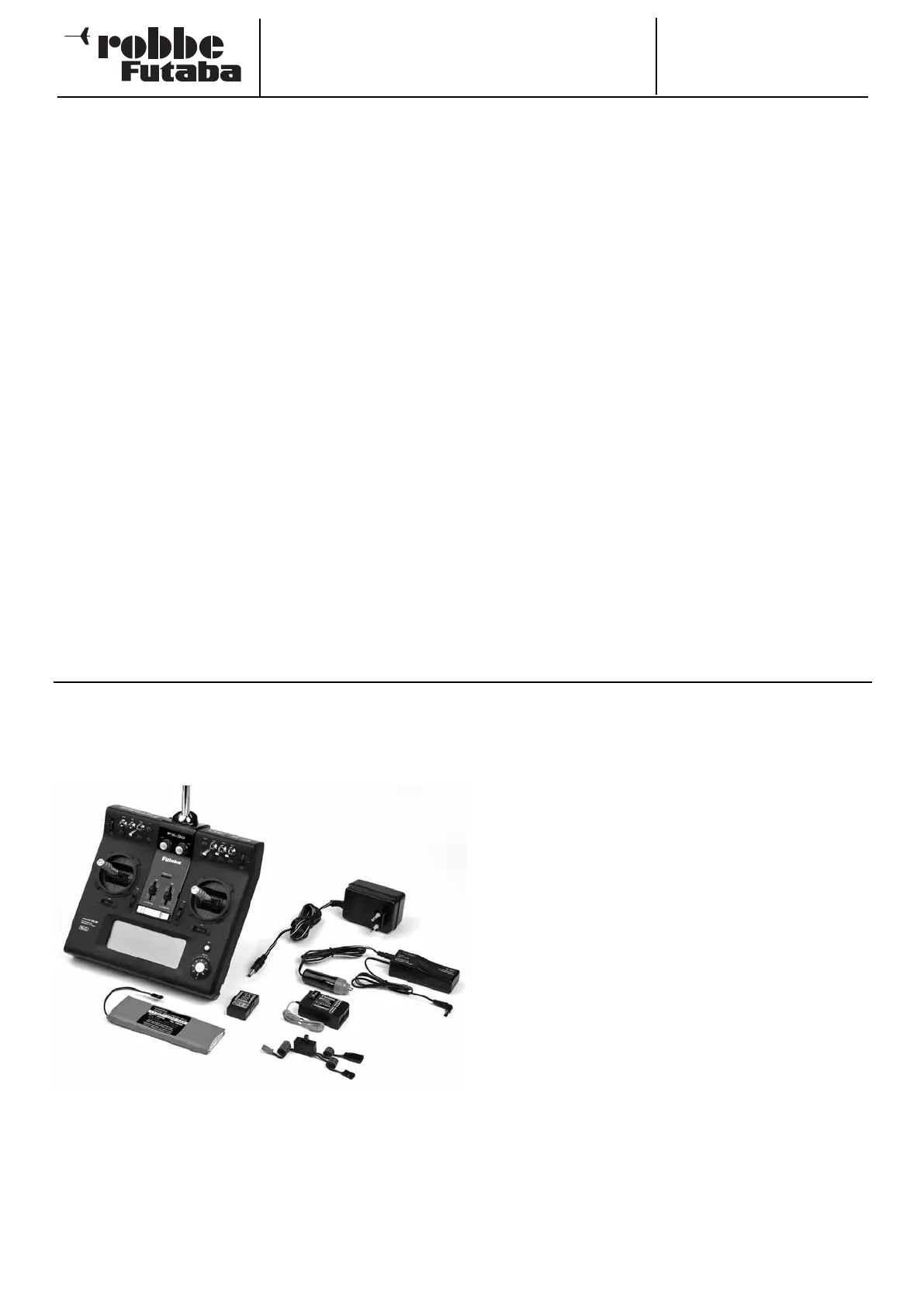
1. SET CONTENTS
Set contents: FX 30
35 MHz No. F 8042
40 MHz No. F 8043
41 MHz No. F 8044
1 FX-30 transmitter
1 FX-FM Synthesizer RF module
1 LiPo transmitter battery, 7.4 V / 3400 mAh
1 R 1410 DP PCM-1024 receiver
1 Switch harness with charge socket
1 12 Volt Lithium battery charger, 2 A
1 110 … 230 Volt AC switch-mode PSU, for charging from
the mains supply
RECOMMENDED ACCESSORIES:
Trainer lead, FF9 -> FF9 No. F 1591
Trainer lead, FF9 -> DIN (6-pin) No. F 1592
Trainer lead -> FX series (2.5 mm) No. 8236
Trainer lead -> F-series (3.5 mm) No. 8238
Flight simulator adaptor lead, FF-9 No. 8239
FX-30 transmitter tray, carbon fibre No. 8491
FX-30 transmitter charge lead No. 8260
Receiver battery, 4.8 V / 1400 mAh No. F 1307
Replacement transmitter battery No. 4846
Stick switch, 2-position No. 8315
Stick switch, 3-position No. 8316
Stick switch, push-button No. 8317
Aero-Team aluminium transmitter case
(transmitter excl. tray) No. F 1556
Aluminium case (FX-40), for transmitter with tray No. F 1565


 To Next Page