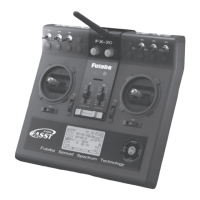
Order No.
3
5 MHz: F 8042
40 MHz: F 8043
41 MHz: F 8044
FX-30
80
26. Programming sequence - model helicopters
Set the model type:
• Select MODEL SELECT in the Base menu.
•
Select New Model.
• Select the model type (Heli).
• Select the swashplate type to suit your model.
S
et the frequency:
• Select FREQUENCY in the Base menu.
• Select the appropriate spot frequency.
S
et the modulation:
• Select FREQUENCY in the Base menu.
• Select the modulation, e.g. PCM 1024
S
et the model name:
• Select MODEL SELECT in the Base menu.
• When confirmed, the newly set-up model is assigned a
default name of NEW 1, NEW 2 etc.
• Select the model, confirm with EDIT.
• Select NEW NAME.
• You can now assign a name to your model in the field.
• After entering the name, select ENTER and confirm with
EDIT.
Function sequence, assigning transmitter controls
The transmitter automatically allocates the appropriate function
sequence and transmitter control assignment when you select
the model and type.
Important: if you change the function sequence, any existing
AFR curves will be erased. For this reason you should always
select the sequence first, and only then select the transmitter
control settings.
TIP: if it should prove necessary to interchange functions, we
recommend that you initially select the functions to be moved,
then ‘park’ them on a free channel before reconfiguring the
model in the correct sequence.
• Select FUNCTION in the Base menu.
• Re-configure the function sequence if necessary.
• Now assign the transmitter controls and trim controls, and
determine whether they are to affect all flight modes (Global)
or only one flight mode (Separate).
• Select SERVO REVERSE in the Base menu.
• Set the direction of servo rotation: Normal / Reverse.
• Important: it is essential to set the correct servo directions
before you adjust the servo centre offset values.
• Select SERVO CENTRE in the Base menu.
• Adjust the servo centre setting if necessary.
• Select END-POINT ATV in the Base menu
Adjust the servo travels in such a way that the maximum
mechanical travel is available, but without the servos binding or
being stalled.
• In the interests of safety, we recommend that you invoke the
Limit function to restrict maximum travel, so that mixed
functions do not exceed the set travel.
• Adjust the servo transit speed if necessary.
• Select FAILSAFE in the Base menu.
• Enter your preferred settings for Fail-Safe and Hold mode,
plus Battery Fail-Safe.
Power models: fail-safe is automatically set on the throttle
channel; check the settings and adjust them if necessary.
• Select MOTOR CUT in the Base menu.
• Assign a switch, and set the ‘motor stopped’ position in
order to be able to cut the motor reliably.
• Select TRIM DISPLAY in the Base menu.
• Set the trim increment size (STEP) for the individual rotary
trims.
• Select SWASHPLATE in the Base menu.
• Swashplates operated by mixers: adjust the travels for
ROLL-AXIS, PITCH-AXIS and COLLECTIVE PITCH to suit
t
he requirements of your model.
• Adjust the values for the swashplate end-points and linkage
compensation.
• Select TRANSMITTER CONTROL AFR in the MODEL menu.
• Adjust the travels and curves for the individual transmitter
controls to suit the requirements of the model.
• Select DUAL RATE in the MODEL menu.
• If required, set up a second, switchable curve or travel for
individual transmitter controls.
• Select FLIGHT MODE in the MODEL menu.
• Activate and set up additional flight modes if necessary.
• If you wish to use multiple flight modes with different set-
tings or assignments, you must ensure that the SEPARATE
function is selected.
• In the MODEL menu, activate and adjust the individual
model-specific mixer functions, and configure the switches
and transmitter controls appropriately.
• Select THROTTLE CURVE in the MODEL menu.
• Set up the desired throttle curve. If you are using multiple
flight modes, ensure that the individual curves are set to
SEPARATE, to enable different settings to be used for each
flight mode.
• Select COLLECTIVE PITCH CURVE in the MODEL menu
• Set up the desired collective pitch curve. If you are using
multiple flight modes, ensure that the individual curves are
set to SEPARATE, to enable different settings to be used for
each flight mode.
• Select GYRO in the MODEL menu.
• Enter the settings for gyro gain and mode.
• Select SPEED GOVERNOR in the MODEL menu.
• Enter the settings for the speed governor, if fitted to your
model.
You may wish to activate and set up additional functions such
as auto-rotation, plus other model-specific mixers such as col-
lective pitch -> tail rotor.
On the next page you will find a detailed description of how the
swashplate mixer is set up in a professional manner.


 To Next Page