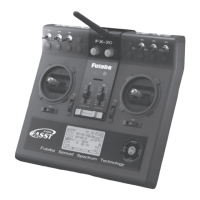
Order No.
35 MHz: F 8042
40 MHz: F 8043
41 MHz: F 8044
FX-30
73
18. TIPS ON INSTALLING THE RECEIVING SYSTEM
In the last few years the technical equipment carried in our
models has undergone enormous changes. These include
b
rushless motors and controllers, Lithium flight batteries, tele-
metry systems, GPS systems etc. etc., to mention just a few
broad categories.
At the same the materials used in our models have altered, with
the widespread introduction of carbon fibre into the modelling
world. More and more carbon parts, Lithium batteries and
brushless motors are now employed, with the aim of producing
strong, lightweight, high-performance models.
In model helicopters the toothed-belt drive system for the tail
r
otor has virtually become standard.
At the design stage the installation of the servos, motor and
flight battery is generally laid down, but the receiver is often left
to last, and has to be squeezed into whatever space remains. At
the same time we all assume that the RC system will provide
completely reliable control of the final model / power system
configuration.
However, this is not a safe assumption on its own, as there are
vast numbers of possible combinations of metal, plastic and
carbon components, and many of them - especially in conjunc-
tion with toothed-belt drive systems - can have a more or less
pronounced adverse effect on quality of reception. Combining
the various electrically conductive and non-conductive materi-
als can cause potential spark points where static charges build
up at the junction between different materials, and these can
have a massive effect on reception.
Although the receiver position is very important to reception
quality, it is not the only problem area: another crucial aspect is
the deployment of the aerial. Neither is it true that all receivers
are the same: small, slim, lightweight types are required for
some applications, whereas top priority for other types of model
might be a large number of channels. The result is that the
range of receivers available commercially is extremely broad,
and every type of receiver features its individual characteristics
in respect of sensitivity to the transmitter signal and rejection of
potential interference (electro-smog).
Reception quality is also affected by the number of servos in the
model, and the length and position of their cables. In some air-
craft large parts of the fuselage or fuselage reinforcements are
manufactured from conductive materials (carbon fibre, alumi-
nium foil, metal), and these substances shield the transmitter
signal, resulting in a significant loss of reception quality. The
same applies to fuselages which are finished in heavily pigmen-
ted or metallic paints.
Pushrods, carbon rovings and servo leads running parallel to
the receiver aerial affect the electrical field around the aerial,
and also tend to absorb the transmitter energy. This has the
overall effect of markedly reducing the energy of the transmitter
signal which the receiver aerial is able to exploit.
Even the weather has its part to play: in fine, dry weather condi-
tions air humidity is reduced, and this tends to produce more
electro-static charge in the model than in damp conditions. On
humid days, on the other hand, the ground reflects a greater
proportion of the transmitted energy.
This can have the effect of generating “reception dead-spots” -
varying according to the aerial angle and the distance to the
model - because the transmitted signals broadcast via the air
and reflected from the ground tend to cancel each other out or
amplify each other (timing differences between the two waves).
Indoor flying - in sports halls, for example - often takes place in
buildings of steel or steel-reinforced concrete construction,
where multiple reflections (roof - floor - walls) can very often
generate “reception dead-spots”.
It is impossible for radio manufacturers to test out all these
c
ombinations of models, materials, aerial angles, aerial posi-
tions etc., especially since the errors are cumulative: several
minor “imperfections” can add up, generating serious interfe-
rence. Only the individual modeller or model flyer can test and
eradicate these conditions for himself.
The following list contains a few elementary notes on
methods of obtaining optimum reception characteristics:
Receiver aerial:
•
If possible deploy the aerial in an L-shape to avoid attitude-
dependent problems.
• Do not deploy the aerial parallel to electrically conductive
materials, such as cables, metal “snakes”, control cables,
carbon pushrods etc., or along the inside or outside of elec-
trically conductive fuselages.
• Cables connected to the receiver (servos, batteries etc.)
should not be the same length as the aerial, nor half its
length, nor whole-number multiples of it. For example: recei-
ver aerial length 1 m; avoid the following cable lengths: 0.5
m, 1 m, 2 m, 3 m etc.
• Keep the aerial as far away as possible from:
• High-current speed controller cables and motor cables;
• Sparkplugs and glowplugs, ignition units and onboard
glowplug energizers;
• Locations where static charges are likely to build up,
such as toothed belts, turbines etc.;
• If the fuselage is made of a material with shielding quali-
ties, run the aerial directly out of the fuselage;
• Do not attach the end of the aerial to an electrically con-
ductive material (metal, carbon fibre);
Receiver:
• When positioning the receiver, please apply the same princi-
ples as described above.
• Wherever possible, do not position any other electronic
components in the immediate vicinity of the receiver.
• We strongly recommend the use of low-resistance NC or
NiMH batteries as the receiver power supply.
• Avoid using switch-mode BEC systems as the receiver
power supply; these are natural “frequency generators”,
producing a powerful, constantly changing spectrum of
interference which is then passed directly to the receiver via
the connecting lead. As the load and voltage of these sys-
tems are constantly fluctuating, they often do not constitute
an adequate receiver power supply in any case. The current
drain of synthesizer receivers is generally high, and they are
affected particularly badly by this problem.
• Speed controllers for relatively high cell-count batteries usu-
ally do not feature a BEC system for the receiver power sup-
ply. However, they still incorporate an “internal” BEC system
for powering the speed controller electronics, and this ope-
rates on the same principle; it just works at lower power.
Once again the receiver connection is the direct route from
the power source to the receiver. We recommend using a
suppressor filter, No. F 1413, to keep this form of interfe-
rence away from the receiver.
Some other filters only feature a ferrite ring, but the Futaba
suppressor unit also filters the input signal.
• Different receiver types also tend to respond unpredictably


 To Next Page