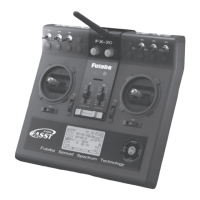
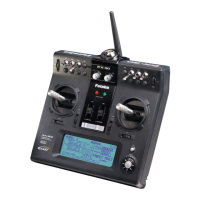
Order No.
35 MHz: F 8042
40 MHz: F 8043
41 MHz: F 8044
FX-30
74
1
8.1 RECEIVER AERIAL
The receiver aerial is conne-
cted permanently to the
receiver. Never shorten or
extend the aerial.
If this is not possible, we
recommend that you deploy
the aerial in an S-shape by win-
d
ing the wire onto a small plate
made of card, plywood or plas-
tic, as shown in the sketch
here, and locate it as close to
the receiver as possible.
Avoid aerial damage by fitting a tension relief and guide, e.g. a
short piece of fuel tubing, where the wire exits the fuselage. It
is essential to ensure that the aerial cannot foul the propeller.
18.2 SWITCH HARNESS
It must be possible to operate the receiving system switch
easily, without mechanical restriction, i.e. the cut-out in the
fuselage side must be large enough to avoid obstructing the
mechanism. In powered models with internal-combustion
engines, the switch should be mounted on the opposite side
to the exhaust, to avoid the danger of oil penetrating the hou-
sing and soiling the contacts. If your model is fitted with a large
number of high-power digital servos, we recommend the use
of a standard commercial dual-battery power supply system.
18.3 SERVO LEADS
When deploying servo leads, please ensure that they are not
under any mechanical strain and are not kinked or bent tight-
ly, as this might cause them to fracture over time. Make sure
there are no sharp edges which might damage the cable insu-
lation. All connectors must be firmly fitted and secure. When
disconnecting servo plugs, pull on the plastic housings - not
on the wires.
Servo leads should not just be left trailing loosely inside the
fuselage; it is far better to attach them neatly to, say, the fuse-
lage side or the chassis using adhesive tape or cable ties. It is
not permissible for modifications of any nature to be made to
the receiving system components. Avoid reversed polarity and
short-circuits of all kinds, as the electronics are not protected
against such errors.
18.4 SERVO SUPPRESSOR FILTERS
If you wish to use long servo leads or extension leads, please
note that interference may be picked up via the overlength
cables. Where servo cables are longer than two normal leads
(approx. 50 cm), you should at least use twisted cables (No. F
1452).
Even better: use suppressor filters, No. F 1413.
when connected to auxiliary electronic modules such as
glowplug energizers, turbine control units, telemetry sys-
tems, GPS, etc. If you experience problems, once again we
recommend that you try using the suppressor filter, No. F
1413, as a de-coupling measure.
Model:
T
o avoid the build-up of static charges in your model, please
take the following measures:
• Helicopters:
• Connect the tail boom to the chassis using an earthing
strap. If your model features a toothed-belt tail rotor
drive, attach a “copper brush” in order to dissipate the
charged energy from the toothed belt. You may also find
it necessary to connect the toothed-belt pulleys to the
chassis using an electrically conductive link.
•
In most electric helicopters it is necessary to connect
the tail boom electrically to the motor case.
• Turbines:
• Connect the turbine to the shielding plate using an earth
strap to avoid the build-up of static charges.
Range checking:
We strongly advise that you make it a matter of routine to carry
out a range-check before you operate any new model, and
whenever you have fitted a new receiver. Note that the model
should not rest on the ground for this; instead position it at a
height of about 1 - 1.5 m. A good idea is to use a plastic or
wooden table as a support, with the model further raised on a
cardboard or wooden box.
Never use a metal support such as a camping table. There
should not be any conductive materials close by (metal fences
etc.).
• First switch the model on, but with the motor not running.
• Walk slowly away from the model holding the transmitter,
operating one control surface slowly but constantly.
• While you move away, watch the associated control surface
and observe whether it deflects or stays still. If possible, ask
a friend to help you; he or she should be able to see the
model clearly, and observe the control surface you are ope-
rating.
• As you increase ground range, rotate the transmitter to left
and right occasionally in order to simulate different aerial
positions relative to the model.
• To avoid ‘hold-mode moments’, the effective range of the
FX-30 under these conditions should be around 80 to 120
metres with the transmitter aerial collapsed, assuming a
PCM 1024 PPM receiver.
• With PCM G3, R5014 and R5114 receivers the ground-
range should be about fifty metres with the aerial removed.
• If this part of the range check is successful, repeat it with
the motor running (caution: the model must be held secu-
rely for this test).
• The range you now obtain should only be slightly lower than
the previous figure (approx. 20%). If it is significantly redu-
ced, then the power system is causing interference to the
receiver. You should be able to minimise this effect by run-
ning through all the measures outlined above, and optimi-
sing them as far as the model allows.
• The final step should be a range check with the transmitter
aerial fully extended and the motor running: the ground-
range should now be at least 500 metres.


 To Next Page