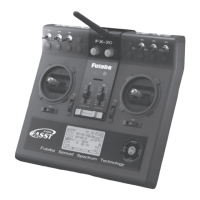
Order No.
35 MHz: F 8042
40 MHz: F 8043
41 MHz: F 8044
FX-30
2. GENERAL DESCRIPTION
The FX-40 is a high-class radio control system which sets new
standards in many areas.
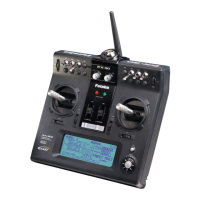
2.1 FX-30 TRANSMITTER
• Third-generation PCM system (PCM-G3) offering unsurpas-
sed transmission speed and accuracy. Compared to the
previous PCM 1024 system, the number of steps (incre-
m
ents) has been doubled from 1024 to 2048, but at the
same time the repeat time has been reduced from 28.5 ms
to 17.6 ms - an improvement of around 40%.
In all RC systems there is inevitably a response lag, i.e. a
delay between the movement of the transmitter stick and
the initial movement of the corresponding servo, but this
has also been reduced by 25%.
The net result is virtually real-time control, i.e. the control
signals arrive at the servos practically at the same instant
a
nd with virtually zero lag, giving the pilot a completely new
feeling of direct control.
PCM-G3 modulation is only possible in conjunction with
the R 5014 DPS or R 5114 DPS receivers.
As you would expect, it is possible to switch the modulation
to the PCM 1024 system and to 8 / 12 channel PPM (FM), to
enable existing receivers to continue to be used.
• The system is unusually easy to use thanks to the clearly
arranged graphical user interface, which is very easy to
understand, and is of consistent, uniform design throug-
hout.
The system includes a completely new, extremely simple
mixer select system based on an initial selection of the
model type using a graphic image of the layout. Simply
select the wing and tail type, and the transmitter sets up the
correct mixers and channel sequence automatically.
The primary means of data input is the 3-D hot-key, with
integral ‘EDIT’ function.
• The transmitter spot frequency is generated using a Direct
Digital Synthesizer (DDS), i.e. no crystals are required. It is
possible to select all channels approved for use in Europe in
the 35 (A + B), 40 and 41 MHz bands if the appropriate RF
module is installed. The selected spot frequency is ampli-
fied selectively in the RF amplifier module, which generates
the level of output power approved for radio control use.
• Thirty internal model memories provide ample space for
model-specific data, but in any case additional model
memory capacity for up to 1958 models is possible on a 1
GB SD card. The SD card can also be used as a simple
method of transferring model data from one transmitter to
another. SD cards are available in any specialist photogra-
phic or electronic shop.
• The transmitter is fitted with new precision-made dual-axis
stick units featuring four ballraces and special long-life
potentiometers of industrial quality. The potentiometer
cable guidance system is very elegant: the cable only
moves through about 45°, which helps to avoid cable fra-
ctures.
• The FX-30 transmitter features the new Rotary Trim System,
which combines the traditional method of operation with
the advantages of digital storing. When you switch model
memories, or switch the system on again after a pause, the
correct trim values are immediately available again automa-
tically.
Trims are provided for all stick functions, and each can be
set to normal, centre or ATL (asymmetrical) function. The
i
ntegral screen provides a clear on-screen display of trim
positions. Trim values are stored in the model memory, eit-
her globally (for all flight modes) or separately (for each
flight mode individually).
• Freely programmable 17-point AFR transmitter control cur-
ves, with separate speed adjustment for each of the twelve
proportional channels.
•
Ten freely programmable 17-point curve mixers; six diffe-
rent D/R settings can be superimposed on them, with sepa-
rately variable delay and speed for both directions of the
servo (‘there’ and ‘back’).
‘Stick-to-stick’ or ‘stick-to-servo’ mix mode, with separate
delay and speed adjustment when the mixer is switched on
and switched off. The mixers can be connected in series
(cascaded), and switches, transmitter control functions or
virtual functions can be selected as transmitter controls.
With Offset function and fine-tuning adjustment: mixer
inputs can be adjusted externally using assigned rotary
controls, switches or transmitter sticks.
• Eight flight modes with selectable priority and variable tran-
sition delay, plus unrestricted name and copy functions.
• Trainer (teacher - pupil, buddy-box) facilities fitted as stan-
dard, plus integral DSC socket. The Trainer system features
individual channel transfer and optional mix operation.
• Li-Po battery technology; mains battery charger included in
the set.
• Programmable count-up or count-down stopwatch with
operating hours timer and model memory timer.
Note:
The FX-30 transmitter features an energy-saving measure in
the form of an automatic RF cut-off circuit. If no transmitter
control (stick, switch, adjustor etc.) is operated for a period
of thirty minutes, the transmitter switches the RF section off,
the screen displays the message “PLEASE SWITCH TRANS-
MITTER OFF”, and the green LED indicator goes out. This is
particularly relevant when you are using the transmitter in
Trainer mode; please bear in mind that it is essential to ope-
rate one control occasionally (at least once every thirty
minutes), otherwise there is a danger of the Teacher trans-
mitter switching itself off.
2.2 R-1410 DP PCM-1024 RECEIVER
Small, lightweight dual-conversion PCM receiver (PCM-1024
system) weighing only 34 g, with end-mounted sockets for up
to ten servos.
The outstanding features of this receiver are excellent reliabi-
lity, compact dimensions and low weight. It is a ten-channel
version of the proven R149DP reference receiver
5


 To Next Page