Order No.
35 MHz: F 8042
40 MHz: F 8043
41 MHz: F 8044
FX-30
Note:
Never disconnect the battery from the transmitter when the
monitor LED is still flashing, as this could corrupt stored values
or cause damage to memory modules. If this should occur,
cease using the transmitter and send it to your nearest robbe
Service Centre.
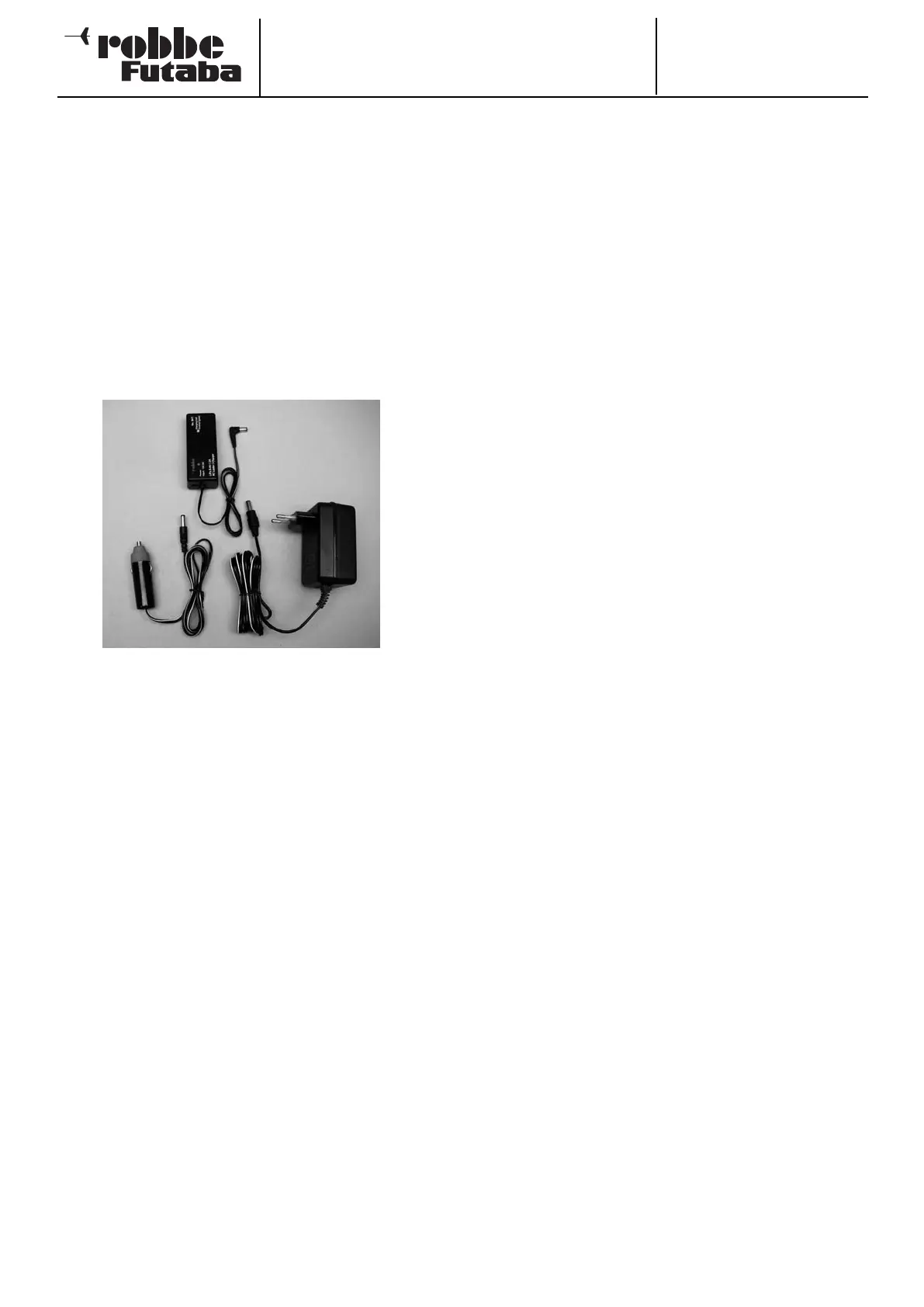
4.2 RC charger, charging the transmitter battery
The RC charger included in the set is suitable for charging 7.4
Volt Lithium batteries, and features a voltage-controlled auto-
matic cut-off circuit (8.4 Volts). The charge current is approxi-
mately 2 A.
It can be connected:
• to a 12 V car battery or 12 V DC mains PSU via the car cigar
l
ighter adaptor (supplied);
• or to a mains socket (110 … 230 V AC) using the mains adap-
tor (also supplied).
Notes on handling and charging the transmitter battery
• Connect the 230 V mains charger to a mains power socket.
• Connect the plug to the 12 V Lithium charger.
• The red monitor LED will now light up.
• Locate the charge lead attached to the 12 V charger, and
connect it to the transmitter.
• The charge monitor LED now lights up red to indicate that
charging is in progress; the charge current is around 2
Ampere.
• The charge time is around 3.5 hours if the battery is initially
discharged.
• When the charge process is almost complete (90%), the
colour of the charge monitor LED changes colour to green;
the charge monitor LED goes out when the charge is 100%
complete. The battery can safely be disconnected at around
90%, since the remainder of the charge to 100% takes
approximately a further thirty minutes using the CC-CV char-
ge method.
Caution:
The LiPo transmitter battery is fitted with an integral balancer and
a protective electronic circuit, which protects against over-volta-
ge and deep-discharge.
The battery must only be charged using the RC charger supp-
lied in the set! Chargers such as the Power Peak Infinity and
similar are not suitable, as these devices are designed for high
cell-count packs, and generate a very high voltage at the cut-
off point, which could destroy the protective battery circuit.
• Li-Poly cells feature an extremely low self-discharge rate of
around 0.2% per day, and for this reason they can be stored
for long periods without problems. However, deep-dischar-
ging must be avoided, as the pack will sustain permanent
damage in the form of loss of capacity if discharged too far
(the protective electronic circuit avoids this). After about five
months of storage - but at the latest when the pack voltage
falls to 2.5 Volts / cell - it is essential to recharge the pack.
Before any protracted period of storage you should recharge
the battery to at least 50% of nominal capacity. After about
five months the pack should be recharged again.
• The theoretical useful life of a Lithium cell when operated at
low discharge currents is around 500 charge / discharge
cycles.
• Since Li-Poly cells do not suffer from the memory effect (lazy
battery effect), it is not necessary to discharge them before
charging (cycling, balancing, as required with NC and NiMH
batteries). In fact, it is harmful to discharge the packs first,
and this should be avoided. The capacity of Li-Poly cells
declines slightly with each charge cycle, so prior discharging
would result in premature capacity loss.
Safety Notes:
• Do not submerge the battery in water or any other liquid.
• Do not heat or incinerate the battery, or place it in a micro-
wave oven.
• Do not short-circuit the pack or charge it with reversed pola-
rity.
• Do not subject the battery to physical pressure; do not
deform or throw it.
• Do not solder directly to the battery.
• Do not modify or open the battery.
• Do not charge the battery to a voltage higher than 4.2 Volts
per cell, or discharge it to a voltage lower than 2.5 Volts per
cell.
• LiPo batteries may only be charged using a charger designed
expressly for this purpose. Never connect the battery direct-
ly to a mains PSU.
• Never charge or discharge the battery in direct sunshine, or
close to a heater or fire.
• Do not use the battery in any location which is subject to
severe static discharges.
• Any of these errors may cause the battery to be damaged,
explode or catch fire.
• Keep the battery well out of the reach of children.
If electrolyte should escape, keep it well away from fire; the
substance is highly inflammable and may burst into flames.
• Avoid the fluid electrolyte contacting your eyes. If this should
occur, rinse the affected part immediately with plenty of clean
water before seeking medical attention.
• If the fluid electrolyte should contact your clothes or any
other object, wash it off immediately using plenty of water.
• Never leave the battery on charge unsupervised.
• Charge the battery only on a fireproof surface.
To protect the environment, take defective and exhausted packs
to your local free battery collection point after ensuring that they
are completely discharged. On no account dispose of exhausted
batteries in the domestic waste. Exhausted batteries can be
recycled.
Operating times:
With a fully charged battery, the transmitter’s operating time is
around ten hours when used with the transmitter battery No.
4846.
The operating time of the receiver battery varies greatly accor-
ding to several factors: the number of servos connected to the
system, the stiffness of the control linkages, and the frequency of
control commands (servo movements). When the servo motor is
running, a servo draws a current of between 150 and 600 mA,
whereas its consumption falls to around 5 to 8 mA when the
motor is stopped. Once the servo reaches the position dictated
by the transmitter stick, the motor switches off, and the servo
only draws its idle current. It makes no difference whether the
servo is at neutral, one end-point or any intermediate point.
7


 To Next Page