J-Link / J-Trace (UM08001) © 2004-2017 SEGGER Microcontroller GmbH & Co. KG
49
1.6 Built-in intelligence for supported CPU-cores
In general, there are two ways to support a CPU-core in the J-Link software:
1. Intelligence in the J-Link firmware
2. Intelligence on the PC-side (DLL)
Having the intelligence in the firmware is ideal since it is much more powerful and
robust. The J-Link PC software automatically detects which implementation level is
supported for the connected CPU-core. If intelligence in the firmware is available, it
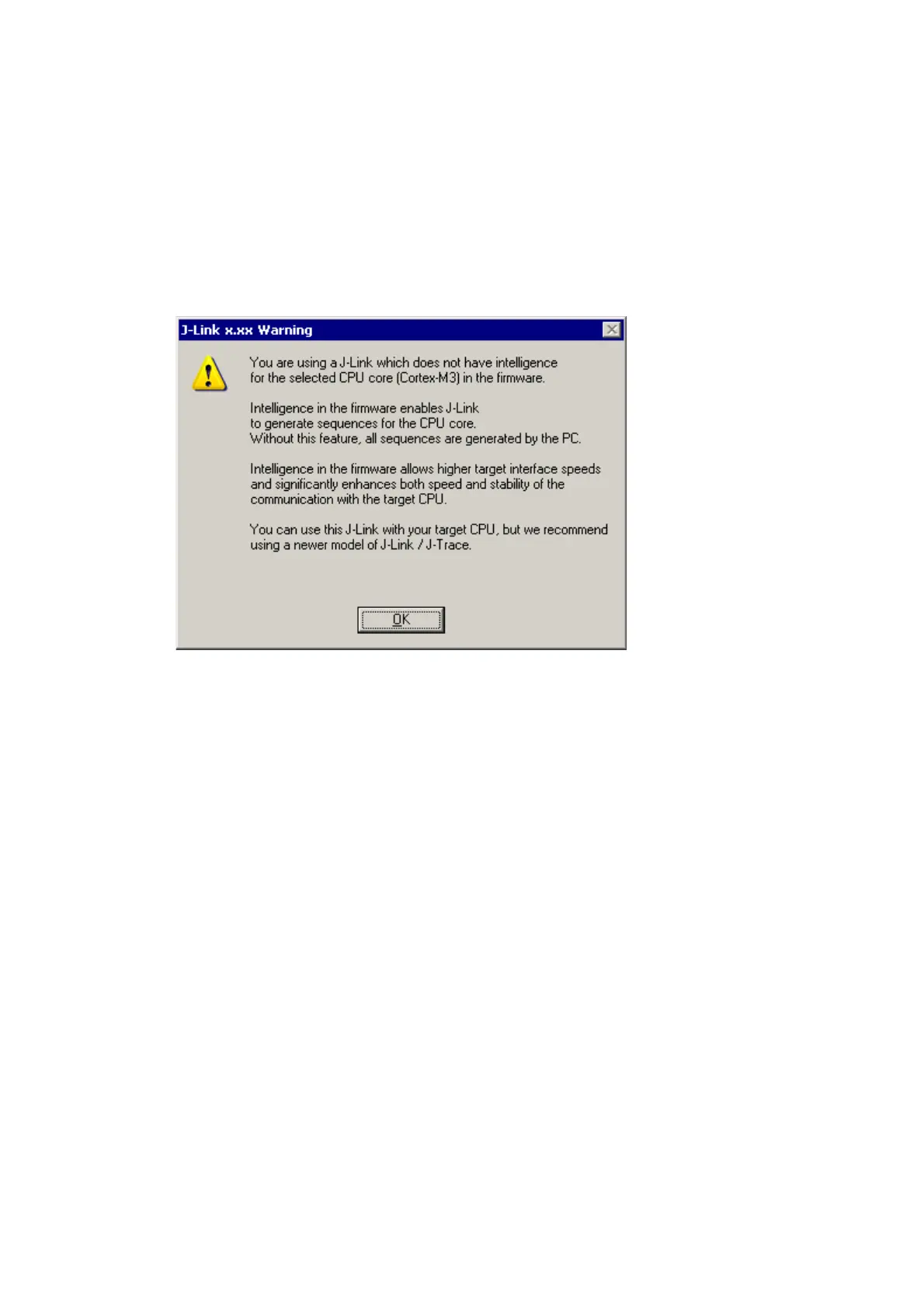
is used. If you are using a J-Link that does not have intelligence in the firmware and
only PC-side intelligence is available for the connected CPU, a warning message is
shown.
1.6.1 Intelligence in the J-Link firmware
On newer J-Links, the intelligence for a new CPU-core is also available in the J-Link
firmware which means that for these J-Links, the target sequences are no longer
generated on the PC-side but directly inside the J-Link. Having the intelligence in the
firmware leads to improved stability and higher performance.
1.6.2 Intelligence on the PC-side (DLL)
This is the basic implementation level for support of a CPU-core. This implementation
is not J-Link model dependent, since no intelligence for the CPU-core is necessary in
the J-Link firmware. This means, all target sequences (JTAG/SWD/...) are generated
on the PC-side and the J-Link simply sends out these sequences and sends the result
back to the DLL. Using this way of implementation also allows old J-Links to be used
with new CPU cores as long as a DLL-Version is used which has intelligence for the
CPU.
But there is one big disadvantage of implementing the CPU core support on the DLL-
side: For every sequence which shall be sent to the target a USB or Ethernet transac-
tion is triggered. The long latency especially on a USB connection significantly affects
the performance of J-Link. This is true especially when performing actions where J-
Link has to wait for the CPU frequently. An example is a memory read/write operation
which needs to be followed by status read operations or repeated until the memory
operation is completed. Performing this kind of task with only PC-side intelligence
requires to either make some assumption like: Operation is completed after a given
number of cycles. Or it requires to make a lot of USB/Ethernet transactions. The first
option (fast mode) will not work under some circumstances such as low CPU speeds,
the second (slow mode) will be more reliable but very slow due to the high number of
USB/Ethernet transactions. It simply boils down to: The best solution is having intel-
ligence in the emulator itself!


 To Next Page