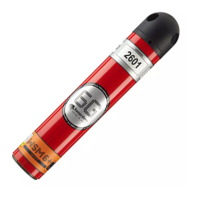
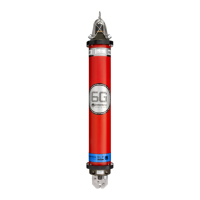
WSM6 Manual
Document Ref: UM-8270-000
Issue: A Rev 0
Section 8
89 October 2011
SECTION 8 – FAULT DIAGNOSIS
8. Introduction
The following section assists in diagnosis of a WSM6 when fully disassembled. For instructions on
disassembly refer to Section 6.5 – Dismantling.
8.1 Test Equipment
To assist in determining a fault with the WSM6 it is recommended to have the following list of
equipment:
Sonardyne ANT Type 7343 – firmware version 2.25 or greater, with ANT coupling loop
7343-042B or ANT test transducer Type 7935-000-B.
Bench Power Supply Unit – which can be set to any output voltage over a range up to
at least 25V dc and with a current limit facility which can be set to 100mA.
Digital Multimeter – capable of reading at least 25V and 100mA dc.
Dual Channel Oscilloscope – minimum 10MHz bandwidth, 10 mV/division minimum
sensitivity, with a x10 probe plus a x100 probe capable of use up to 4kV. A guarded
probe tip for connection to integrated circuit legs is strongly recommended.
Frequency Counter – capable of measuring up to 200kHz minimum, accuracy 0.1%.
Test Cable 1 – a Type MCIL5F connector with 300cm tail.
Test Cable 2 – PSU (18V) to the battery connector (4-pin Molex, pin 2 = +, pin 4= -)
8.2 Quick Voltage Checks
1. With the unit switched ON, measure the battery voltage using a Digital Multimeter, across the
terminal of the large capacitor – C16 on the Tx board.
2. Measure the voltage of the CPU logic rail by moving the positive probe to pin 3 of JP3, which
should read 5V ± 0.1V. JP3.3 is the unsoldered pad of JP3, closest to the central fixing screw
on the upper board, see Figure 8-3.
3.
Measure the 5V rail on the Tx card which is generated by a separate regulator, on the via
hole closest to TP3 on the lower board, refer to Figure 8-2.
8.3 Diagnostic Set-up
1. Check the ON/OFF switch is in the OFF position. Make sure the Power Supply Unit (PSU) is
OFF. Refer to Figure 8-1.
2.
Disconnect the battery pack from the Tx card by disconnecting PL1, refer to Figure 8-2.
3.
Connect Test Cable 2 to PL1 on the Tx card, refer to Figure 8-2.
4.
Connect Test Cable 2 Molex pin 4 to the PSU –ve terminal.
5. Connect an ammeter (100mA dc range) between the PSU +ve terminal, and Molex pin 2.


 To Next Page