Black plate (391,1)
一般Model "A8170GE-A" EDITED: 2011/ 7/ 25
5) kPa (kgf/cm
2
)
6) REAR
7) When using snow tires, speed should
never exceed XXX km/h (speed symbol
X) or XXX km/h (speed symbol X)
Check the tire pressures when the tires
are cold. Use a pressure gauge to adjust
the tire pressures to the values shown on
the tire placard.
Driving even a short distance warms up
the tires and increases the tire pressures.
Also, the tire pressures are affected by the
outside temperature. It is best to check tire
pressure outdoors before driving the
vehicle.
When a tire becomes warm, the air inside
it expands, causing the tire pressure to
increase. Be careful not to mistakenly
release air from a warm tire to reduce its
pressure.
WARNING
Do not let air out of warm tires to
adjust pressure. Doing so will result
in low tire pressure.
NOTE
. The air pressure in a tire increases
by approximately 30 kPa (0.3 kgf/cm
2
,
4.3 psi) when the tire becomes warm.
. The tires are considered cold when
the vehicle has been parked for at least
3 hours or has been driven less than
1.6 km (1 mile).
Incorrect tire pressures detract from con-
trollability and ride comfort, and they
cause the tires to wear abnormally.
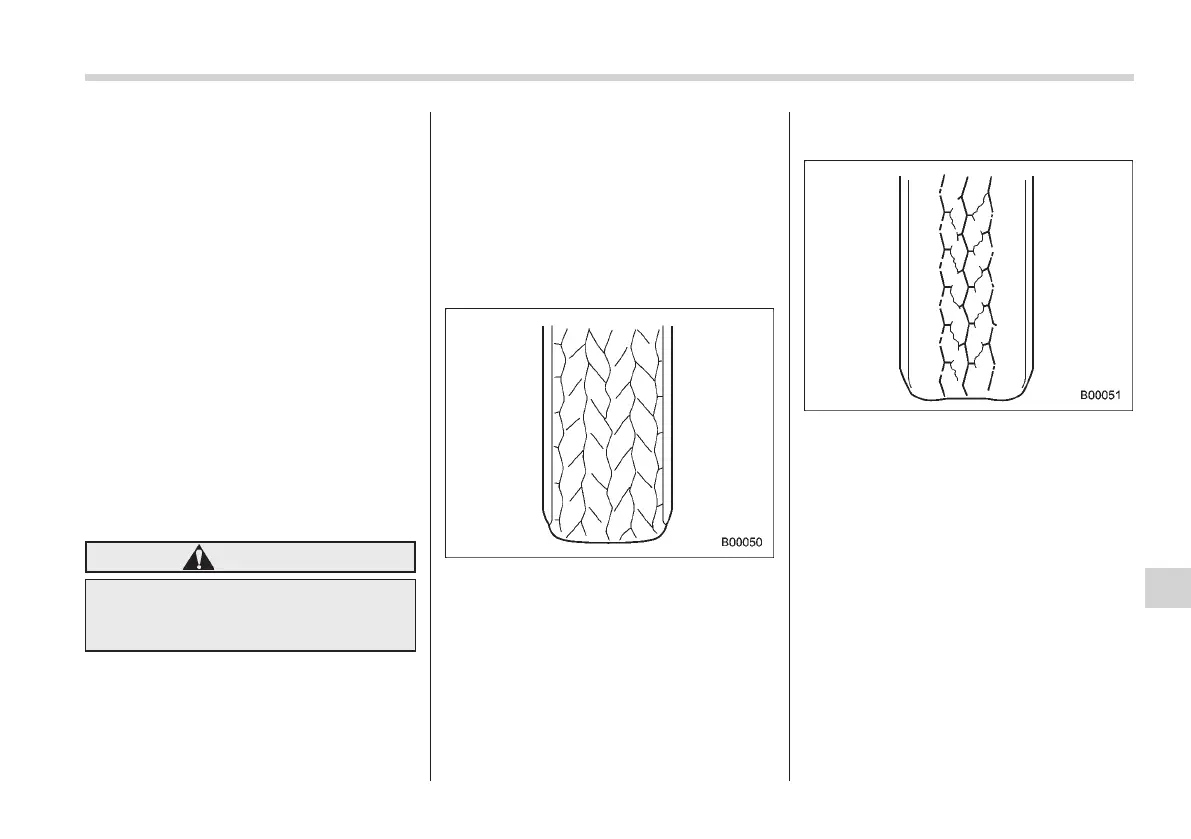
. Correct tire pressure (tread worn
evenly)
Roadholding is good , and steeri ng is
responsive. Rolling resistance is low, so
fuel consumption is also lower.
. Abnormally low tire pressure (tread
worn at shoulders)
Rolling resistance is high, so fuel con-
sumption is also higher.
Maintenance and service 11-41
– CONTINUED –
11











 To Next Page