UTT Technologies Advanced Menu
http://www.uttglobal.com Page 69
7.1.2.3 NAT Types
The Device provides two types of NAT: One2One and EasyIP.
One2One (One to One): It indicates static network address translation. It is always
referred to as Basic NAT, which provides a one to one mapping between an internal
and an external IP address. In this type of NAT, IP address need be changed, but port
needn’t.
One to One NAT can be used to allow the outside users to access a LAN server: In
the local network, the LAN server still uses the private IP address, which is provided to
the LAN hosts to access; and on the Internet, the Device will assign an external IP
address to the local server, then the outside users can use this external IP address to
access the server through the Device.
EasyIP: It indicates network address and port translation (NAPT). Since it is the most
common type of NAT, it is often simply referred to as NAT. NAPT provides
many-to-one mappings between multiple internal IP addresses and a single external
IP address, that is, these multiple internal IP addresses will be translated to the same
external IP address. In this type of NAT, to avoid ambiguity in the handling of returned
packets, it must dynamically assign a TCP/UDP port to an outgoing session and
change the packets’ source port to the assigned port before forwarding them. Besides,
the Device must maintain a translation table so that return packets can be correctly
translated back.
When you obtain multiple public IP addresses from your ISP, you can create more
than one NAT rule for each type of NAT. In an actual network environment, different
types of NAT rules are often used together.
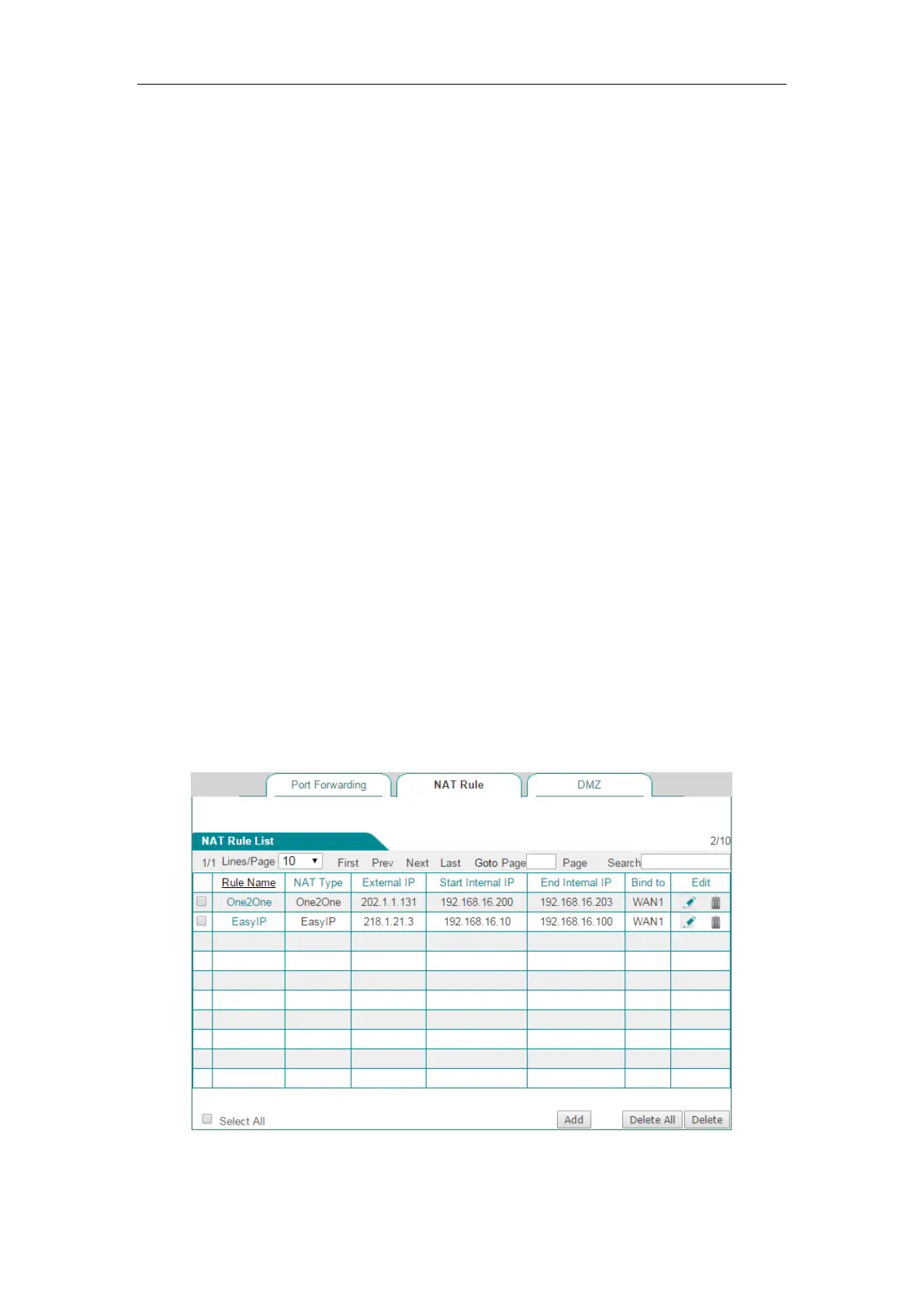
7.1.2.4 NAT Rule List
Figure 7-6 NAT Rule list



 To Next Page