Need help?
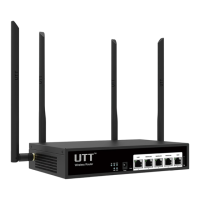
Do you have a question about the UTT AC750W and is the answer not in the manual?
Details the LEDs and interfaces located on the Device's front panel.
Describes how to access the Device's web-based utility via a browser and log in.
Guides users through configuring basic parameters to connect the Device to the Internet.
Allows configuration of load balancing for multiple Internet connections.
Enables the Device to act as a DHCP server for automatic network configuration of LAN hosts.
Recommends configuring wireless passwords and introduces security modes like WEP, WPA/WPA2.
Allows filtering wireless clients based on their MAC addresses to permit or deny access.
Sets up an FTP server to share data with local area users.
Implements user identification by binding IP and MAC address pairs to prevent IP spoofing.
Enables the Device to act as a PPPoE server for LAN hosts to dial up.
Enhances network security by requiring web browser authentication for non-PPPoE users.
Enables and configures Internet application management policies.
Sets upload/download limits for LAN hosts to manage bandwidth allocation.
Limits the upload/download speed for P2P users to manage network bandwidth usage.
Configures defenses against internal and external network attacks like DDoS and SYN floods.
Implements rules to control Internet access privileges for LAN users based on various criteria.
Sets up rules to block or allow access to specific domain names.
Filters wireless clients by MAC address to control network access.
Explains PPTP VPN tunneling protocol and its implementation.
Introduces IPSec VPN technology and its security features.
Manages administrator credentials, including changing the default password.
Allows downloading and upgrading the Device's firmware to the latest version.
 General
| Wireless Standard | IEEE 802.11a/b/g/n |
|---|---|
| Frequency Band | 2.4 GHz, 5 GHz |
| Ports | 1 x 10/100M WAN, 4 x 10/100M LAN |
| Wireless Standards | IEEE 802.11a/b/g/n |
| Ethernet Ports | 4 x LAN, 1 x WAN |
| Security | WPA/WPA2 |


 To Next Page