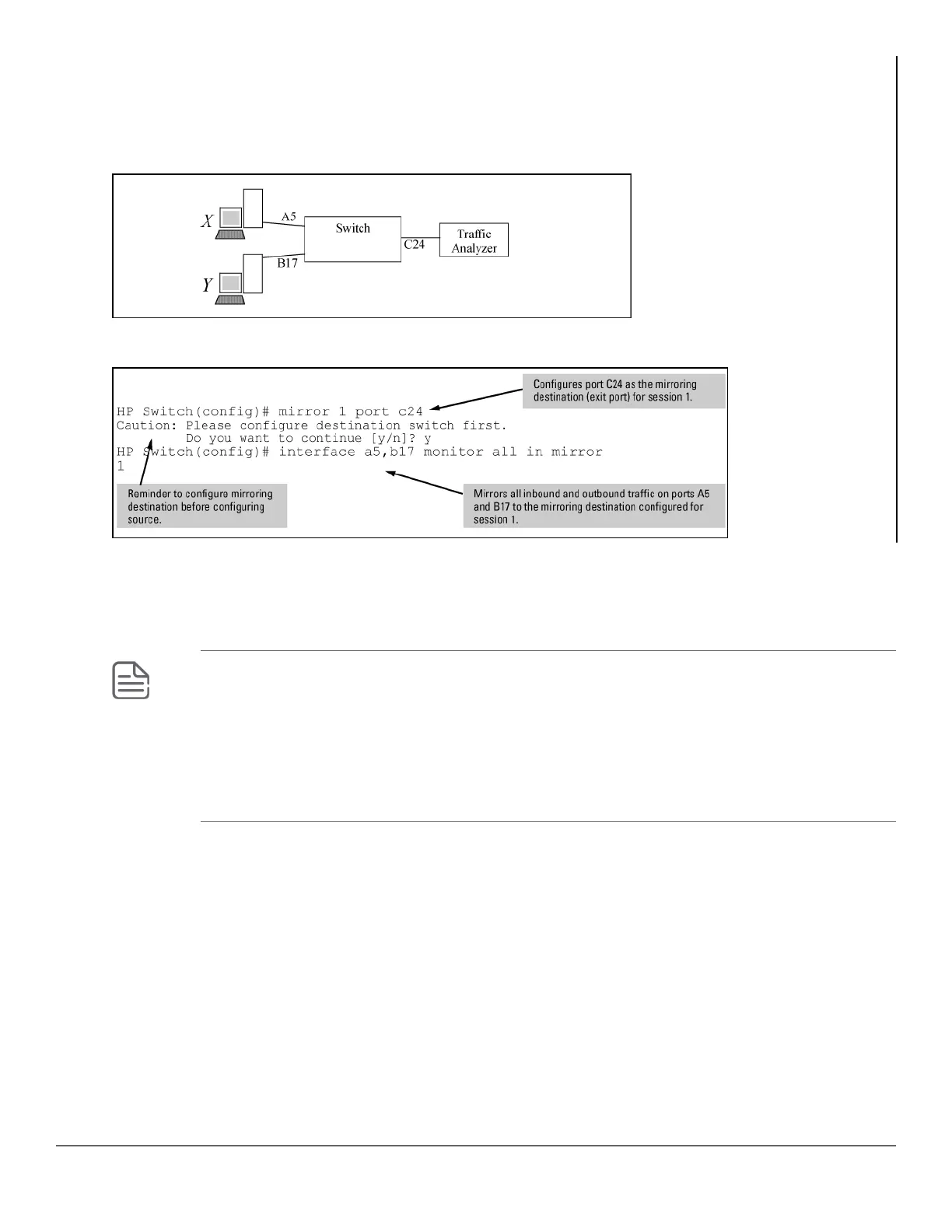
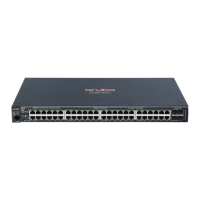
• Configure the local mirroring session, including the exit port.
• Configure the monitored source interfaces for the session.
Figure 54: Local mirroring topology
Figure 55: Configuring a local mirroring session for all inbound and outbound port traffic
Maximum supported frame size
The IPv4 encapsulation of mirrored traffic adds a 54-byte header to each mirrored frame. If a resulting frame
exceeds the MTU allowed in the network, the frame is dropped or truncated.
NOTE:
Oversized mirroring frames are dropped or truncated, according to the setting of the [truncation]
parameter in the mirror command. Also, remote mirroring does not allow downstream devices in a
mirroring path to fragment mirrored frames.
If jumbo frames are enabled on the mirroring source switch, the mirroring destination switch and all
downstream devices connecting the source switch to the mirroring destination must be configured to
support jumbo frames.
Enabling jumbo frames to increase the mirroring path MTU
On 1-Gbps and 10-Gbps ports in the mirroring path, you can reduce the number of dropped frames by enabling
jumbo frames on all intermediate switches and routers. (The MTU on the switches covered by this manual is 9220
bytes for frames having an 802.1Q VLAN tag, and 9216 bytes for untagged frames.)
Chapter 15 Monitoring and Analyzing Switch Operation 299




 To Next Page