If your console uses the earlier design
‘Style 1’ faders please refer to Appendix
A. Style 1 faders have a different button
layout, and are slightly different, in the way
that the current assignment, interrogated
paths and VCA groups are indicated.
Each fader can control two independent
audio signal paths, named A and B.
These signal paths can be either channels
or groups, although for easy reference,
the faders are simply known as channel
faders. B signal paths are fully equipped
with all the same facilities as an A path.
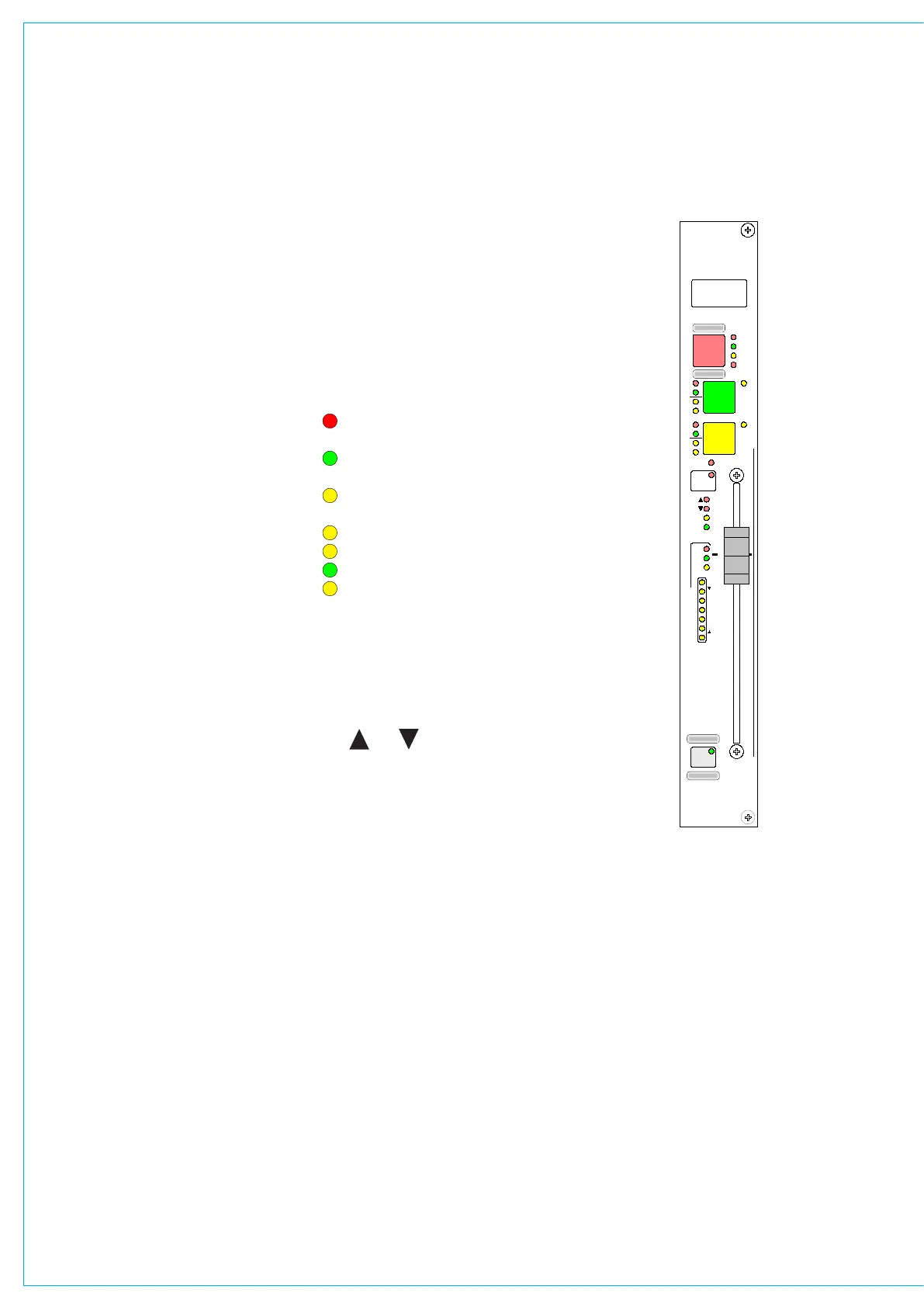
The A and B buttons are used to select
the two channel paths. Selecting a path
causes the central control panels (the
Assign panels) to display and control the
settings for that fader’s channel or group
path. Any changes made to the Assign
panels will affect the selected path only.
When switching between the two paths,
the indicative displays and fader position
will change to match the settings of each
path. If a layer button flashes rapidly, it
may be because the layers are locked.
The label in the display is the name
associated with the input assigned to the
path, or the group number if the path is a
group. The input labels default to the Port
ID but can be changed to a more suitable
label using the I/O screens. Path A’s label
is shown in the top half of the display, and
path B’s label is shown in the bottom half
of the display. If path A is active, the A
fader assign button and the label will be lit
in green. If path B is active, the B fader
assign button and the label will be lit in
amber.
The CUT button cuts the channel or
group, its effect is the same as fading it
out completely. Alternatively, there can
be ON buttons here instead, which switch
the channel on.
A set of indicative LEDs give more
information about the path.
MR - The fader path is a Master of a
VCA style group
SL - The fader path is a slave within a
VCA style group
ST - The path is a stereo channel or
group
SS - The path is a surround master
GP - A group is assigned to the path
A - Path A is active
B - Path B is active
AFL will be heard in surround through
the monitor loudspeakers (main or small),
if surround panning is in use and the
loudspeaker system is surround.
The
and Null LEDs illuminate
when the position of the fader is not
the same as the level of the audio. For
example, if a VCA Master is moved away
from the `0’ position, the null LEDs on the
slaves will light to indicate whether the
audio is above or below the position of the
fader.
The T LED indicates that the console
has recognized that the fader has been
touched.
The PEAK LED will illuminate if the
channel or group signal is within 3 dB of
the clipping level.
The ON LED illuminates when the audio
level is not at the
: position.
The EQ, FLTR, DYN and M/S LEDs
indicate that these functions are switched
IN on the selected path (EQ, Filters and
Dynamics settings may be flat).
IU5472
Pres 1
SL
SL
ST
ST
MR
MR
SS
SS
AFL
T
ON
CUT
GP
GP
60
50
40
30
20
10
5
0
10
5
M/S
EQ
DYN
PEAK
PFL
DYN
O/P
I/P
E
C
8
12
16
20
24
4
48
FLTR
8
Mic 1
A
B
CHANNEL AND gROUP fADERS
The fader bargraph indicates the level
at the channel input (post the input gain
and switching and the tone switching),
the channel direct output, or the gain
reduction of the dynamics, indicated by
the three LEDs. Selection is made either
on the Functions panel, or on the USER-
CHAN screen.
PFL is provided on the fader overpress
and on the button. It will be heard on the
small LS (or the main LS if PFL to Mon
is selected), or PFL LS (depending upon
how the monitoring is configured).


 To Next Page